
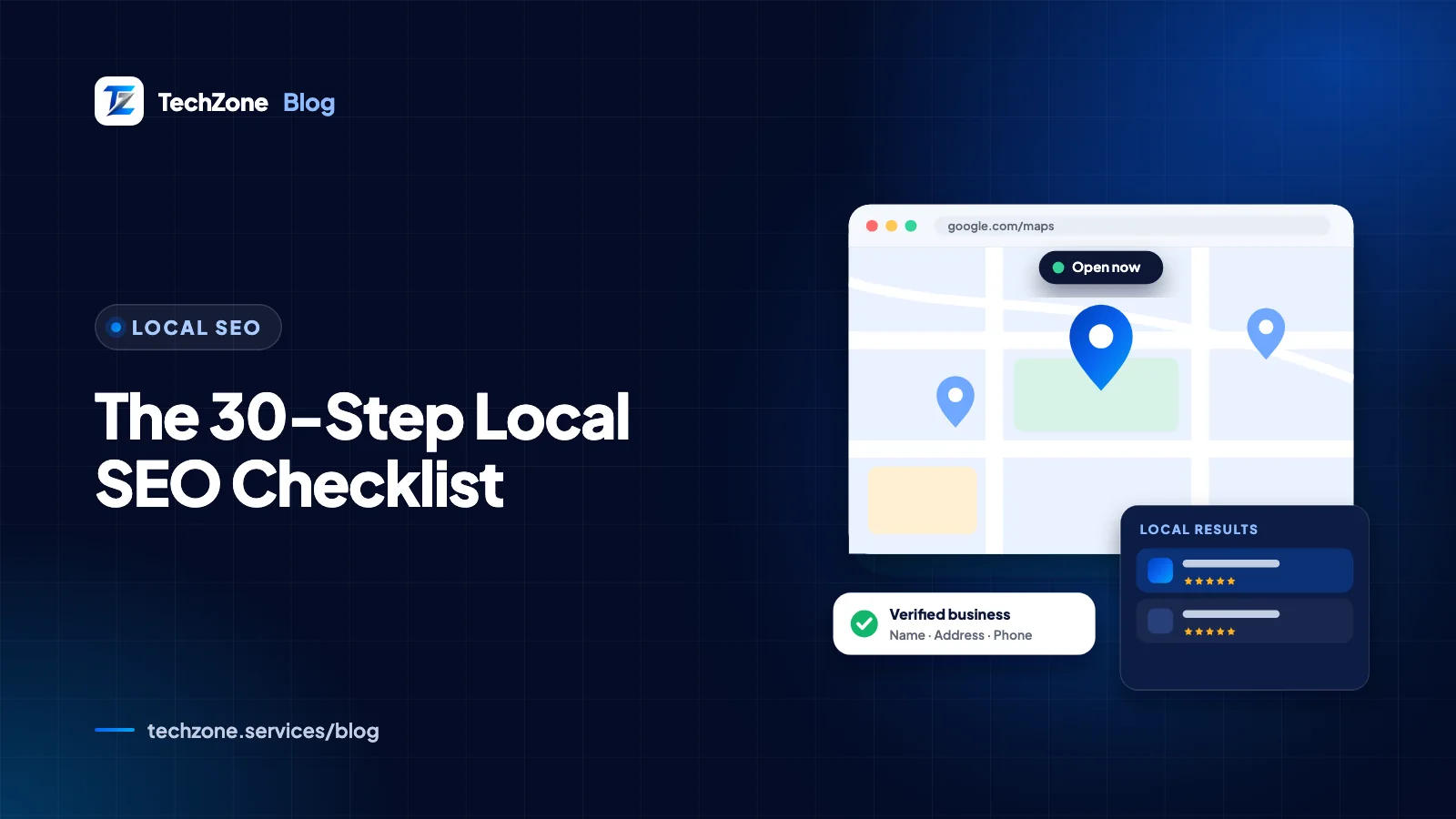
This local SEO checklist gives small businesses 30 steps in seven phases: foundations, Google Business Profile, website and location pages, citations, reviews, local links and measurement. Work through them in order. Google ranks local results mainly on relevance, distance and prominence, and every step below strengthens relevance or prominence, the two you can influence.
Each phase has a table with the step, why it matters and how to check it. Copy the rows into a spreadsheet, add an owner and a due date, and you have a working plan. Where a topic needs more than a table row, the step links to a deeper guide.
This 2026 edition reflects recent platform changes: Apple Business replaced Apple Business Connect in April 2026, Bing Places moved to bing.com/forbusiness, and Google Analytics can now import Business Profile metrics directly.
Key takeaways
- Start by confirming your business type (storefront, service-area or hybrid), because it shapes your profile, website pages and citations.
- Google ranks local results on relevance, distance and prominence, and says nobody can pay for a better local ranking.
- Use one exact name, address and phone format everywhere, because Google can update your profile from other sources that disagree.
- Ask every customer for a review through your Google link; incentives, review gating and requesting specific wording all break Google’s policies.
- Measure calls, directions and website clicks in Business Profile Performance and GA4, and check rankings across a grid of locations.
What does a local SEO checklist for small businesses cover?
It covers everything that decides whether you appear in Google Maps and the local results on Search: an eligible Business Profile, a website that backs it up, consistent listings on other sites, reviews, local links and tracking. Google’s local ranking help page names relevance, distance and prominence as the main factors, and states that you can’t request or pay for a better local ranking. For industry-specific versions, see our guides for dentists, restaurants and real estate agents.
| Phase | Steps | Main factor | Deep-dive guide |
|---|---|---|---|
| 1. Foundations | 1 to 4 | Eligibility and relevance | Covered in this article |
| 2. Google Business Profile | 5 to 11 | Relevance and prominence | Business Profile optimization, field by field |
| 3. Website and location pages | 12 to 17 | Relevance | Location pages for SEO |
| 4. Citations and NAP consistency | 18 to 21 | Prominence and accuracy | Local citations and where to list |
| 5. Reviews | 22 to 25 | Prominence | Getting more Google reviews within the rules |
| 6. Local links and content | 26 to 28 | Prominence and relevance | Covered in this article |
| 7. Measurement | 29 and 30 | All three | Google Maps ranking factors and grid checks |
If you only have one week, do these first
- Step 1: confirm your business type and eligibility, so you don’t build on a profile Google may suspend.
- Step 2: write down one exact name, address and phone format.
- Step 4: set up tracking, so you can see what each change does.
- Steps 5 to 7: verify your Business Profile, fix the primary category and fill in every core field.
- Step 12: make your website show the same details, and point the profile at the matching page.
- Step 22: start asking every customer for a review with your Google link.
Phase 1: Foundations (steps 1 to 4)
Foundations decide what you’re allowed to list and which searches you’re chasing. Skip them and you risk a suspended profile, or pages aimed at the wrong searches.
| # | Step | Why it matters | How to check |
|---|---|---|---|
| 1 | Confirm your business type: storefront, service-area or hybrid | Google only lists businesses that meet customers in person during stated hours; virtual offices and P.O. boxes aren’t eligible | You receive customers at a signed address during your hours, or you travel to them |
| 2 | Fix one exact name, address and phone (NAP) format | Every listing copies it, and Google can change your profile when other sources disagree | A one-page NAP sheet; the name matches your signage with no added keywords |
| 3 | Map the services and places you want to rank for | Relevance starts with knowing the searches you want: service plus place | Each core service and town is assigned to a page and a profile service |
| 4 | Set up Search Console and GA4 key events | You need a baseline before you change anything | Calls, form submissions and WhatsApp clicks appear as key events in GA4 |
Storefront, service-area or hybrid?
A storefront serves customers at its address. A service-area business, such as a plumber or cleaner, travels to customers and should hide its address. A hybrid does both, like a restaurant that also delivers. Service-area profiles list the cities or postal codes you serve, not a radius, and Google says the overall area shouldn’t reach beyond about two hours’ drive from your base. Our guide to SEO for service-area businesses covers that setup in full.
Multiple locations and multi-country businesses
Each staffed location gets its own profile and its own page on your website; Google allows only one profile per location. If you sell into another country without an office there, you can’t create a Business Profile in that country, because the business must meet customers in person. Compete there through country or city pages on your website and a reputation on the platforms buyers in that market use.
Pakistan note
Many Pakistani addresses are written by sector, block or plot rather than street number, for example Street 5, E-11/1, Islamabad. Enter the official address exactly; if Google can’t find it, set the pin on the map. Google allows cross-streets or landmarks only where the official address doesn’t pinpoint the location. For more on the Pakistani market, read local SEO in Pakistan.
Phase 2: Google Business Profile (steps 5 to 11)
Your Business Profile is the listing that appears in Google Maps and the local pack, so it carries most of your relevance signals. Complete it once, then keep it current; the complete Google Business Profile optimization checklist explains every field.
| # | Step | Why it matters | How to check |
|---|---|---|---|
| 5 | Claim and verify one profile per location | Only verified profiles can be managed and get Performance data | You can edit the profile and open its Performance report |
| 6 | Choose the most specific primary category, then a few additional ones | Google says categories affect local ranking, and asks for as few as describe your core business | The primary category completes “this business is a”, not “this business has a” |
| 7 | Complete hours, phone, website, description and attributes | Google says complete, accurate profiles are more likely to show in local results | Holiday hours set in advance; a description of what you do, with no links or promotions |
| 8 | Add your services or products | A listed service may be highlighted when someone searches for it | Every core service appears under Edit services with a short description |
| 9 | Upload real photos and short videos | Photos help customers recognize and choose you | Sharp, unfiltered exterior, interior, team and work photos, not stock images |
| 10 | Publish updates, offers or events | Posts show your latest news and offers on Search and Maps | At least one current post; offers carry start and end dates |
| 11 | Review Google updates and suggested edits | If you don’t respond within four days, Google may publish a suggested edit | No unexpected blue text in the profile editor; notifications checked weekly |
Two guideline breaches put profiles at risk. The first is adding keywords, locations or taglines to the business name, which Google’s guidelines say could lead to suspension. The second is listing an address where you don’t meet customers, such as a virtual office or an unstaffed co-working desk.
Phase 3: Website and location pages (steps 12 to 17)
Your website has to confirm what your profile claims. Google says it can pick up category information from your website and from mentions across the web, and the page your profile links to matters most.
| # | Step | Why it matters | How to check |
|---|---|---|---|
| 12 | Show your NAP as text and link the profile to the matching page | Google asks for a website that represents your individual location | The contact page and footer match your NAP sheet exactly |
| 13 | Create one strong page per core service and per real location | Specific pages match specific searches; near-identical city pages risk Google’s doorway abuse policy | Each location page has unique local details, not swapped town names |
| 14 | Put the service and place in titles, headings and copy | Tells searchers and Google what you do and where | A unique title per page, such as “Emergency Plumber in Leeds | Brand” |
| 15 | Add LocalBusiness structured data | States your name, address, phone and hours in machine-readable form | The Rich Results Test shows valid markup that matches the visible page |
| 16 | Pass mobile speed and usability checks | Google indexes the mobile version of your pages, and phone visitors won’t wait | PageSpeed Insights field data passes Core Web Vitals |
| 17 | Make contacting you one tap away | A ranking only pays off when the visitor calls, books or messages | Tap-to-call and WhatsApp buttons work on a phone and fire key events |
Don’t add review markup for your own reviews: Google shows review stars for local businesses only on sites that collect reviews about other businesses. For page templates and a schema example, see how to create local pages that rank, and for speed fixes, read why Core Web Vitals cost you customers.
Phase 4: Citations and NAP consistency (steps 18 to 21)
Citations are listings of your name, address and phone on other sites. Google builds profiles partly from crawled web content and licensed third-party data, so a wrong listing elsewhere can feed wrong details back into your profile.
| # | Step | Why it matters | How to check |
|---|---|---|---|
| 18 | Claim Bing Places, Apple Business and a Facebook page | Bing Places covers Bing and Bing Maps; Apple Business covers Apple Maps, Siri and Spotlight | Bing listing imported from Google; Apple place card claimed; details identical |
| 19 | List on the leading directories in your country | Customers search them directly, and they confirm your details | Listed on the main general directories, such as Yell in the UK or Yelp in the US |
| 20 | Add industry and association listings | Niche platforms add relevance and send qualified visitors | Listed with your trade body, chamber of commerce and main industry platform |
| 21 | Find and fix inconsistent or duplicate listings | Old addresses and phone numbers mislead customers and data providers | Search old phone numbers and addresses in quotes; correct, merge or close each hit |
Quality beats volume. Bulk submissions to hundreds of low-quality directories add little and are hard to keep accurate. Our country-by-country citation list names the directories worth claiming in the UK, the USA, Canada, Australia, the UAE and Pakistan.
Phase 5: Reviews (steps 22 to 25)
Google says more reviews and positive ratings can help your local ranking, and that helpful replies make you stand out. Ask as part of every job rather than in occasional campaigns; Google’s policies look for unusual review volumes or patterns that suggest manipulation.
| # | Step | Why it matters | How to check |
|---|---|---|---|
| 22 | Ask every customer, using your review link or QR code | Review count and rating feed prominence | Link copied from Read reviews, then Get more reviews, and added to receipts, emails and WhatsApp follow-ups |
| 23 | Follow Google’s review rules | Incentives, review gating and fake reviews lead to removals and profile restrictions | No discounts for reviews, no asking only happy customers, no scripted wording |
| 24 | Reply to reviews, especially negative ones | Replies show future customers how you treat people | Replies are short, specific and polite, with no promotions or private details |
| 25 | Show reviews on your website | Social proof helps visitors decide | Real quotes or an embed on service and location pages |
Watch out
Google’s Maps content policy also bars businesses from asking customers to include specific content in a review, pressuring them to review while on the premises, or setting staff review quotas. Ask for honest feedback and let customers write what they want.
Phase 6: Local links and content (steps 26 to 28)
Links count toward prominence: Google says it looks at information such as how many websites link to your business. Local, relevant links also send real customers, which makes them worth having even without any ranking effect.
| # | Step | Why it matters | How to check |
|---|---|---|---|
| 26 | Join local organizations that list their members | Chambers of commerce, trade bodies and business networks link to members | A member directory profile that links to your website |
| 27 | Build partnerships, sponsorships and community work | Local press, partners and event pages mention active businesses | Paid sponsorship links carry rel=”sponsored”; you’re paying for exposure, not ranking credit |
| 28 | Publish local content that shows real work | Project write-ups and local guides prove experience in the area | Each case study names the area and shows the work, never a customer’s address |
Avoid anything that looks like buying rankings. Paid links without rel="sponsored", excessive link exchanges and automated link packages all break Google’s link spam policy.
Phase 7: Measurement (steps 29 and 30)
Measure what people do, not only where you rank. Your Business Profile reports searches, views, calls, direction requests and website clicks, and rankings need checking from several points, because distance changes the results for every searcher.
| # | Step | Why it matters | How to check |
|---|---|---|---|
| 29 | Review Performance monthly and link your profile to GA4 | Shows which searches find you and what people do next | In GA4 Admin, Google Business Profile links under Product links shows your profile connected |
| 30 | Track rankings across a grid and repeat this checklist quarterly | A search from your own office only shows results nearest to you | A geo-grid tool or a browser location override shows your rank across your area |
GA4 shows Business Profile metrics for the last six months, and several linked profiles appear as one combined total. Tag each location’s website link with its own UTM parameters so you can still separate locations, as in this example:
https://www.example.com/locations/leeds/?utm_source=google&utm_medium=organic&utm_campaign=gbp-leedsOur guide to ranking higher on Google Maps explains grid checks and how to tell whether relevance, distance or prominence is holding your listing back.
How TechZone can help
TechZone works through this checklist with businesses in Pakistan, the UK, the UAE, the USA, Canada and Australia. We start with an audit of your Business Profile, website and listings against the 30 steps, then give you a fix list ordered by impact. Our local SEO and Google Business Profile services cover profile management, location pages, citation cleanup, review systems and monthly reporting. It is part of our wider SEO services, so technical and on-page fixes are handled by the same team. Nobody can honestly promise map rankings, but we can show you what’s holding yours back. Book a free 30-minute consultation to go through your checklist together.
Frequently asked questions
How long does local SEO take to show results?
Local SEO timelines depend on competition, how complete your profile already is and how quickly you earn reviews and links. Profile fixes can take effect soon after Google approves the edits, but ranking gains from reviews, citations and links build over months. Judge local SEO progress by calls and direction requests quarter by quarter rather than week by week.
What is the difference between local SEO and regular SEO?
Local SEO targets searches with a place in mind, such as “dentist near me” or “accountant in Lahore”, where Google shows a map and a short list of businesses. It adds work that regular SEO doesn’t need: a Google Business Profile, citations, reviews and location pages. Regular SEO focuses on ranking web pages in organic results. Both depend on a fast, useful website.
Do I need a physical address for local SEO?
A business doesn’t need a public address to do local SEO. Service-area businesses can hide their address on Google and list the areas they serve instead, but they still need a real base, not a virtual office, and must meet customers in person. Online-only businesses aren’t eligible for a Google Business Profile, so they compete through their website instead.
Can I do local SEO myself?
Most local SEO tasks are free and can be done by a business owner: claiming a Google Business Profile, Bing Places and Apple Business, listing on directories and asking customers for reviews. The harder parts are location pages that aren’t thin, structured data, cleaning up years of inconsistent listings and tracking results properly. Many owners handle the basics and bring in help for those.
How much does local SEO cost?
Local SEO costs depend on how many locations you have, how competitive your market is and how much work you do in-house. The core platforms, including Google Business Profile, Bing Places and Apple Business, are free. Agencies price by scope, so ask for a written proposal that lists which checklist steps are included, what gets reported monthly and how long the engagement runs.
Does social media help local SEO?
Google’s local ranking guidance doesn’t list social media activity as a ranking factor. Social profiles still help local SEO indirectly: you can add social links to a Google Business Profile in supported regions, active pages give customers another place to find accurate details, and social followers are a natural audience to ask for reviews after a purchase.
Sources and further reading
- Tips to improve your local ranking on Google – Google Business Profile Help
- Guidelines for representing your business on Google – Google Business Profile Help
- Understand Google updates on your Business Profile – Google Business Profile Help
- Maps user contributed content policy: prohibited and restricted content – Google Maps Help
- Connect Google Business Profile (GBP) to Google Analytics – Analytics Help
- Introducing Apple Business: a new all-in-one platform for businesses of all sizes – Apple Newsroom