
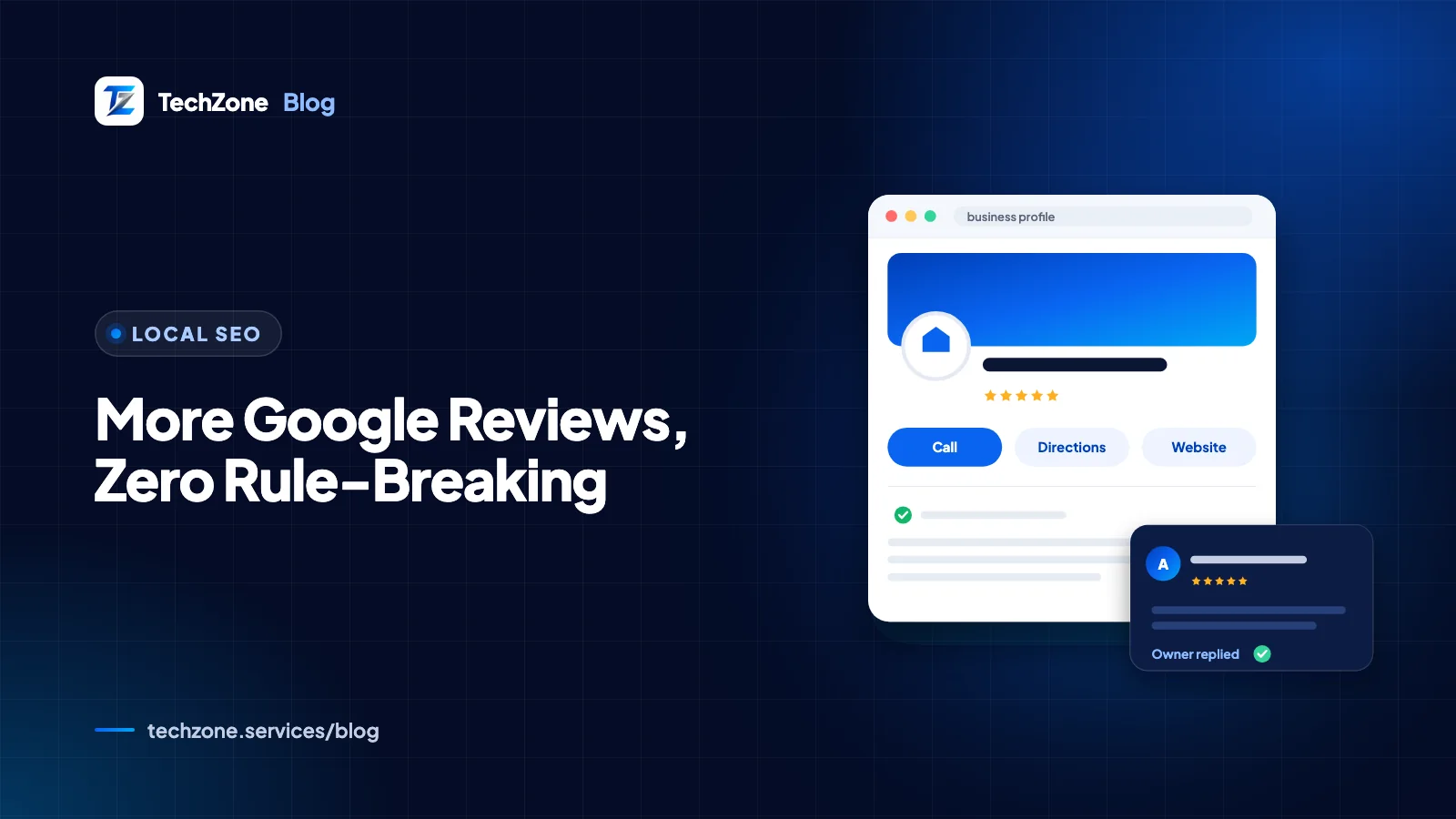
Knowing how to get more Google reviews comes down to three habits: ask every customer soon after a good experience, send your direct review link or QR code, and build the request into your normal process. Do it without incentives, without asking only happy customers, and without pressure, because Google’s policies prohibit all three.
Reviews matter beyond reputation. They appear next to your Business Profile on Maps and Search, and Google says the number of reviews and your ratings feed into prominence, one of the three factors behind local rankings.
This guide starts with the rules, then covers the review link, timing, WhatsApp, SMS and email templates, a staff script and a routine that keeps reviews coming every week.
Key takeaways
- Google prohibits incentives for reviews, review gating, pressuring customers on your premises, and review quotas for staff.
- Create your Google review link and QR code under Read reviews > Get more reviews; QR codes need a computer browser.
- Ask at the moment of success, such as a finished job or a delivered order, and send one reminder at most.
- Google itself suggests sending review requests by email, WhatsApp or a Facebook post, as well as on receipts.
- Reply to reviews; Google says helpful replies can help your business stand out.
What are Google’s rules for asking for reviews?
You may ask any customer for an honest review, but you may not pay for it, choose who gets asked based on how happy they are, or push for a particular rating or wording. These rules come from the Google Maps policy on prohibited and restricted content, and they apply however you ask.
| Practice | Allowed? | What Google’s policy says |
|---|---|---|
| Asking every customer for an honest review | Yes | Merchants may encourage reviews of genuine experiences, without incentives or attempts to influence the rating |
| Offering a discount, free item or payment for a review | No | Incentives such as payment, discounts, free goods or services are prohibited |
| Asking only customers you expect to be happy (review gating) | No | Merchants may not selectively solicit positive reviews |
| Discouraging unhappy customers from posting | No | Merchants may not discourage or prohibit negative reviews |
| Asking customers to post on the spot, for example on a tablet at the counter | Avoid | Merchants shouldn’t require or pressure customers to review while on the premises |
| Staff review quotas, or asking for reviews that name a staff member | No | Both are listed as prohibited ways of soliciting reviews |
| Reviews from employees, relatives or business partners | No | Conflict-of-interest content, including employment and family ties, is removed |
Breaking these rules costs more than the reviews themselves. Google removes violating reviews, and when it finds a business has broken its fake engagement policy, its Business Profile restrictions can stop the profile receiving new reviews for a set period, unpublish existing reviews, or show customers a warning that fake reviews were removed.
Reviews are one part of a strong profile. Our Google Business Profile optimization checklist covers every other field.
Can you offer incentives for Google reviews?
No. Google prohibits incentives such as money, discounts, free goods or free services in exchange for posting a review, changing one or removing a negative one, even if you’d accept any rating. Treat prize draws the same way: an entry in exchange for a review is still an incentive.
Local law can be looser than Google, which catches people out. The US Federal Trade Commission’s rule on consumer reviews, in effect since October 21, 2024, bans incentives tied to a positive or negative review but not neutral ones. In the UK, the Digital Markets, Competition and Consumers Act 2024 has made fake reviews and concealed incentivized reviews banned practices since April 2025. Neither law makes an incentive acceptable on Google.
| Practice | Google policy | US FTC rule | UK DMCC Act |
|---|---|---|---|
| Incentive for any review, whatever the rating | Prohibited | Not banned by the rule itself | Must be disclosed; hidden incentives are banned |
| Reviews by staff or family | Removed as conflict of interest | Family reviews need a clear disclosure of the relationship | Asking staff to write reviews counts as commissioning; undisclosed, it’s a banned concealed incentivized review |
| Asking only happy customers | Prohibited | Not in the rule, but the FTC says it could violate the FTC Act | The CMA lists encouraging only satisfied customers as cherry-picking that may break the law |
| Fake reviews | Removed; the profile can be restricted | Banned | Banned |
How do you get your Google review link and QR code?
Google generates both inside your Business Profile, so customers don’t have to search for your business to find the review option.
- On a computer, go to your Business Profile by searching your business name while signed in to the managing account.
- Select Read reviews > Get more reviews.
- Select Copy to copy your Google review link.
- To download the QR code, right-click it and choose Save image as. Google says review QR codes can currently only be generated in a computer browser, not on mobile.
Google suggests adding the link to receipts and thank-you emails, sending it at the end of a chat, and printing the QR code for your store. Other good spots: invoice footers, booking confirmation emails, packaging inserts and the counter card you hand over with a receipt.
Customers need a Google Account to post, but Google notes they can create one with a non-Gmail email address. Mention that to customers who say they “don’t have Gmail”.
When is the best time to ask for a Google review?
Ask as soon as the customer has experienced the result, while the details are fresh: the moment you’d normally expect a thank-you. Use the table to pick one trigger per service.
| Business type | Best moment to ask | Channel |
|---|---|---|
| Restaurant or cafe | When the bill is settled | QR code on the table card or receipt |
| Clinic, salon or spa | A few hours after the appointment, the same day | WhatsApp or SMS |
| Contractor or home service | When the job is signed off and paid | WhatsApp or SMS |
| Retail store or showroom | At purchase, or after delivery of a large item | Receipt QR code or email |
| Agency, consultant or B2B firm | After a milestone the client praised, such as a launch | Personal email from the account lead |
| Car workshop | At vehicle pickup | Printed card, then WhatsApp or SMS |
Send one reminder at most, two or three days later, and only if you asked by message. Chasing beyond that starts to feel like pressure, which is exactly what Google’s policy warns against.
Review request templates for WhatsApp, SMS and email
Keep requests short, personal and neutral: thank the customer, ask for honest feedback and include the link. Don’t mention stars or suggest what to write, because Google’s policy says merchants shouldn’t ask for specific content in reviews.
WhatsApp review request
Example
Hi [Name], thanks for choosing [Business] today. If you have a minute, we’d really appreciate an honest review on Google. It helps other customers decide and helps us improve: [review link]. Thank you, [Your name], [Business]
Roman Urdu version: Assalam o Alaikum [Name], aaj [Business] ka intekhab karne ka shukriya. Agar aap ke paas ek minute ho to Google par apna honest review zaroor dein. Is se doosre customers ko faisla karne mein aur humein behtar hone mein madad milti hai: [review link]. Shukriya, [Your name]
Send it from the number the customer already chats with, and save the text as a ready-made message so every staff member uses the same neutral wording. For account setup, catalogs and messaging rules, see our WhatsApp marketing guide.
SMS review request
Thanks for visiting [Business] today, [Name]. Would you share an honest review on Google? [review link] Only text customers who gave you their number for updates, and follow your country’s rules on business messages.
Email review request
- Subject: How did we do, [Name]?
- Body: Hi [Name], thank you for choosing [Business] for [service]. We’d value your honest feedback on Google; it takes about a minute: [review link]. If anything wasn’t right, just reply to this email and I’ll help personally. [Your name], [Role]
Offering help is fine. What crosses the line is sending the review link only to people who say they’re happy, or steering unhappy customers into a private form instead of Google.
What staff can say in person
“Thanks so much, I’m glad it went well. If you get a minute later, we’d really appreciate an honest Google review. This card has a QR code that takes you straight there.” Notice what’s missing: no asking them to post right now, no tablet handed over, no mention of stars or staff names, and no targets for staff to hit.
How to get more Google reviews for your business every week
Consistency is the real answer to how to get more Google reviews. A steady flow of genuine reviews is safer than a sudden burst, because Google’s policy names “unusual volumes or patterns” of reviews as a sign of rating manipulation.
- Pick one trigger per service line, such as job completed, order delivered or appointment finished, and one person responsible for sending requests.
- Automate what you can: put the link in invoice and receipt templates, booking confirmations, and your CRM or point-of-sale follow-up.
- Send the request to every customer who reaches the trigger, not a hand-picked list.
- Send one reminder, then stop.
- Check new reviews weekly, reply to each, and pass service problems to the person who can fix them.
- Each month, track review count and average rating alongside calls and direction requests in your profile’s Performance report.
Watch out
Not every business can collect reviews. Google says reviews are only available in certain countries and regions and for certain business categories, and its page on missing or delayed reviews explains that reviews are disabled on profiles primarily categorized as schools for students aged 6 to 18.
If you’d like the whole system set up and run for you, it’s part of our local SEO services.
Why replying to reviews helps you get more
Replies show future reviewers that someone actually reads them. Google includes responding to reviews in its tips for improving local ranking and says helpful replies can help a business stand out.
Google’s reply advice is practical: keep replies short and personal, and don’t use them to push deals or promotions. Negative reviews need more care, so use our guide on responding to negative Google reviews, which includes templates.
What about competitors with fake reviews?
Don’t copy them, and don’t let it stop your own routine. Google’s fake engagement policy covers reviews posted by one person from multiple accounts and content posted to undermine a competitor, and Google removes such content when it finds it.
You can report policy-breaking reviews on any listing from Google Maps, and on your own profile through the Reviews Management Tool, where you can also track decisions. Our guide to reporting and removing fake Google reviews covers the evidence to gather and how to appeal.
How TechZone can help
TechZone sets up review systems that stay inside Google’s rules: review links and QR codes, WhatsApp, SMS and email templates in your brand voice, triggers in your booking or order flow, and a weekly routine for replies. We can’t promise a number of reviews, because customers decide whether to post, but we make asking easy and consistent.
Explore our SEO and Google Business Profile services or book a free 30-minute consultation.
Frequently asked questions
How many Google reviews does a business need?
Google doesn’t set a minimum number of Google reviews for a business to appear or rank. Google says prominence is partly based on how many reviews a business has, and that more reviews and positive ratings can help local ranking. A practical benchmark is the review count of the businesses that already rank for your main search in your area, reached through a steady flow of genuine reviews.
Can a business delete bad Google reviews?
No. A business can’t delete Google reviews from its Business Profile. Only the reviewer can edit or delete a review, and Google removes reviews only when they break its content policies. If a review contains spam, personal information, harassment or a conflict of interest, the business can report it for removal. Genuine negative reviews stay up, so a calm public reply is the better response.
Are review funnels that ask customers to rate you first allowed?
A review funnel that asks customers for a private rating first and sends only high scorers to Google is review gating, which Google’s policy prohibits as selectively soliciting positive reviews. A review request tool is fine if every customer receives the same Google review link. Collecting private feedback is allowed only if it doesn’t replace or block the Google review option for unhappy customers.
Why did some of my Google reviews disappear?
Google reviews usually disappear because Google’s systems removed them for policy violations such as spam, and reviews removed for violations aren’t restored. Reviews can also take a few days to appear while they’re checked, or show late after two Business Profiles are merged. If a genuine review was removed by mistake, Google suggests contacting Google Business Profile support.
Do Google reviews help local SEO?
Yes. Google says prominence, one of its three local ranking factors, is partly based on how many reviews a business has, and that more reviews and positive ratings can help a business’s local ranking. Google reviews also appear next to the Business Profile on Maps and Search, where potential customers read them before calling or visiting.
Sources and further reading
- Prohibited & restricted content – Maps User Generated Content Policy Help
- Tips to get more reviews – Google Business Profile Help
- Create a Google link or QR code to request reviews – Google Business Profile Help
- Tips to improve your local ranking on Google – Google Business Profile Help
- The Consumer Reviews and Testimonials Rule: Questions and Answers – Federal Trade Commission
- Fake reviews (CMA208) – Competition and Markets Authority, GOV.UK