
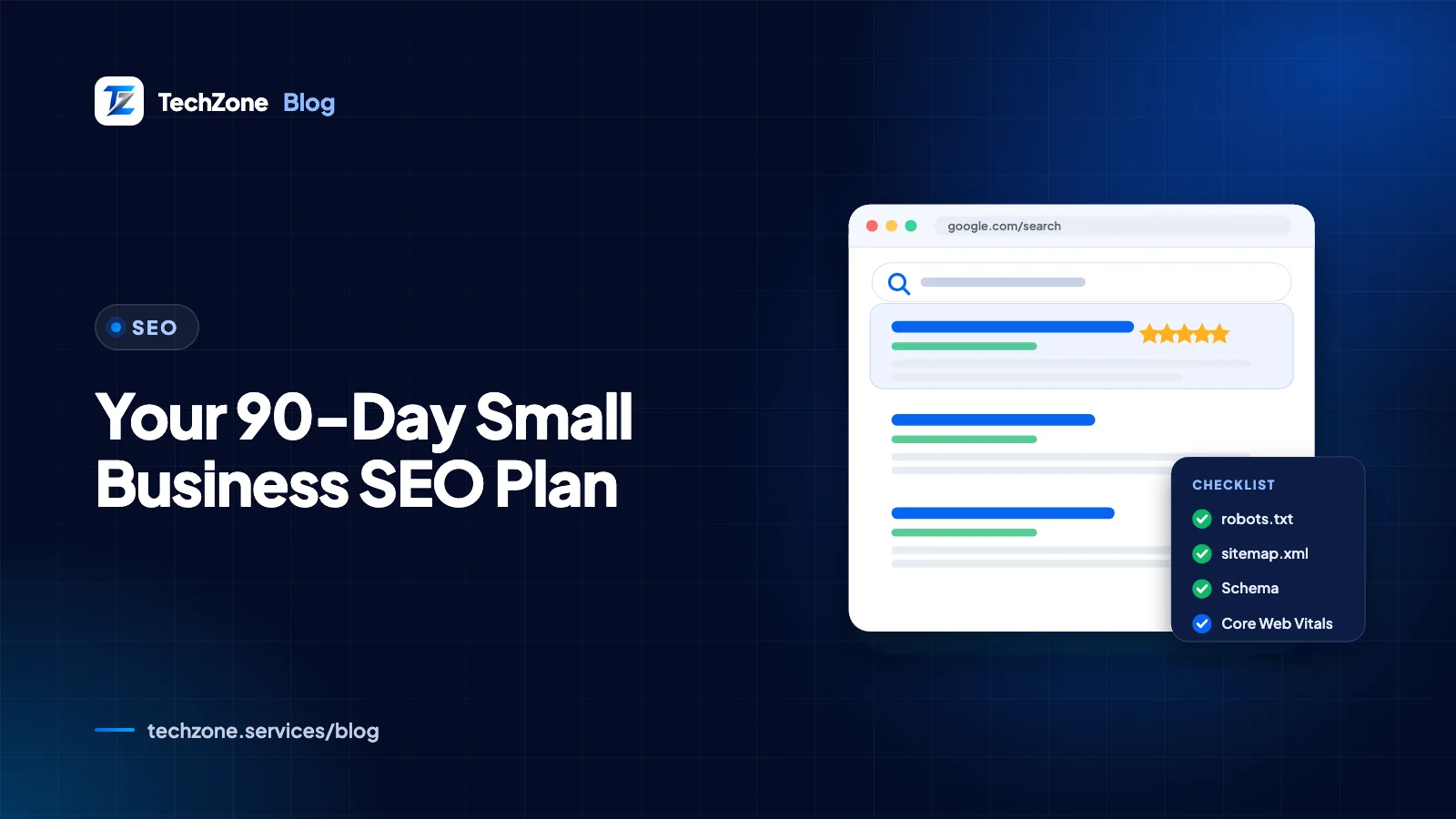
SEO for small business means making sure Google can find your website, understands what you sell and where, and trusts you enough to show you to people ready to buy. In 90 days you can set up tracking, fix indexing problems, strengthen your money pages, publish content that answers buyer questions and start earning reviews and links.
Most SEO tips for small businesses are correct but arrive in no particular order. This plan puts the work in sequence for an owner with two to four hours a week, and flags the points where hiring help is worth it.
It also covers two things generic guides skip: how Google’s AI Overviews change small business search, and what to do when you sell in more than one country, for example from Pakistan to customers in the UK and the UAE.
Key takeaways
- Spend weeks 1–2 on Search Console, GA4 key events, a verified Google Business Profile and fixing anything that stops pages being indexed.
- Month 1 is for money pages: one focused page per service or location, with a clear title, direct opening, proof and call to action.
- Month 2 adds pages that answer buyer questions from first-hand experience, the kind of content Google’s AI search guidance favors.
- Month 3 builds authority through genuine reviews, local links and consistent citations; paid links and review incentives break Google’s policies.
- Judge the first 90 days on indexed pages, impressions and non-branded searches in Search Console, then on leads tracked in GA4.
What does a 90-day SEO plan for a small business include?
It includes four phases in a fixed order: foundations, money pages, content that answers buyer questions, then authority and measurement. The order matters because each phase depends on the one before it: content can’t rank if Google can’t index it, and links help most when they point at strong pages.
| When | Focus | Key tasks | Done when |
|---|---|---|---|
| Weeks 1–2 | Foundations | Search Console, GA4 key events, Google Business Profile, Bing Webmaster Tools, indexing fixes | Key pages show as indexed and every type of lead is tracked |
| Weeks 3–4 | Money pages | One page per service or location, with a clear title, direct opening, proof and call to action | Every service you sell has a page that answers a buyer’s first questions |
| Month 2 | Buyer-question content | Cost, comparison, process and problem pages built on first-hand experience | Each money page is supported by pages that answer pre-sale questions |
| Month 3 | Authority and measurement | Review requests, local links, consistent citations, a monthly look at Search Console and GA4 | Reviews arrive steadily and you can report organic impressions, clicks and leads |
What to do with two to four hours a week
Block a fixed weekly slot so the work actually happens, because SEO for small business rewards steady effort more than occasional bursts. A workable split:
- Hour one: the next task for your current phase in the checklist above.
- Hour two: write or improve one page, using photos, prices and examples you already have.
- Any remaining time: ask recent customers for reviews, reply to new reviews and email one supplier, partner or local organization that could link to you.
- Once a month: compare this month with last month in Search Console and GA4, then pick next month’s priorities.
When hiring help makes sense
Google’s own advice is that a small local business can probably do much of this work itself. Paying for help makes sense when the work needs skills or hours you don’t have:
- You’re planning a redesign or a new site. Google’s hiring guide calls that a great time to bring in an SEO, and says the earlier the better.
- Search Console reports indexing, speed or structured data problems you can’t fix in your website builder.
- You compete for national terms, or in several countries at once.
- Your busy season makes a weekly slot unrealistic.
If you hire, agree the scope in writing, keep ownership of your Search Console and analytics accounts, and walk away from anyone who guarantees rankings. You can see how we structure this work on our small business SEO services page.
Weeks 1–2: What should you set up before anything else?
Set up the free tools that show what Google sees, then fix anything stopping your important pages from being indexed. Nothing else in the plan works until those two jobs are done.
- Google Search Console. Add a Domain property: it covers every subdomain and both http and https, and you verify it with a DNS record. Google starts collecting data as soon as the property is added, and the first figures appear within a few days.
- Google Analytics 4. Mark the actions that bring you business as key events (Admin, then Data display, then Events): form submissions, clicks on your phone number, WhatsApp chats and bookings.
- Google Business Profile. If you meet customers in person or travel to them, create and verify a profile. Depending on the business, Google offers verification by video recording, phone or text, email or live video call. Then work through our Google Business Profile optimization checklist.
- Bing Webmaster Tools. Import your site from Search Console instead of verifying it again. Its AI Performance report also shows how often Microsoft Copilot and Bing’s AI summaries cite your pages.
- Indexing check. Run URL Inspection on your home page and each main service page. Any page reported as “URL is not on Google” needs fixing before you write anything new.
Running an older site with years of pages? Work through our SEO audit checklist built on free tools before you move on.
Month 1: How do you optimize the pages that make you money?
Give every service, product line or location its own page that answers the buyer’s first questions and makes contacting you easy. These money pages turn search traffic into leads, so they come before blog posts.
Start with the words your customers actually type. Our free-tools keyword research guide shows how to find them; the rule here is one main search intent per page.
| Element | What good looks like | Example: a dental clinic in Islamabad |
|---|---|---|
| Title tag | Service and place first, brand last, unique to the page | Dental Implants in Islamabad | [Clinic name] |
| Heading and opening lines | Say what you do, where and for whom within two sentences | Dental implants in Islamabad, planned and placed at our F-7 clinic |
| Proof | Photos of real work, qualifications, reviews, and prices or price ranges if you can share them | Before-and-after photos shared with consent, dentist profiles, recent Google reviews |
| Answers | Cost factors, process, timing and common worries | What affects implant cost, how many visits it takes, recovery |
| Call to action | Call, WhatsApp and form visible without scrolling on a phone | Call and WhatsApp buttons in the page header |
| Internal links | Linked from the menu and from related pages with descriptive anchor text | Linked from the services overview and the crowns page |
Two rules keep this manageable. Don’t create near-identical pages for every suburb or phrasing: Google’s spam policies treat pages made to rank for similar searches as doorway abuse. And write for the reader rather than a word count, since Google says there is no ideal length and keywords in a domain name have hardly any effect.
For every element in detail, page type by page type, use our on-page SEO checklist.
Month 2: What content should a small business publish?
Publish pages that answer the questions buyers ask before they contact you: cost, comparisons, process, timelines and common problems. A few genuinely useful pages beat a weekly blog written to fill a schedule.
Google’s 2026 guide to generative AI search separates commodity content, such as generic tip lists anyone could write, from non-commodity content built on first-hand expertise. Small businesses have plenty of the second kind: jobs you’ve done, mistakes you see customers make, and questions you answer on the phone every week.
- Cost explainers: what drives the price of your service, with real ranges if you’re comfortable publishing them.
- Comparisons: option A versus option B, written by someone who installs, repairs or sells both.
- Process pages: what happens from first contact to finished job, illustrated with your own photos.
- Problem pages: the “why does my…” questions people search before they know they need you.
- Case studies: one real job, the problem, what you did and the outcome, shared with the customer’s permission.
Link each new page to the money page it supports. Don’t publish a separate page for every phrasing of the same question: Google says doing that mainly to manipulate rankings or AI responses breaks its scaled content abuse policy.
Month 3: How do you earn reviews, links and citations safely?
Ask every satisfied customer for a Google review, earn links through real business relationships, and keep your name, address and phone number identical everywhere they appear. Google calls this kind of reputation prominence, and says it draws on information such as links to your business and how many reviews you have.
Reviews
Send customers the review link or QR code from your Business Profile, and reply to reviews, including critical ones. Google strictly prohibits incentives such as discounts or free services in exchange for posting, changing or removing reviews.
Links
The best small business links come from relationships you already have: suppliers, trade associations, local sponsorships, event listings, partners and local press. Buying links, or swapping goods and services for them, is listed as link spam in Google’s policies. Our guide to safe link building for small businesses covers the options.
Citations
Citations are listings of your business details on directories, maps and industry sites. Keep every one consistent with your Business Profile. For the full local side, including map pack rankings, follow our local SEO checklist for small businesses.
How do you know if your SEO is working after 90 days?
Check leading indicators first: more pages indexed, rising impressions and more searches that don’t include your business name. Leads tracked as GA4 key events are the result that pays the bills, but they come after the other signals move.
| Signal | Where to find it | What progress looks like |
|---|---|---|
| Indexed pages | Search Console, Page indexing report | Money pages and new content listed as indexed |
| Impressions | Search Console, Performance report | More impressions for service and location searches |
| Non-branded searches | Performance report, Query filter set to Non-branded | Growth in searches from people who don’t know your name yet |
| AI visibility | Search Console, Generative AI performance report | Impressions from AI Overviews and AI Mode start to appear |
| Leads | GA4 key events | Forms, calls and WhatsApp clicks from organic search |
Mark each change with a custom annotation (right-click the Performance chart and choose Add annotation) so later movement is easy to explain. The non-branded filter only appears for top-level properties with enough search volume, so newer sites may not see it yet.
Pakistan note
Search Console dates its daily figures by California time, which runs 12 to 13 hours behind Pakistan, so a Search Console day won’t match your own records exactly. If customers usually contact you on WhatsApp rather than through forms, track WhatsApp clicks as a key event, or your organic leads will be invisible.
Expect these signals to move before leads do. Our guide to realistic SEO timelines breaks the wait down by scenario.
How do AI Overviews change SEO for small business?
They change which searches send clicks, not what earns visibility. Google says AI Overviews and AI Mode are rooted in its core ranking systems, so indexed, helpful pages are what get cited, and there’s no special file or markup to add.
- Quick-answer searches send fewer clicks. Google’s head of Search has said people who want a quick answer may not click further, while people who want to dig deeper or make a purchase still click through.
- Your Business Profile feeds AI answers. Google notes that AI responses can include local business details, and that an accurate Business Profile helps you appear in them.
- You can measure it. Search Console’s Generative AI performance report, available to all sites since August 31, 2026, shows impressions from AI Overviews and AI Mode by page, country and device.
- There’s one setting to check. Under Settings, Search generative AI, sites are included by default; choosing to exclude removes your links and content from AI Overviews, AI Mode and AI features in Discover.
- ChatGPT and Perplexity use their own crawlers. OpenAI says sites that block OAI-SearchBot won’t appear in ChatGPT search answers, and Perplexity’s results rely on PerplexityBot, so check that robots.txt allows both.
For tactics beyond these basics, read our guide to ranking in Google AI Overviews and AI Mode.
What changes if your business sells in several countries?
You need to tell Google which pages serve which market, give each market genuine local detail, and keep Business Profiles to places where you really operate. Google says it doesn’t go looking for country versions of a page on its own, so make them explicit.
| Structure | Example | Strengths | Trade-offs |
|---|---|---|---|
| Country domains | example.pk, example.ae | Clearest country signal; server location doesn’t matter | More infrastructure, some countries restrict registration, one country per domain |
| Subdirectories | example.com/uk/, example.com/ae/ | Easy to set up; one site to maintain | Targeting isn’t obvious from the URL alone |
| Subdomains | uk.example.com | Easy to set up; can use different servers | Visitors may not recognize the targeting from the URL |
| URL parameters | example.com?loc=uk | Nothing worth relying on | Not recommended by Google |
- Use hreflang for similar versions. Google’s example is near-identical English sites for the US, UK and Australia: hreflang annotations help the right version appear in each country.
- Don’t redirect by IP address. Most Google crawling comes from the US, so automatic redirects can hide your other versions. Offer a visible country or language switcher instead.
- Add local detail to each version. Local phone numbers and addresses, local currency and links from local sites are among the signals Google uses.
- Keep Business Profiles genuine. A rented virtual office isn’t eligible for a profile, so only list places where customers can visit you or where you serve them from a staffed base.
- Report by country. Filter the Performance report by country to see whether each market’s pages are gaining impressions.
Don’t overthink the domain ending itself: Google says the TLD only matters when you target a specific country, and even then it’s usually a low-impact signal.
How TechZone can help
TechZone can run this 90-day plan for you or alongside your team. Our SEO team sets up Search Console, GA4 key events and your Google Business Profile, fixes indexing and technical issues directly or with your developer, improves your money pages, and reports monthly on rankings, organic traffic and leads. If you want a prioritized fix list first, start with an SEO audit. We work with businesses in Pakistan, the UK, the UAE, the USA, Canada and Australia, agree scope and cost in a written proposal first, and never promise rankings. Book a free 30-minute consultation to plan your first 90 days.
Frequently asked questions
Is SEO worth it for a small business?
SEO is worth it for a small business when customers search online for what it sells. Organic results cost nothing per click, because Google never accepts payment for organic rankings, but they take months to build. If you need leads this month, pair SEO with a small ads budget. If you can wait, SEO builds a channel that keeps sending visits without paying for each one.
How much does SEO cost for a small business?
SEO costs for a small business depend on how many pages need work, how competitive the market is and whether you handle some tasks yourself. There’s no standard price, so ask for a written scope that lists deliverables, reporting and who implements changes. Compare the monthly cost with the value of the extra leads you need, and avoid any package that promises rankings.
What is the difference between SEO and local SEO?
SEO covers everything that helps a website appear in Google’s organic results, while local SEO focuses on searches with local intent, such as “electrician near me”, and on the map results. Local SEO adds Google Business Profile work, reviews, citations and location pages. Google says local results mainly depend on relevance, distance and prominence, and that no business can pay for a better local ranking.
Do I need a blog to do SEO for my business?
A small business doesn’t need a blog to do SEO, but it does need pages that answer buyer questions. Service pages come first. After that, publish articles only when you have something useful to add, such as a cost explainer or a case study. Google says there’s no ideal word count for ranking, so a few useful pages beat a steady stream of thin ones.
How do I get my business on the first page of Google?
Getting a business on the first page of Google means earning a place in the map results or the organic results, since the only paid route is advertising. For map results, complete and verify your Business Profile and collect genuine reviews. For organic results, build a focused page for each service and earn links from real relationships. No one can guarantee a first-page position.
Sources and further reading
- Do you need an SEO? – Google Search Central
- Optimizing your website for generative AI features on Google Search – Google Search Central
- Spam policies for Google web search – Google Search Central
- Managing multi-regional and multilingual sites – Google Search Central
- Search generative AI control – Search Console Help
- AI in Search is driving more queries and higher quality clicks – Google