
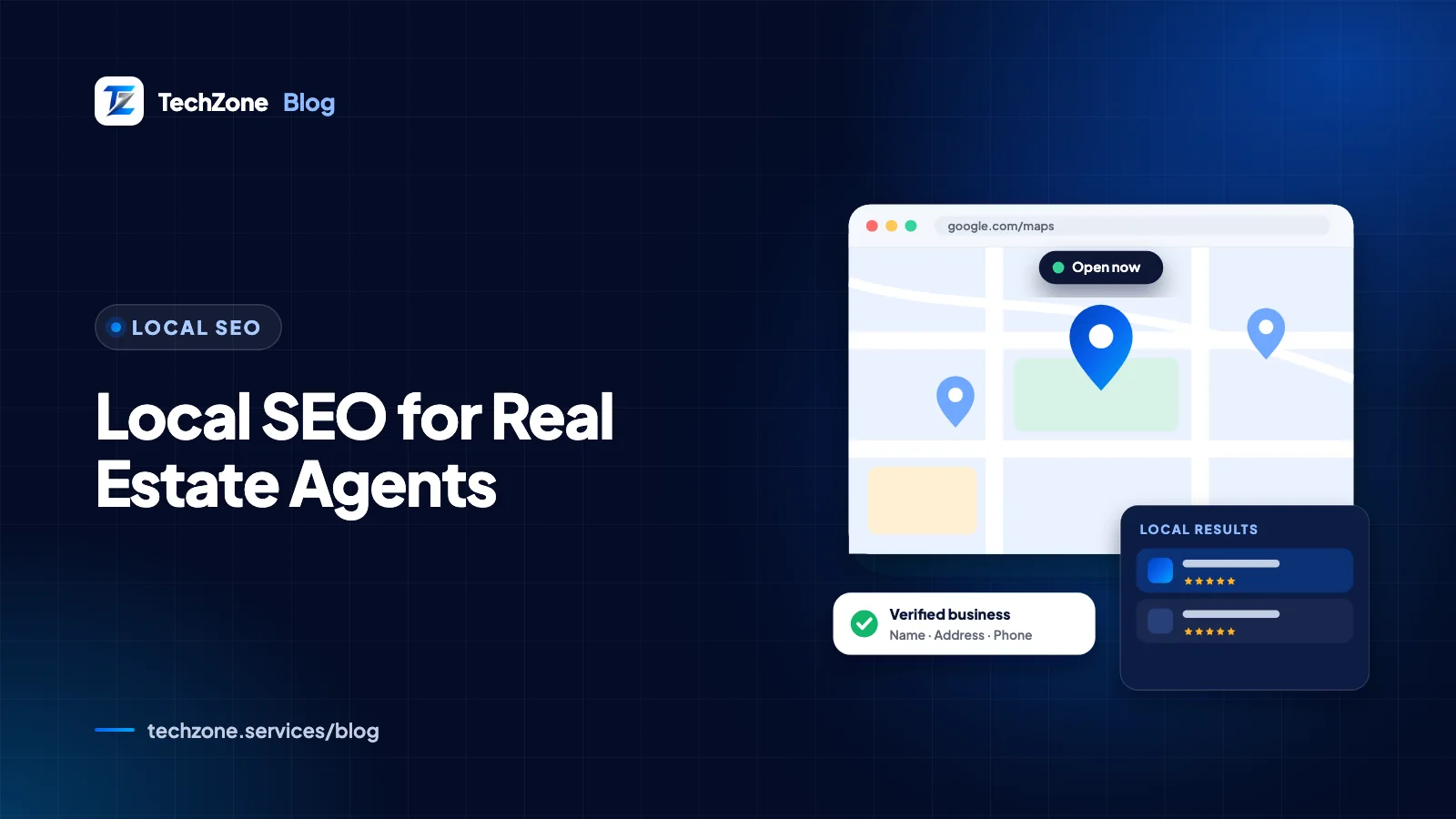
Local SEO for real estate agents means winning the searches property portals can’t: “real estate agent in [neighborhood]”, “sell my house in [town]” and your own name. You won’t outrank Zillow, Rightmove or Zameen for every listing, so compete where local knowledge counts: a verified Business Profile, neighborhood pages, client reviews and a website that’s more than a copy of the listings feed.
This playbook works for solo agents, teams and agencies, whether you call yourself a realtor, an estate agent or a property consultant. It covers what’s specific to property: Google’s rules for agents and home-based realtors, duplicate listing content, reviews after a sale, schema and how to use portals instead of fighting them.
Key takeaways
- Google treats agents as individual practitioners: an agent may have a profile, but individual listings, model homes and vacant properties can’t.
- Home-based agents should hide their address and list up to 20 service areas, such as cities or postal codes, instead.
- Portals win most searches for individual listings, so target neighborhood, seller and agent-name searches with pages only you can write.
- Listing feeds repeat the same text across many sites; add sold stories, local commentary and your own photos to stand apart.
- Never trade closing gifts or discounts for Google reviews, and ask every buyer and seller the same way after completion.
What does local SEO for real estate agents cover?
It covers the searches where a local agent can realistically appear: the map results for agent searches, seller searches like valuations, neighborhood research and searches for your name or brand. Real estate SEO for individual listings is mostly a portal game, so good SEO for realtors puts the effort where portals are weak. For clinics and food businesses, see our guides to local SEO for dentists and restaurants.
| Search type | Example | Realistic target | Your best asset |
|---|---|---|---|
| Agent searches | “real estate agent near me”, “estate agents in Clifton” | Map results | Business Profile and reviews |
| Seller searches | “house valuation Leeds”, “sell my flat DHA Lahore” | Map and organic results | Valuation page with local proof |
| Neighborhood research | “living in Dubai Hills”, “best areas for families in Islamabad” | Organic results | Neighborhood guides |
| Listing searches | “3 bed house for sale in Richmond” | Portal listings, rarely your site | Complete portal profiles |
| Brand and name searches | “[your name] realtor” | Your site, profile and portal pages | Consistent details everywhere |
How should agents set up a real estate Google Business Profile?
Set up one profile per office that receives clients, and add individual agent profiles only where Google’s practitioner rules allow. Google’s guidelines name real estate agents as individual practitioners, alongside doctors and lawyers, and set out who may have their own listing.
Offices, teams and home-based agents
- Agency with several agents: the office gets its own profile. A public-facing agent who can be contacted directly at that office during stated hours may have a separate profile, named with the agent’s name only.
- Solo agent at a branded brokerage: share one profile named in the format [brokerage]: [agent], such as “Example Realty: Sara Khan”.
- Home-based agent: set up as a service-area business, hide your home address and list the areas you cover. A shown address needs permanent signage and clients who actually visit.
- Co-working desk: only eligible if the office has clear signage, receives clients during business hours and is staffed by your team. Virtual offices aren’t eligible.
Google’s eligibility rules also exclude rental and for-sale properties, including model homes and vacant apartments, from having their own profiles, though sales and leasing offices are eligible. Lead generation companies aren’t eligible either, and no agent should keep several profiles for different specialties.
Categories and service areas
Use Real estate agency as the primary category for an agency office and Real estate agent for an individual’s profile, then search the list for a genuine specialty, such as commercial property, before adding it as a secondary category. For a service area, you can add up to 20 cities, postal codes or other areas; Google no longer accepts a radius, and your overall area shouldn’t stretch beyond about two hours’ drive from your base. Our guide to SEO for service-area businesses explains the setup in detail.
Photos and video
Add photos of the office exterior and signage, the team and you at work in the area. Short video tours of neighborhoods you cover work well on your profile, your website and YouTube. Get the owner’s permission before publishing interior footage of any client’s home.
How do you compete with property portals?
Use portals for listing exposure and your own site for everything portals can’t offer: seller leads, area expertise and your personal reputation. Portals have far more listings and links than any agency, so they’ll usually win searches for individual properties.
| Market | Main portals | What to do there |
|---|---|---|
| United States | Zillow, Realtor.com, Redfin | Complete your agent profile, collect reviews and keep contact details identical to your Business Profile |
| Canada | REALTOR.ca | Keep your brokerage and contact details consistent with your website |
| United Kingdom | Rightmove, Zoopla, OnTheMarket | Keep branch details consistent and link each branch page to your own website where the portal allows |
| United Arab Emirates | Property Finder, Bayut, dubizzle | Complete agency and agent profiles, and use your own photos and descriptions |
| Pakistan | Zameen.com, Graana.com | Keep your agency profile, phone and office address consistent across portals and your website |
| Australia | realestate.com.au, Domain | Build agent profiles with sales history and reviews where offered |
Treat each portal profile as a citation: the same agency name, address and phone number as your Business Profile, word for word. Then give people a reason to visit your site directly, such as a valuation tool, sold-price commentary or a neighborhood guide they can’t get on the portal.
How do you write neighborhood pages buyers and sellers trust?
Write each neighborhood page from first-hand knowledge, with details a portal or a generic writer couldn’t produce. A page that only swaps the area name into a template is what Google’s spam policies call doorway abuse: pages aimed at similar city or region searches that funnel visitors to one place.
| Thin page | Useful page |
|---|---|
| “Brookside is a great place to live with many amenities.” | Which streets have the larger family homes, which blocks back onto the main road, and where the new builds are |
| A stock photo of a park | Your own photos and a short video walk through the area |
| A generic list of schools copied from elsewhere | Which schools families you’ve worked with chose, with a note to check current admissions rules |
| No market information | Recent sales you handled, what sold quickly and why, in your own words |
| No author | Written by a named agent with a photo and a link to their profile |
Start with the three or four areas where you do most business, not every postal code you could cover. For URL structure, internal links and how many area pages to create, see our guide to location pages that rank.
What should you do about IDX and duplicate listing content?
Accept that syndicated listings won’t rank for you, and add original content around them. In the US and Canada, IDX and similar MLS feeds show the same listings and descriptions on hundreds of broker sites. In the UK, UAE and Pakistan, the same effect comes from uploading one listing to several portals.
Google clusters pages whose main content looks the same, picks the most complete and useful one as the canonical version and usually shows only that page. Some duplicate content is normal and isn’t a spam violation, but it means a copied listing description rarely earns your site any visibility.
- Your own listings: publish the fullest version on your own site, with a longer description, your own photos, a floor plan and neighborhood notes the portal version doesn’t have.
- Sold stories: after completion, turn the listing into a short case page: the pricing approach, how many viewings it took and what the seller cared about, with the client’s permission.
- Feed pages: keep IDX search for visitors, but if it generates thousands of thin pages, ask your developer whether to keep them out of Google’s index so your original pages get crawled.
Not sure which of your pages Google has actually indexed? Our real estate SEO team can review your listing and feed pages and tell you which ones earn visibility.
How do you get reviews from buyers and sellers?
Ask every client at the same moment, usually at completion or key handover, with your Google review link in a short message. Real estate has a few traps worth knowing, because Google’s review policy covers all of them:
- Closing gifts: a gift is fine; a gift, discount or fee reduction in exchange for a review isn’t.
- Selective asking: you can’t ask only the clients whose sale went smoothly.
- Conflicts of interest: reviews from colleagues, other agents in your office or family members break the policy, however well meant.
- Scripted content: don’t ask clients to mention a particular agent’s name or specific words; let them write what they want.
When you reply, keep sale prices, addresses and client names out of it, even if the reviewer mentions them. Our guide to earning more Google reviews without breaking the rules has message templates you can adapt for buyers and sellers.
Which local links work for real estate SEO?
Links from organizations that serve the same neighborhoods work best, because they’re relevant and send people who may move soon. Google counts links from other websites toward a business’s prominence in local results.
- Partner businesses: conveyancers or real estate lawyers, mortgage brokers, moving companies and home inspectors often keep recommended-partner pages.
- Community groups: residents’ associations, school fairs and local sports teams you sponsor or support.
- Local media: offer market commentary to local news sites and area blogs; a quote with a link is worth more than a paid directory.
- Professional bodies: your national or city real estate association’s member directory.
Paid sponsorship links should carry rel="sponsored", and bulk link packages aimed at rankings break Google’s link spam policy.
How do you add RealEstateAgent schema and track leads?
Mark up each office page with the schema.org type RealEstateAgent, which sits under LocalBusiness. Google’s local business documentation asks for the most specific type available and requires a name and address; add phone, URL, hours and coordinates to match your Business Profile. Here’s a trimmed example:
<script type="application/ld+json">
{
  "@context": "https://schema.org",
  "@type": "RealEstateAgent",
  "name": "Example Realty",
  "url": "https://www.example.com/offices/downtown/",
  "telephone": "+1 555 010 0100",
  "address": {
    "@type": "PostalAddress",
    "streetAddress": "100 Example Street, Suite 2",
    "addressLocality": "Austin",
    "addressRegion": "TX",
    "postalCode": "78701",
    "addressCountry": "US"
  }
}
</script>
Then measure leads rather than rankings. Your Business Profile’s Performance report shows calls, direction requests and website clicks; in GA4, mark valuation requests, viewing bookings, calls and WhatsApp clicks as key events, and ask every new client how they found you. For the wider checklist of setup and tracking steps, use our local SEO checklist.
How TechZone can help
TechZone’s local SEO and Business Profile services are available to agents and agencies in Pakistan, the UAE, the UK, North America and Australia. We can set up or clean up office and agent profiles, plan neighborhood pages from your local knowledge, sort out duplicate listing content, add RealEstateAgent schema and track valuation requests and viewings. We don’t promise rankings; we show you where portals and competitors are beating you and what to fix first. Book a free 30-minute consultation to review your current setup.
Frequently asked questions
Can a real estate agent have a Google Business Profile without an office?
A real estate agent without an office can have a Google Business Profile as a service-area business, provided the agent meets clients in person. The agent hides the home address and lists the areas served. A virtual office address isn’t eligible, and a co-working desk qualifies only with clear signage, staff present and clients received there during business hours.
Should every agent in an agency have a Google Business Profile?
Not every agent in an agency needs a Google Business Profile. Google allows one for a public-facing agent who can be contacted directly at the verified office during stated hours, but each extra profile splits reviews and must be updated or closed when the agent leaves. A practical approach is to give profiles only to senior, long-standing agents and keep most reviews on the office profile.
Is real estate SEO worth it when portals dominate search results?
Real estate SEO is worth it for agents who focus on searches portals don’t own: agent and valuation searches in the map results, neighborhood research and branded searches for the agent’s own name. Portals will keep winning most searches for individual listings. A local agent’s advantage is first-hand knowledge, reviews from real clients and a consistent presence across Google and the portals.
How long does SEO take for a realtor?
SEO for a realtor has no fixed timeline, because competition varies hugely between a busy city and a small town. Profile fixes, such as the right category and service areas, can take effect once Google approves them. Neighborhood pages, reviews and local links build over months, so track valuation requests and calls from Google quarter by quarter rather than checking rankings weekly.
Should real estate agents use Google Ads as well as SEO?
Google Ads and SEO work well together for real estate agents, especially for seller searches such as house valuations, where one new listing can be worth a lot. Ads show immediately and stop when the budget stops, while SEO builds a presence that keeps working. Check local rules on advertising properties and financial terms before running property ads in your market.
Sources and further reading
- Guidelines for representing your business on Google – Google Business Profile Help
- Business eligibility and ownership guidelines – Google Business Profile Help
- Manage your service areas for service-area & hybrid businesses – Google Business Profile Help
- Prohibited & restricted content – Maps User Generated Content Policy Help
- What is URL Canonicalization – Google Search Central
- Local Business (LocalBusiness) Structured Data – Google Search Central