
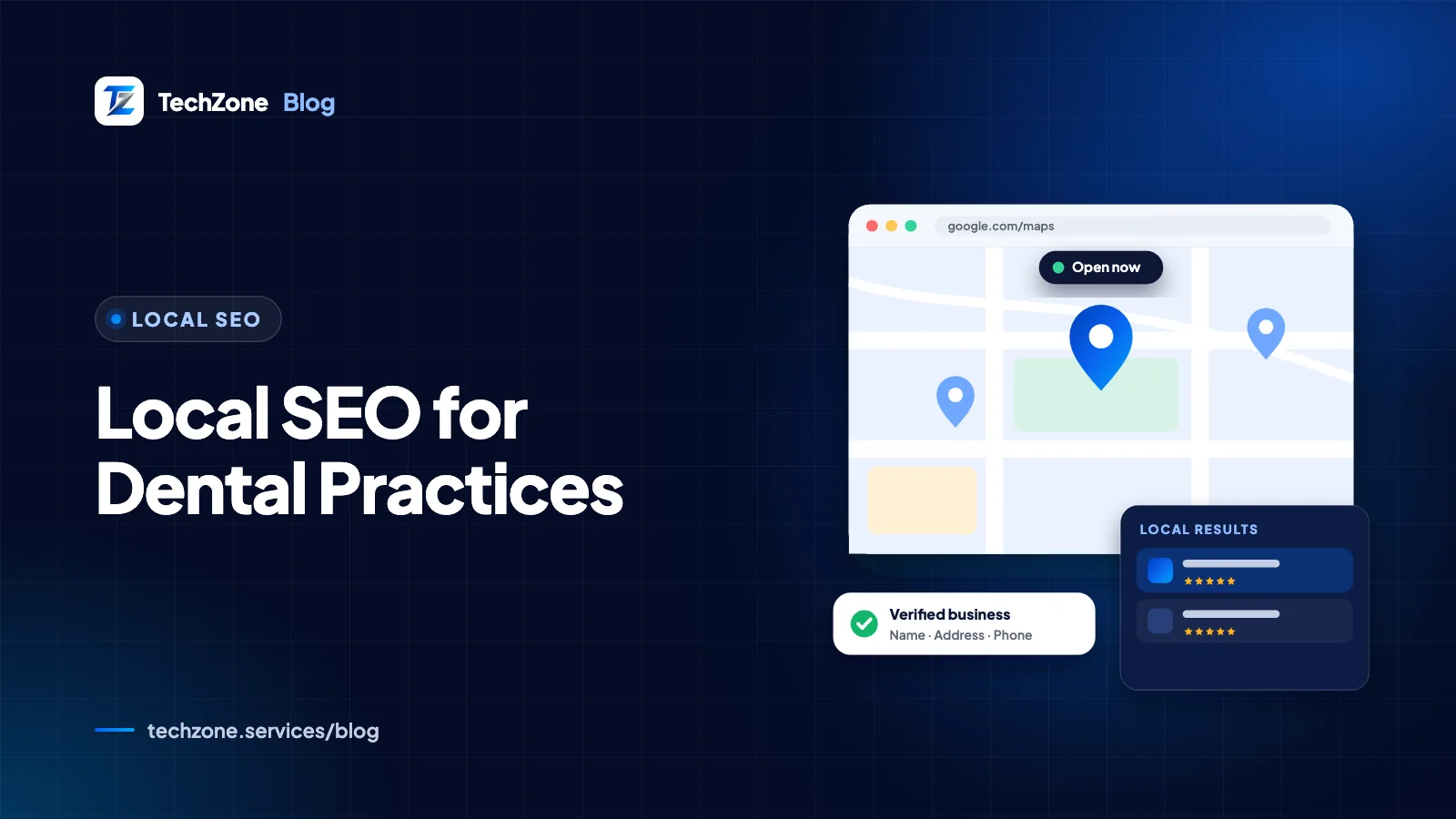
Local SEO for dentists means making your practice the one patients find when they search “dentist near me”, “emergency dentist” or “dental implants in [area]”. It rests on five jobs: a complete Google Business Profile, one website page per treatment, a steady flow of patient reviews, accurate directory listings and tracking the calls and bookings that result.
The general mechanics are the same for any local business, and our 30-step local SEO checklist covers them in order. This guide covers what’s different for a dental practice: Google’s rules for individual dentists, the categories that fit, replying to reviews without breaching patient confidentiality, schema for a practice and the directories patients use in each country.
Key takeaways
- Keep one Business Profile per practice location; a dentist gets a separate profile only if patients can reach them there directly.
- Pick Dentist or Dental clinic as the primary category, and add specialist categories only for care your team actually provides.
- Give each main treatment its own page with local details, fee guidance and a booking button, written or reviewed by a named dentist.
- Never confirm a reviewer is a patient or mention their treatment in a reply; Google’s policy and dental confidentiality rules both forbid it.
- Judge results by calls, direction requests, website clicks and bookings, not by where you rank from the practice’s own computer.
What does local SEO for dentists involve?
Local SEO for a dental clinic covers the listing patients see in Google Maps, the website that backs it up and the reputation signals around both. Few patients travel far for a check-up, so the aim is to appear in the map results near your practice, both for “dentist” and for each treatment you offer. Restaurants and estate agents need a different mix, covered in our guides to local SEO for restaurants and local SEO for real estate agents.
| Area | What it covers | Start with |
|---|---|---|
| Google Business Profile | Categories, services, hours, booking link, photos and reviews | Verify the profile and correct the primary category |
| Treatment pages | One page per service, such as implants, whitening, aligners and emergency care | Your three most requested or most profitable treatments |
| Reviews | A routine for asking every patient, and replies that disclose nothing | A review link in your post-appointment message |
| Directories and links | Dental platforms, associations and local organizations | The two or three platforms patients in your country use most |
| Measurement | Calls, direction requests, bookings and form inquiries | A baseline month before you change anything |
Dental SEO also carries two constraints most businesses don’t face: professional advertising rules and patient confidentiality. Both come up below, because breaking either costs more than any ranking is worth.
How should you set up a dentist Google Business Profile?
Create one profile per practice location, name it exactly as your signage reads, and complete every field Google offers for your category. Google’s guidelines class dentists as individual practitioners, which changes who can have a profile.
Practice profiles vs individual dentist profiles
A public-facing dentist may have their own profile if patients can contact them directly at the verified location during stated hours. Support staff such as nurses and receptionists shouldn’t have profiles, and no dentist should have several profiles to cover different specialties.
- Several dentists at one practice: the practice has its own profile, and each dentist’s profile uses only their name, such as “Dr. Sara Ahmed”, without the practice name.
- One dentist at a branded practice: use a single shared profile named in the format [practice]: [dentist], for example “Smile Studio: Dr. Sara Ahmed”.
- Associates and visiting dentists: think twice. Every extra profile splits reviews across listings and has to be updated or closed when that dentist leaves.
Which categories suit a dental practice?
Choose the primary category that completes the sentence “this business is a”, then add a few secondary categories for services you genuinely offer as distinct treatments. Editing categories can prompt Google to ask you to verify again, so settle them early.
| Practice type | Primary category | Secondary categories to consider |
|---|---|---|
| General family practice | Dentist | Cosmetic dentist, Pediatric dentist, Emergency dental service (only if offered) |
| Multi-chair clinic or group practice | Dental clinic | Dentist, Dental implants provider, Emergency dental service |
| Orthodontic practice | Orthodontist | Dentist, only if general dentistry is offered |
| Children’s practice | Pediatric dentist | Dentist |
Category names come from Google’s English list and can differ from the words you use locally, so type a few options into the category box and pick from the suggestions. Our Business Profile optimization checklist walks through every other field.
Watch out
In the UK, the General Dental Council says a dentist who isn’t on one of its specialist lists must not use titles that imply specialist status, such as Orthodontist, Periodontist or Endodontist. Apply the same care to profile names, categories and treatment pages: “special interest in orthodontics” is acceptable wording, “orthodontic specialist” isn’t.
Services, booking links and photos
- Services: add every treatment as a service with a one-line description, in the words patients search, such as “teeth whitening” rather than “tooth bleaching”.
- Booking link: in your profile, select Booking, then Add link, and paste the URL of your online booking page.
- Hours: show when patients can actually be seen, and set special hours for public holidays in advance.
- Attributes: mark accessibility features such as a wheelchair-accessible entrance, which matter to many patients choosing a practice.
- Photos: the entrance from the street, reception, a treatment room and the team. Keep patients, screens and anything showing records out of every shot.
Which treatment pages does a dental website need?
It needs one page for each treatment patients search for separately, rather than a single “Services” page. A dedicated implants page can answer implant questions in depth and match searches like “dental implants in Headingley”; a bullet point on a services page can’t.
Every treatment page should include:
- a title and H1 that name the treatment and area, such as “Dental Implants in Headingley, Leeds | Practice Name”
- who the treatment suits, what happens at each appointment and what recovery looks like, written or reviewed by a named dentist
- how fees work: a starting price, a fee guide, or a clear note that an assessment comes first
- the dentists who provide the treatment, with their qualifications
- before-and-after photos only where the patient has given written consent
- a booking button and tap-to-call number visible without scrolling on a phone
- answers to the questions your front desk hears every week
Extra website requirements for UK practices
The GDC’s advertising guidance requires a practice website to show the practice name and address, contact details including email and phone, a link to the GDC, your complaints procedure and the date the site was last updated. Each dentist named on the site needs their qualification, the country it came from and their GDC registration number, and your publicity must say whether the practice is NHS, mixed or private.
How do you get more patient reviews within Google’s rules?
Ask every patient at the same point in every visit, and never filter who gets asked. Google’s content policy bars incentives such as discounts or free treatment in exchange for reviews, selectively asking happy patients, and asking for specific content, including a staff member’s name.
The simplest routine is a follow-up message after each appointment with your review link. Our guide to getting more Google reviews within the rules has message templates and shows where to find your link.
How do you reply to dental reviews without breaching confidentiality?
Reply as though you can’t confirm the reviewer is a patient, because in public you can’t. Thank them, respond to the general point and move the conversation to a private channel. Don’t mention treatment, appointments or records, and don’t confirm or add to health details the reviewer shared themselves.
Google’s policy prohibits posting other people’s medical information without consent. The GDC’s standards say dental professionals must not post any information or comments about patients on social networking sites. In the US, patient details in a public reply can breach HIPAA’s privacy rule. Elsewhere, check your own regulator’s guidance before you reply.
| Review says | Unsafe reply | Safe reply |
|---|---|---|
| “My filling fell out after a week.” | “Sorry, Ahmed. Our notes show you skipped the follow-up we booked for that molar.” | “Thank you for telling us. We’d like to put this right; please call our practice manager on [number] so we can talk privately.” |
| “Waited ages past my appointment time.” | “You arrived late for your root canal, which delayed everyone after you.” | “We’re sorry about the wait. We’re reviewing how we schedule longer appointments, and our manager would welcome your call on [number].” |
| “Best dentist in town, my new smile looks great!” | “Thanks! Your veneer case was one of our most complex this year.” | “Thank you for the kind words. The whole team appreciates it.” |
For more reply patterns, including suspected fake reviews, see how to respond to negative Google reviews.
How do you add Dentist schema to a practice website?
Add JSON-LD structured data using the schema.org type Dentist on your home page or each location page, with the same name, address, phone number and hours as your Business Profile. Google’s local business documentation asks for the most specific business type available, and lists name and address as the required properties.
Here’s an example for a single practice. Replace every value with your own, then check the page in Google’s Rich Results Test:
<script type="application/ld+json">
{
  "@context": "https://schema.org",
  "@type": "Dentist",
  "name": "Example Dental Care",
  "url": "https://www.example.com/",
  "telephone": "+44 113 496 0000",
  "image": "https://www.example.com/images/practice-entrance.jpg",
  "address": {
    "@type": "PostalAddress",
    "streetAddress": "12 Example Road",
    "addressLocality": "Leeds",
    "postalCode": "LS6 1AA",
    "addressCountry": "GB"
  },
  "geo": {
    "@type": "GeoCoordinates",
    "latitude": 53.81950,
    "longitude": -1.57680
  },
  "openingHoursSpecification": [{
    "@type": "OpeningHoursSpecification",
    "dayOfWeek": ["Monday", "Tuesday", "Wednesday", "Thursday", "Friday"],
    "opens": "08:30",
    "closes": "17:30"
  }]
}
</script>
Leave out review and rating markup for your own practice. Google doesn’t show star ratings for reviews a business collects or embeds about itself, so the markup adds nothing.
Which dental directories matter in your country?
The ones patients in your country use to find and book a dentist. List the practice with exactly the same name, address and phone number as your Business Profile, then add your dental association’s member directory if you belong to one.
| Market | Dental platforms and directories | Notes |
|---|---|---|
| United States | ADA Find-a-Dentist, Healthgrades, Zocdoc, Yelp | ADA Find-a-Dentist lists ADA members; Zocdoc is a booking platform, so compare its fees with the new patients you expect |
| United Kingdom | NHS Find a dentist (England), Yell, Yelp | The NHS search shows practices accepting new NHS patients, so keep your NHS profile current |
| Canada | Provincial directories, such as the RCDSO’s Find a Dentist in Ontario, plus YellowPages.ca | Make sure your regulator record matches your practice details |
| Australia | HotDoc, Yellow Pages, True Local | HotDoc handles online dental bookings; the others are general directories |
| United Arab Emirates | Okadoc, Yellow Pages UAE | Okadoc lists and books dentists in Dubai |
| Pakistan | Marham, oladoc | Both list dentists by city and take appointment bookings |
Two or three accurate, active listings beat dozens of generic directory entries. Claim each one in the practice’s name, so you keep access when staff or agencies change.
Where do local links for a dental practice come from?
They come from the community you already serve. Google counts links from other websites toward a business’s prominence, and a link from a local school or club also reaches families who live nearby.
- Schools and nurseries: oral-health talks and check-up days often earn a mention on the school’s news page or newsletter.
- Sports clubs: sponsor a junior team or run mouthguard fittings; clubs usually list their supporters online.
- Community events: free screening days, health fairs and charity runs appear on event pages and local news sites.
- Professional bodies: dental association memberships, study clubs and university alumni pages for your dentists.
Where you pay for a sponsorship, the link should carry rel="sponsored", which is how Google’s spam policies allow paid links. You’re paying for local exposure, not ranking credit.
How do you measure calls and bookings from Google?
Measure new-patient inquiries, not rankings. Your Business Profile’s Performance report shows how many people called, asked for directions and clicked through to your website, and counts completed bookings if you take them through a supported booking provider.
- Add UTM parameters to the website link on your profile, so visits from it show up separately in Google Analytics.
- In GA4, mark completed online bookings, contact form submissions and tap-to-call clicks as key events.
- Ask every new patient how they found you when they register, and record the answer in your practice management system.
- Check rankings from several points around the practice, because results change with the searcher’s location.
- Compare each month with the same month last year, since check-up demand is seasonal in many areas.
TechZone’s SEO services for dental practices include a monthly report built around inquiries and bookings rather than rankings alone.
How TechZone can help
If you’d rather hand this work over, TechZone’s local SEO and Google Business Profile team can take it on for practices in Pakistan and abroad. We audit your profiles, categories and practitioner listings, plan treatment pages, add Dentist schema and booking tracking, and set up a review routine your front desk can run without risking patient confidentiality. We won’t promise a map position; we will explain, in plain terms, what’s limiting your visibility. Our healthcare and wellness page covers the wider picture for clinics. Book a free 30-minute consultation, and you’ll receive a written proposal with scope and cost before any work starts.
Frequently asked questions
How long does local SEO take for a dental practice?
Local SEO for a dental practice has no fixed timeline, because it depends on how many practices compete nearby and how complete the profile already is. Fixes such as the right category or accurate hours can take effect soon after Google approves the edit. Treatment pages, reviews and links build more slowly, so judge progress by new-patient inquiries over several months rather than week by week.
Can a dental practice ask patients for reviews while they’re still at the practice?
A dental practice can mention reviews at the front desk, but Google’s policy says businesses shouldn’t require or pressure customers to leave ratings or write reviews while on the premises. A card with a QR code works as a gentle reminder. The safer routine is a follow-up message after the appointment, sent to every patient, so nobody feels watched while writing.
Is dental SEO better than Google Ads for new patients?
Dental SEO and Google Ads do different jobs. Ads can put a practice at the top of results for high-value treatments such as implants as soon as a campaign is approved, and stop when the budget stops. Local SEO builds map visibility, reviews and treatment pages that keep working without a cost per click. A common approach is to run ads for a few key treatments while organic visibility grows.
Should a dental practice list its prices online?
Publishing prices or a fee guide on a dental website helps patients compare and cuts calls from people who were never going to book. Where the fee depends on an assessment, show a starting price and explain that a consultation comes first. Keep prices on the website rather than the Business Profile description, because Google’s guidelines don’t allow prices and offers in that field.
Do dental directories like Healthgrades or Marham help Google rankings?
Dental directories help Google rankings indirectly. A listing with the same name, address and phone number as the Business Profile gives Google another consistent source, and directory pages often rank for dentist searches themselves, so patients can find a practice there too. Their main value is patients who search and book on the directory directly, so choose the few your market actually uses.
Sources and further reading
- Guidelines for representing your business on Google – Google Business Profile Help
- Tips to improve your local ranking on Google – Google Business Profile Help
- Prohibited & restricted content – Maps User Generated Content Policy Help
- Local Business (LocalBusiness) Structured Data – Google Search Central
- Guidance on advertising – General Dental Council
- Guidance on using social media – General Dental Council