
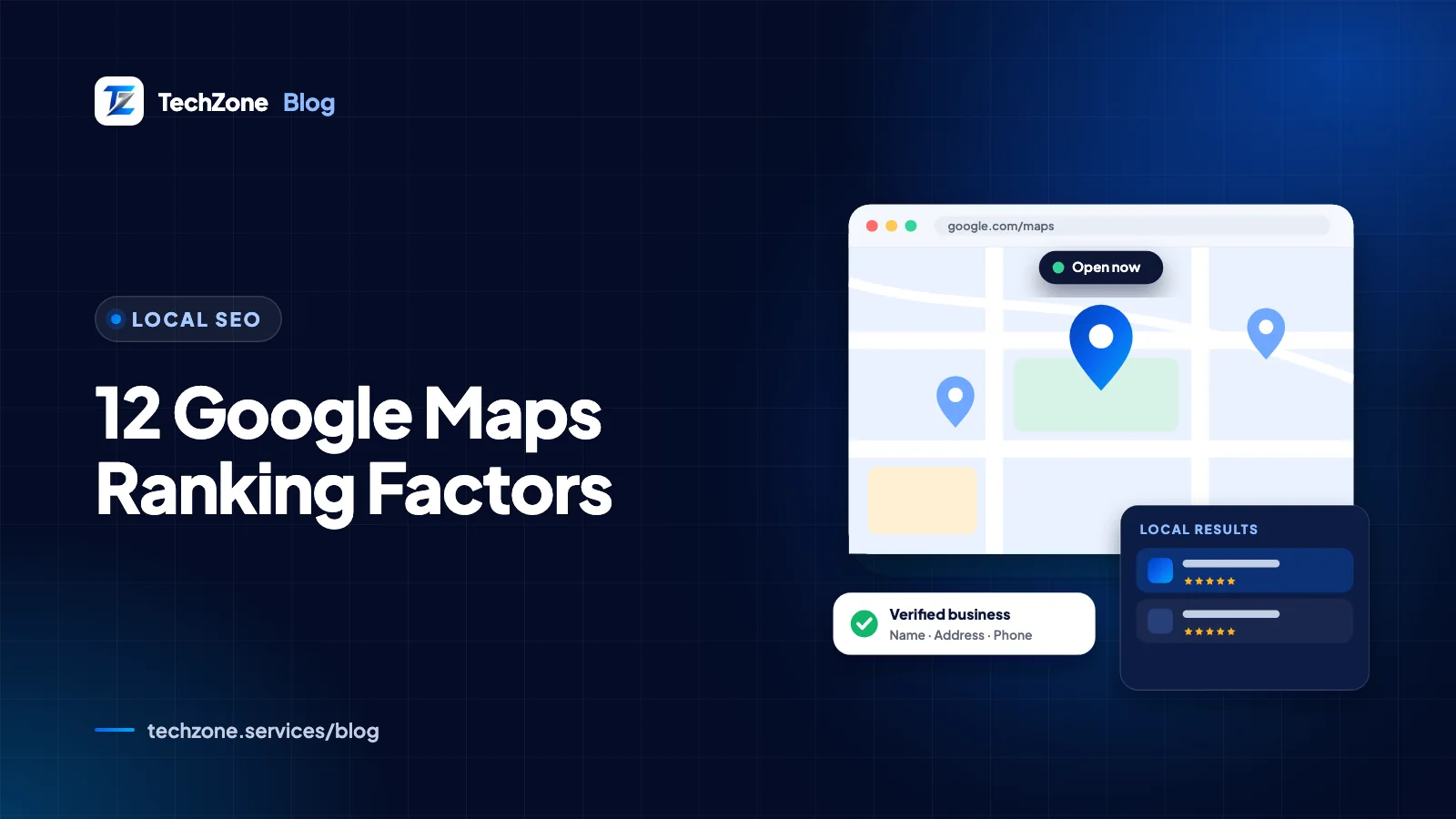
To rank higher on Google Maps, improve what Google measures: relevance, distance and prominence. You can’t move closer to every searcher, but you can control 12 factors that feed relevance and prominence, from your primary category and reviews to your website, citations and local links. First, work out which of the three is holding you back.
A list of tips doesn’t tell you where to start, so this guide begins with a diagnosis. It then covers each factor with what to change and how to check it, and ends with how to measure rankings across your whole area rather than from one desk.
Everything here stays within Google’s guidelines. Shortcuts such as keywords in your business name or a borrowed address can get a profile suspended, which costs far more than any ranking they buy.
Key takeaways
- Google ranks local results on relevance, distance and prominence, and says there’s no way to pay for a better local ranking.
- If you don’t appear even near your own address, fix relevance first: primary category, services, business name and the linked page.
- If you rank close to your location but fade farther out, build prominence with reviews, citations and local links.
- Check rankings on a geo-grid or with a browser location override; a single search from your office misleads you.
- Keyword-stuffed names, virtual offices and incentivized reviews break Google’s rules and put your profile at risk of suspension.
What are the Google Maps ranking factors?
Google says local results are based mainly on relevance, distance and prominence (its help page also uses the word popularity). The same factors decide who appears in the map pack on Google Search and in the Google Maps app.
| Factor | What Google says it means | How much you control it |
|---|---|---|
| Relevance | How well your Business Profile matches what someone searched for | Mostly: categories, services, profile details and your website |
| Distance | How far your business is from the searcher; if the searcher doesn’t share a location, Google uses what it knows about it | Barely: only your real address and your real locations |
| Prominence | How well known your business is, including how many websites link to you and how many reviews you have | Over time: reviews, links, citations and a reputation offline |
Because distance is measured from each searcher, there is no single “rank” for your business. You might be first for someone two streets away and absent for someone across town. That’s why the diagnosis below compares where you rank, not just whether you rank.
Which factor is keeping you out of the top 3 on Google Maps?
Compare the pattern of your rankings with the table below. The pattern usually points to one bottleneck, and fixing that one first saves months of effort in the wrong place.
| What you see | Likely bottleneck | Check first |
|---|---|---|
| You’re missing even for searches made next to your address | Relevance | Primary category, services and the linked page (factors 2, 5 and 7) |
| You appear for your business name but not for your service | Relevance | Primary category and whether your website mentions the service (factors 2 and 7) |
| You rank well within a few streets, then disappear | Prominence; distance is doing all the work | Reviews, citations and links compared with the businesses above you (factors 8 to 10) |
| Businesses with fewer reviews and thin profiles outrank you | Relevance, or spam | Their categories and names; report fake or keyword-stuffed listings (factor 12) |
| Rankings dropped suddenly | A profile edit, a new competitor or a Google update to your details | Blue text in your profile editor, recent edits and new listings nearby |
| You don’t appear anywhere, even for your exact name | Not a ranking issue | Verification, suspension or duplicates |
If your listing is missing entirely, work through our guide to why a business isn’t showing on Google Maps before touching anything below.
Profile factors (1 to 6): what Google reads first
These six live inside your Business Profile and appear in Google’s own list of ways to improve local ranking. They’re free, fast to change and the first place to look for relevance problems.
1. Verification and one profile per location
Google says verifying tells it you’re authorized to represent the business, so the profile is more likely to show. Keep exactly one profile per location: Google’s guidelines forbid more than one page for the same location. Search your name in Maps to find duplicates and report them through Suggest an edit.
2. Primary category
Google says the categories you select affect your local ranking, and the primary one matters most. Pick the most specific option that completes “this business is a”, such as “Nail salon” rather than “Salon”. Check the primary categories of the businesses in the top three for your main search; our guide to choosing Business Profile categories shows how.
3. Additional categories
You can add up to 9 more categories, but Google asks for as few as it takes to describe your core business. Add one only when it’s a genuine line of business, never as a keyword, and never for a separate business operating inside yours.
4. Complete and accurate details
Google says businesses with complete, accurate information are more likely to appear in local results. Fill in hours and holiday hours, attributes, a local phone number you control and a description of up to 750 characters without links or promotions. Accurate hours also matter for searches such as “open now”.
5. Services and products
Add every core service under Edit services, using Google’s suggestions where they fit and custom services where they don’t, each with a short description. Google may highlight a listed service when someone searches for it. Retailers in the US, Canada, the UK and Ireland can also show in-store products.
6. Photos, videos and posts
Photos and videos are on Google’s list of ranking tips. Upload real exterior, interior, team and work photos that are sharp, well lit and unfiltered, plus short videos of the work. Posts for updates, offers and events keep the profile current, although Google doesn’t list posts as a ranking factor.
Website and web factors (7 to 9): what Google finds elsewhere
Google also reads your website and the wider web. It says it can detect category information from your site and from mentions of your business, and that prominence includes how many websites link to you.
7. The page your profile links to
Link each profile to the page that represents that location, as Google’s guidelines ask, not automatically to your home page. That page should name the service and place in its title and main heading, show the same name, address and phone as the profile, and describe the services listed in your profile.
8. Citations and consistent details
Google compiles Business Profiles from several sources, including websites it crawls and data licensed from third parties. If other sources report different details, such as an old address on a directory, Google may update your profile to match them. Claim Bing Places and Apple Business too, and keep your name, address and phone identical everywhere; the 30-step local SEO checklist sets out the order.
9. Local links and mentions
Links from local organizations carry both ranking and referral value: chambers of commerce, trade associations, suppliers, local news and community groups. If you pay for a sponsorship link, Google expects it to carry rel="sponsored", so treat sponsorship as exposure rather than a ranking shortcut.
Reviews and competition (10 to 12): prominence you earn
Reviews are the prominence signal you can grow every week. According to Google, a higher review count and better ratings can lift local rankings, and good replies help a business stand out.
10. Review count and rating
Ask every customer, not just the happy ones, using the link or QR code from Read reviews, then Get more reviews in your profile. Send it by WhatsApp, email or on a receipt right after the job. Never offer discounts or gifts for reviews. Our guide to getting more Google reviews has message templates that stay within the rules.
11. Review replies
Reply to every negative review and to positive ones where you can add something useful. Keep replies short, specific and polite; Google advises against promotions in replies and against sharing a reviewer’s private details. Future customers read your replies as a preview of how you treat people.
12. Fighting spam around you
Fake listings and keyword-stuffed names can take map pack places you’d otherwise earn. In Google Maps, use Suggest an edit to correct a competitor’s name to its real-world name. For a business that doesn’t exist, choose Place is closed or not here, then Offensive, harmful, or misleading. For suspected fraud involving names, phone numbers or website links, use Google’s Business Redressal Complaint form, which accepts spreadsheets for 10 or more profiles.
Can you do anything about distance?
Only honestly. Distance is measured from your real location, and if a searcher doesn’t share where they are, Google uses what it knows about their location. You can’t fake proximity, but you can make sure it works for you.
- Check your pin. A pin on the wrong street or the wrong side of a highway changes who counts as nearby. Correct it under Edit profile, then Location.
- Open real locations where the demand is. A staffed branch with its own signage can have its own profile. A virtual office, or a shared desk with no staff or signage, can’t.
- Widen your reach with prominence. Google weighs all three factors together, so a well-reviewed, well-linked business can sometimes outrank a closer one.
- Use your website and ads for distant areas. Pages about the areas you serve can rank in organic results, and Google Ads can show you wherever you target.
A wide service area on a service-area profile doesn’t move your business closer to anyone. It tells customers where you work.
How do you check your Google Maps rankings properly?
Check from many points, not one. A search from your office, even in an incognito window, shows the results nearest to you, which is usually where you already rank best.
- Geo-grid rank trackers. Tools such as Local Falcon and BrightLocal’s Local Search Grid run the same search from points on a grid around your business and color-code your position at each. A sensible starting point is a 7 by 7 grid with points about 1 km apart in a city, wider in rural areas, run monthly for 3 to 5 core searches.
- A free spot check. In Chrome, open DevTools, press Ctrl+Shift+P (Command+Shift+P on a Mac), run Show Sensors and set a custom latitude and longitude under Geolocation. Allow Google to use your location, then search. Repeat for a few points across your area.
- Your own data. The Performance report in your Business Profile shows the search terms people used to find you, updated at the start of each month, along with calls, direction requests and website clicks.
Record the grid, keywords and date each time, and change one thing at a time where you can. That’s the only way to connect a ranking change to something you did.
What should you never do to rank higher on Google Maps?
Avoid anything Google’s guidelines or content policies forbid. These tactics can work briefly, then end in a suspended profile or removed reviews.
- Adding keywords, cities or taglines to your business name. Google says unnecessary information in the name could lead to suspension.
- Listing a virtual office, P.O. box or mailbox as your address, or an unstaffed co-working desk.
- Creating more than one profile for the same location, in one account or several.
- Offering discounts, gifts or payment for reviews, or asking only happy customers to review.
- Asking customers to include specific words, such as your city or a staff member’s name, in their reviews.
- Posting reviews on a competitor’s listing, or buying link packages that break Google’s link spam policy.
How TechZone can help
TechZone audits Google Business Profiles for local businesses in Pakistan and abroad, and starts where this guide does: working out whether relevance, distance or prominence is the real bottleneck. From there, our SEO and Google Business Profile management services handle categories and profile fixes, location pages, citation cleanup, review systems and grid-based rank tracking. It is part of our wider SEO services, so technical and on-page fixes are handled by the same team. We won’t promise a top-three spot, because nobody honestly can. Book a free 30-minute call and we’ll look at your map rankings with you.
Frequently asked questions
How long does it take to rank higher on Google Maps?
There is no fixed timeline for ranking higher on Google Maps. Fixes to categories and profile details can change rankings soon after Google approves the edits, while prominence from reviews, citations and links builds over months. Competitive categories in big cities usually take longer than niche services in small towns, so track progress monthly on the same grid of locations.
Does posting on Google Business Profile improve rankings?
Google’s local ranking guidance doesn’t list Business Profile posts as a ranking factor. Posts still earn their place: offers and events give searchers a reason to choose you, and a recent post shows the business is active. A short monthly update keeps the profile looking current for the customers who compare you with competitors.
Can you pay Google to rank higher on Google Maps?
No. Google states there’s no way to request or pay for a better local ranking. Businesses can pay for Google Ads, and ads with location assets can appear on Google Maps, but they’re labeled as ads and don’t change the order of the unpaid results. Organic Maps rankings come only from relevance, distance and prominence.
Does my business name affect my Google Maps ranking?
Your business name on Google must match the name you use on your signage, website and stationery. Adding keywords or cities to the name breaks Google’s guidelines and can lead to suspension. If a keyword is genuinely part of your registered, real-world name, such as “Leeds Plumbing Co”, you can use it, as long as you use it consistently everywhere.
Why do Google Maps results look different on my phone and my computer?
Google Maps results change with the searcher’s location. A phone with location services on usually gives Google a more precise position than a desktop browser, and Google measures distance from wherever it believes the searcher is. Search history and the exact words used also vary between devices, so compare rankings with a consistent method such as a geo-grid tool.
Sources and further reading
- Tips to improve your local ranking on Google – Google Business Profile Help
- Guidelines for representing your business on Google – Google Business Profile Help
- Maps user contributed content policy: prohibited and restricted content – Google Maps Help
- Report a business on Google Maps – Google Maps Help
- Understand your Business Profile performance and insights – Google Business Profile Help
- Edit your Business Profile – Google Business Profile Help