
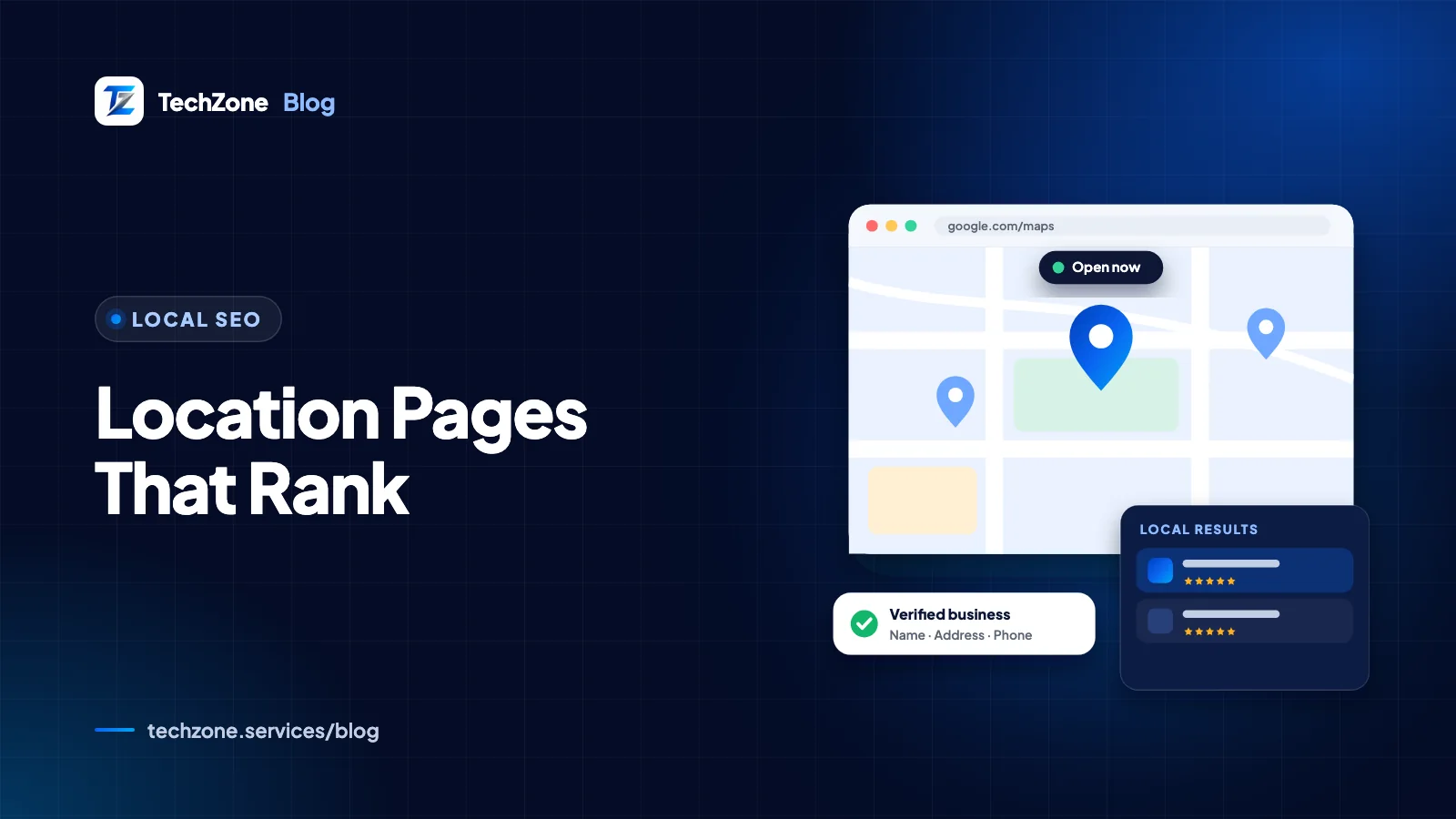
Location pages for SEO are pages on your website that each represent one real branch, with its own address, phone number, hours, map, team, reviews and local details. Build one for every location customers visit, link each Google Business Profile to its page, and make every page genuinely different, or Google may treat the set as doorway pages.
Businesses without branches can use area pages too, but the bar is higher; our guide to SEO for service-area businesses covers that strategy. This article focuses on the page itself: when to create one, what goes on it, a template with structured data, URLs and internal links, and how many pages make sense.
Key takeaways
- Create a location page for each real, staffed location customers can visit, and link that location’s Business Profile to it.
- Each page needs unique local content: NAP, hours, map, directions, team, local reviews and projects, not a swapped city name.
- Mark up each page with the most specific LocalBusiness type, including that location’s own URL, phone number and hours.
- Near-identical city pages that funnel visitors to one destination match Google’s description of doorway abuse.
- Use a simple URL pattern such as /locations/city/ and link every location page from a locations hub.
When should a business create location pages for SEO?
Create one whenever you have a physical location that customers visit or that is staffed to serve an area. If there’s no real location behind the page, it’s an area page or a market page, and different rules apply.
| Your situation | Create a location page? | What to do instead or as well |
|---|---|---|
| Several branches or offices | Yes, one per branch | Link each branch’s Business Profile to its own page |
| One storefront | Optional | Your contact page can hold the location details; add a page if it can say more than that |
| Service-area business with no branches | Not a location page | Area pages only where you have real local work to show |
| Serving other cities or countries remotely | No | Market or service pages that explain how you work with clients there, with no invented address |
That last row matters for agencies and consultants. A firm in Islamabad serving clients in London can have a page about working with UK businesses, but it shouldn’t look like a London office, because it isn’t one.
What should every location page include?
Everything a customer needs to choose, find and contact that branch, most of which is unique by nature. Use this template for every location, and our on-page SEO checklist for the basics shared by all page types.
| Section | What to include | Why it matters |
|---|---|---|
| Title tag and H1 | Service or brand plus place, such as “Dentist in Clifton, Bristol | Brand” | Matches how people search and confirms they’re in the right place |
| Opening summary | Two or three sentences: what this location offers, where it is and who it serves | Answers the visitor’s first question at once |
| NAP block | Name, full address and local phone number as text, identical to the Business Profile | Confirms the details Google shows for that location |
| Hours | Regular and holiday hours, kept in step with the profile | Wrong hours cost visits and trust |
| Map and directions | Embedded Google Map, directions from main roads or transit, parking and accessibility | Useful, and different for every location |
| Services here | What this branch offers, including anything it doesn’t | Differences between branches are genuine unique content |
| Team | Names, roles and photos of the people customers will meet | Shows real people and experience at this address |
| Local proof | Reviews from this branch’s customers, nearby projects or cases, local memberships | Evidence no other page on your site has |
| Photos | Exterior, entrance, interior and staff at work, taken on site | Helps customers recognize the place when they arrive |
| Local FAQs | Parking, payment options, languages spoken, booking rules | Answers questions specific to this branch |
| Call to action | Tap-to-call, booking link or WhatsApp button for this location | Turns a visit into an inquiry |
To embed the map, open the location in Google Maps, choose Share, then Embed a map, and copy the HTML into the page.
Pakistan note
Where addresses run by sector, block or phase rather than street number, the directions section does extra work. Name the nearest main road and a landmark customers know, check that the map pin sits on your entrance, and put a WhatsApp button beside the phone number if that’s how your customers prefer to get in touch.
How do you add LocalBusiness schema to a location page?
Add one LocalBusiness block per location page, using the most specific type available, such as Dentist or Plumber. Google requires only name and address, but recommends the location’s own URL, a phone number with country and area code, coordinates with at least five decimal places, and opening hours.
Example for a fictional clinic, placed in the page’s HTML:
<script type="application/ld+json">
{
  "@context": "https://schema.org",
  "@type": "Dentist",
  "name": "Example Dental Clinic",
  "url": "https://www.example.com/locations/clifton/",
  "telephone": "+44 117 496 0000",
  "image": "https://www.example.com/images/clifton-clinic.jpg",
  "address": {
    "@type": "PostalAddress",
    "streetAddress": "1 Example Street",
    "addressLocality": "Bristol",
    "postalCode": "BS8 0XX",
    "addressCountry": "GB"
  },
  "geo": {
    "@type": "GeoCoordinates",
    "latitude": 51.45512,
    "longitude": -2.61901
  },
  "openingHoursSpecification": [{
    "@type": "OpeningHoursSpecification",
    "dayOfWeek": ["Monday", "Tuesday", "Wednesday", "Thursday", "Friday"],
    "opens": "09:00",
    "closes": "17:30"
  }]
}
</script>- Make every value match what’s visible on the page and on that location’s Business Profile.
- Don’t add review or rating markup for your own reviews: Google supports review snippets for local businesses only on sites that collect reviews about other businesses.
- Validate each page with the Rich Results Test before publishing, then spot-check with URL Inspection in Search Console.
Our guide to schema markup for small businesses covers Organization markup, plugins and validation in more depth.
How do you avoid doorway pages?
Make each page useful on its own and part of a clear site structure. Google’s spam policies define doorway abuse as pages created to rank for similar searches that lead users to less useful intermediate pages. Its examples include pages targeted at specific cities that funnel users to one page, and substantially similar pages that are closer to search results than a browseable hierarchy.
Run every location page through four questions:
- Would this page exist if search engines didn’t? A real branch page would, because customers need directions and hours.
- Does it contain facts that are only true of this location? Team, directions, local reviews and projects qualify; a swapped town name doesn’t.
- Can a visitor finish their task here, by calling, booking or getting directions, without being pushed to another page?
- Is it reachable from a locations hub and your navigation, rather than sitting orphaned for search engines to find?
Two related policies catch location pages too. Google lists blocks of text naming cities and regions a page wants to rank for as keyword stuffing, and it treats many pages generated without adding value for users as scaled content abuse, however they’re produced. If you already have thin city pages, improve them with real local content, or merge them into a stronger page and 301 redirect the old URLs.
How do you write unique local copy at scale, including with AI?
Collect real facts for each location first, then write from them. Google says using automation, including AI, to generate content mainly to manipulate rankings breaks its spam policies, but that not all AI use is spam; the difference is whether the page adds value.
- Send each branch manager a fact sheet: services offered and not offered, team members, parking and transit, nearby landmarks, languages spoken, payment options, common customer questions and two or three recent jobs they can describe.
- Collect local proof: reviews that mention the branch, photos taken on site, and project details shared with the customer’s permission.
- Draft each page from its own fact sheet. If you use an AI assistant, give it the facts and tell it not to add anything that isn’t in them.
- Have someone who knows the location check every claim, then edit for tone.
- Read the pages side by side. If two read the same apart from the town name, the facts aren’t specific enough yet.
What URL structure and internal links work best for local landing pages?
Use one predictable pattern, such as /locations/leeds/, with a hub at /locations/ that lists every branch. Google recommends readable words in URLs rather than ID numbers, written in your audience’s language.
- Keep one folder level for most businesses. Add a neighborhood only when you have two branches in one city, such as /locations/leeds-headingley/.
- Link the hub from your main navigation or footer, each location page from the hub, and relevant location pages from your service pages.
- Add breadcrumbs, such as Home, then Locations, then Leeds, so visitors and crawlers both see the hierarchy.
- Point each Business Profile’s website link at its own location page, as Google’s guidelines expect, and give each link its own UTM tags so you can tell the profiles apart in Google Analytics.
- Include every location page in your XML sitemap, and check that none is accidentally set to noindex.
How many location pages should you have?
As many as you have real locations, plus area pages only where they pass the doorway questions above. More pages don’t mean more visibility if they’re thin.
- Multiple branches: one page per branch, each linked from its own Business Profile.
- Service-area businesses: start with one strong page covering the areas you serve, then add area pages one at a time as you build up jobs, reviews and photos in each area.
- Remote firms serving other markets: a few market pages that describe how you work with clients in each country, not pages that imply offices you don’t have.
Add pages when existing ones earn impressions and inquiries in Search Console and GA4, not in bulk. The 30-step local SEO checklist shows where location pages fit alongside your profile, citations and reviews.
How do you measure whether location pages work?
Judge each page by the searches it appears for and the inquiries it produces, not by traffic alone. Check these every quarter:
- Search Console: in the Performance report, filter by the page’s URL and look at the queries it appears for. Service-plus-place searches mean the page is doing its job.
- Google Analytics 4: check the landing page report for your location pages, and the key events, such as calls, bookings and WhatsApp clicks, that start on them.
- Business Profile Performance: compare each profile’s website clicks with the UTM-tagged sessions GA4 records for that location.
Read the pattern. A page with impressions but few clicks usually needs a clearer title; one with visits but no inquiries needs a stronger call to action or more local proof.
How TechZone can help
TechZone builds location pages for multi-location businesses and service companies, from the fact-sheet process and copywriting to LocalBusiness structured data, internal linking and Business Profile connections. Our SEO services include auditing existing city pages for doorway risk and consolidating the thin ones, and our web development team can build a reusable template in WordPress or a custom stack. You can see the full scope on our local SEO service page. Book a free 30-minute consultation to review your location pages.
Frequently asked questions
Can location pages share the same content?
Location pages can share small elements, such as a company introduction or a description of a standard service, but most of each page should be unique to that location. When location pages are nearly identical apart from the town name, they compete with each other and resemble the doorway pages Google’s spam policies describe. Branch details, team, reviews and directions provide the unique content.
Does every location page need its own Google Business Profile?
Every real, staffed location that meets customers should have its own Google Business Profile, linked to its own location page. Area pages for places where you have no office can’t have a Business Profile, because Google requires a real location or a service-area setup based at your actual address. Never create profiles for locations you don’t operate.
Should location pages go on subdomains or separate websites?
Location pages work best as folders on your main website, such as /locations/leeds/. Google’s spam policies list multiple domain names targeted at specific regions or cities as an example of doorway abuse. A single site also concentrates your links and reviews in one place and is far easier to maintain than a network of city sites.
How long should a location page be?
A location page has no ideal word count. It should be long enough to cover the template sections with real facts: address, hours, directions, services, team, local reviews and answers to local questions. A branch with lots of local proof will naturally produce a longer page; padding a page with generic text only makes it harder to read.
What is the difference between a location page and a service page?
A location page describes one branch: where it is, when it’s open, who works there and what it offers. A service page describes one service, such as teeth whitening, and can list the branches that provide it. Link them to each other, so people searching for a service can find the nearest branch, and people viewing a branch can see its services.
Sources and further reading
- Spam policies for Google web search – Google Search Central
- Local business (LocalBusiness) structured data – Google Search Central
- Review snippet (Review, AggregateRating) structured data – Google Search Central
- Guidelines for representing your business on Google – Google Business Profile Help
- Google Search's guidance about AI-generated content – Google Search Central Blog
- URL structure best practices for Google Search – Google Search Central