
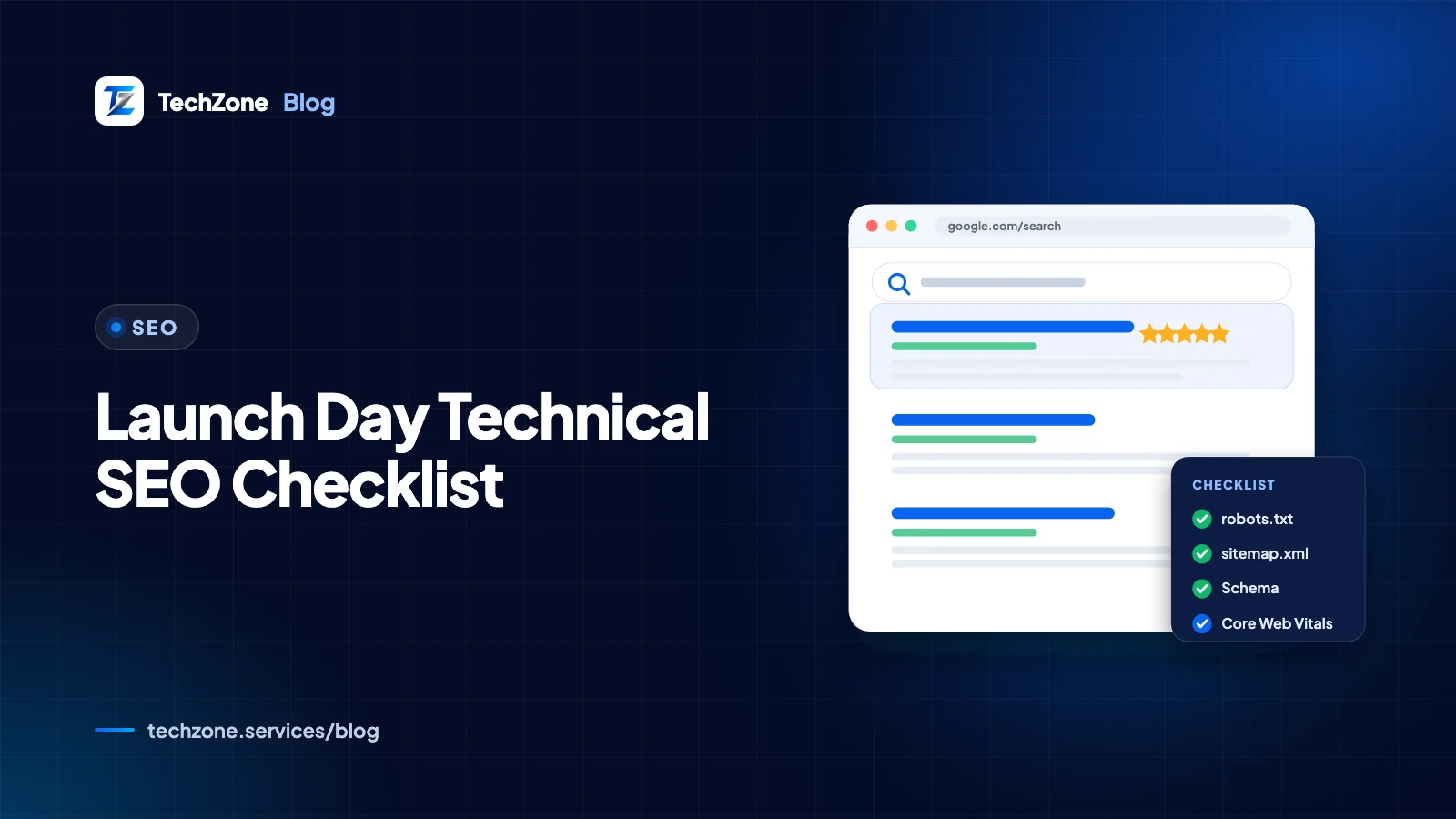
A technical SEO checklist for a new website confirms that search engines can crawl, index and understand every important page. The essentials are a correct robots.txt and XML sitemap, Search Console and Bing Webmaster Tools setup, HTTPS, canonical tags, 301 redirects from old URLs, a clear site structure, fast mobile pages and valid structured data.
Launch problems are rarely exotic. A staging noindex left switched on, a robots.txt that still blocks everything, or a redesign that changed every URL without redirects can keep a new site out of results, or drain an old site’s traffic, until someone notices.
Run the checklist three times: on staging before launch, on launch day, and again a few weeks later once Google has recrawled the site. It covers the 2026 basics, including what actually matters for visibility in AI search.
Key takeaways
- Check robots.txt, noindex tags and the XML sitemap on launch day; leftover staging settings are a common cause of missing pages.
- Verify the site in Google Search Console and Bing Webmaster Tools, submit the sitemap, and test key URLs with URL Inspection.
- When relaunching, 301 redirect every old URL to its closest new equivalent and keep those redirects for at least a year.
- Google stopped showing FAQ rich results on May 7, 2026; Organization, BreadcrumbList and Article markup remain worth adding.
- Google’s AI features draw on its normal search index, so standard technical SEO applies, and Google Search ignores llms.txt files.
What does a technical SEO checklist for a new website include?
It covers everything that lets search engines find, render, index and understand your pages, separate from content and link building. Use the table as your master checklist; the sections below explain each item.
| Check | What “done” looks like | Where to verify |
|---|---|---|
| Robots.txt | Public pages crawlable; no leftover Disallow: / from staging; sitemap listed | yoursite.com/robots.txt, URL Inspection |
| Indexing directives | No stray noindex on pages that should rank | URL Inspection, site crawl |
| XML sitemap | Only canonical, indexable URLs; submitted to Google and Bing | Search Console Sitemaps report, Bing Webmaster Tools |
| HTTPS | Valid certificate; HTTP and www/non-www variants redirect to one version | Browser, redirect checker |
| Canonical tags | Self-referencing canonical on every indexable page | Page source, URL Inspection |
| Redirects | Every old URL 301s to its closest new equivalent; no chains | Crawler such as Screaming Frog |
| Site structure | Key pages a few clicks from the home page; no orphan pages | Site crawl |
| Titles, descriptions, headings | Unique title and meta description per page; one clear H1 | Site crawl |
| Images | Descriptive alt text; WebP or AVIF; width and height set | Lighthouse, site crawl |
| Mobile and speed | Same content on mobile and desktop; Core Web Vitals pass | PageSpeed Insights, Search Console |
| Structured data | Valid markup that matches visible content | Rich Results Test |
| 404 handling | Missing pages return a real 404 status | URL Inspection, site crawl |
| AI search access | Googlebot, Bingbot, OAI-SearchBot and PerplexityBot not blocked | robots.txt |
Can Google and Bing crawl and index your new site?
They can if nothing blocks them and they have a way to discover your URLs. On launch day, check robots.txt, indexing directives and the XML sitemap, then register the site with both search engines.
Robots.txt
Robots.txt tells crawlers which URLs they may request. It does not keep a page out of Google; use noindex or password protection for that. Make sure the file doesn’t block CSS or JavaScript your pages need to render, and that the staging rule Disallow: / is gone.
Noindex and staging settings
In WordPress, confirm that the “Discourage search engines from indexing this site” box under Settings → Reading is unchecked after launch. On any platform, remove password protection and noindex tags that were only meant for staging.
XML sitemap
List only canonical URLs that return a 200 status and should be indexed, written as full absolute URLs. One sitemap can hold up to 50,000 URLs or 50 MB uncompressed; larger sites use a sitemap index. Add a Sitemap: line to robots.txt. Google ignores the priority and changefreq fields, so don’t bother tuning them.
Yoast SEO, Rank Math and Shopify generate sitemaps automatically; check the output for tag archives, attachment pages and test products that shouldn’t be there.
Search Console, Bing Webmaster Tools and URL Inspection
- Verify a Domain property in Google Search Console, which covers HTTP, HTTPS, www and other subdomains, and submit the sitemap in the Sitemaps report.
- Add the site to Bing Webmaster Tools. You can import a verified Search Console property, including its sitemaps, instead of verifying again.
- Run URL Inspection on the home page and your top service or product pages. Confirm Google can fetch them, sees the right canonical and is allowed to index them, then request indexing.
- Consider IndexNow, a protocol that notifies Bing, Yandex, Naver, Seznam.cz and Yep when URLs change. Google isn’t a participating search engine, so it complements your sitemap rather than replacing it.
Are HTTPS, canonical tags and redirects set up correctly?
They are when every page loads over HTTPS at one preferred address, declares that address as canonical, and every retired URL permanently redirects to its replacement. Together these prevent duplicate URLs and protect rankings during a relaunch.
- HTTPS: install a valid certificate and 301 redirect all HTTP and www or non-www variants to one version. Secure HTTPS serving is one of the page experience aspects Google lists.
- Canonical tags: give each indexable page a self-referencing
rel="canonical"to its preferred URL. Google treats redirects and canonical tags as strong signals and sitemap inclusion as a weak one, so keep all three consistent. Don’t use robots.txt ornoindexto handle duplicates. - Redirects when relaunching: export every old URL from the old sitemap, analytics and Search Console, map each one to its closest new equivalent, and set up server-side 301 redirects. Google recommends keeping them for at least a year and avoiding redirect chains.
- No blanket redirects to the home page: sending many unrelated old URLs to the home page confuses visitors, and Google may treat those redirects as soft 404s.
- Internal links: update menus, footers and in-content links to point straight at the new URLs instead of relying on redirects.
404 pages
Pages that no longer exist should return a real 404 or 410 status, which tells Google to drop them from its index. A page that says “not found” while returning a 200 status appears as a soft 404 in Search Console. Give your 404 page a search box and links to main sections so visitors aren’t stranded.
Relaunching an existing site rather than launching a new one? Our website migration SEO checklist walks through redirect mapping, launch-day checks and the first weeks of monitoring in more depth.
Is your site structure and on-page markup clean?
A clean structure means every important page is reachable through normal links, grouped logically, and labeled with a unique title, a clear H1 and descriptive image text. That helps crawlers understand your topics and helps visitors find what they came for.
Site structure and internal linking
- Keep key service, category and product pages within a few clicks of the home page.
- Use short, readable URLs made of words:
/services/seo/beats/?page_id=482. - Link related pages with descriptive anchor text, and make sure no page is an orphan with zero internal links.
- Add breadcrumbs on deeper sites; they help visitors and can be marked up with BreadcrumbList.
Titles, meta descriptions and headings
Write a unique, descriptive title for every indexable page, main topic first and brand at the end. Google truncates long titles and sometimes builds snippets from page content instead of your meta description, but a specific description per page still gives it a good option. Give each page one clear H1, then H2s and H3s in logical order.
Images
Describe meaningful images in alt text: “Technician replacing a laptop battery” tells Google and screen-reader users far more than “IMG_2041”. Google Search supports WebP and AVIF alongside JPEG, PNG, GIF, SVG and BMP, so serve modern formats where your platform allows, set width and height, and lazy-load images below the fold.
For page-level detail, use our on-page SEO checklist, which covers service pages, location pages, blog posts and product pages separately.
Is the site mobile-friendly and fast?
It has to be, because Google uses the mobile version of your pages for indexing and ranking. Under mobile-first indexing, content, structured data, titles and meta descriptions should match between mobile and desktop.
- Check key templates at phone width in Chrome DevTools and on at least one real Android phone and iPhone.
- Don’t load primary content only after a click, swipe or typed input; Google won’t trigger those interactions to find it.
- Avoid intrusive interstitials and pop-ups that cover the content on small screens.
- Pass all three Core Web Vitals (LCP, INP and CLS) in field data, not just in a Lighthouse test.
Performance deserves its own guide. Our article on Core Web Vitals and why slow sites lose customers covers the thresholds, measurement and a prioritized fix list, and our web development team writes those targets into the build spec from the start.
Which structured data should a new website use?
Start with Organization markup on the home page, BreadcrumbList on inner pages and Article on blog posts, all in JSON-LD. Structured data helps Google understand a page and makes it eligible for some rich results, but it doesn’t guarantee them.
| Schema type | Where to use it | What it tells Google |
|---|---|---|
| Organization | Home or About page | Official name, logo, URL, contact details and social profiles |
| BreadcrumbList | Inner pages with breadcrumbs | The page’s position in your site; since January 2025, Google shows breadcrumbs only in desktop results |
| Article or BlogPosting | Blog posts and news | Headline, images, author and publish and update dates |
| Product with Offer | Store product pages | Price, availability and reviews for merchant listings |
| LocalBusiness | Businesses with a physical location | Address, opening hours and contact details |
FAQ markup in 2026
Google limited FAQ rich results to well-known, authoritative government and health websites in 2023, then stopped showing FAQ rich results entirely on May 7, 2026. FAQPage markup will not produce a Google rich result. Keep a visible FAQ section if it helps readers, but don’t add the markup expecting extra space in Google results.
Validate markup with Google’s Rich Results Test or the Schema Markup Validator, and make sure every property matches content visible on the page.
Our guide to schema markup for small businesses includes a copyable JSON-LD example and shows how to add it in WordPress and Shopify.
How do you make a new website visible in AI search?
Mostly by getting the technical SEO above right. Google says its AI Overviews and AI Mode are rooted in its core Search ranking systems and need no special files or markup; a page has to be indexed and eligible to show with a snippet.
Write answer-first content
Open each page and section with a direct, self-contained answer, then add detail, examples and first-hand experience. Google’s guide to generative AI search favors unique, non-commodity content organized under clear headings, and says you don’t need to split pages into tiny chunks.
Let search and AI crawlers in
Check that robots.txt doesn’t block the crawlers behind the answer engines you care about:
- Googlebot for Google Search, including AI Overviews and AI Mode.
- Bingbot for Bing. Bing Webmaster Tools also offers an AI Performance report showing citations in Microsoft Copilot and Bing’s AI-generated summaries.
- OAI-SearchBot for ChatGPT search. OpenAI says sites that block it won’t appear in ChatGPT search answers, though they may still show as navigational links.
- PerplexityBot for Perplexity’s search results. Perplexity says it doesn’t use this crawler to train AI foundation models.
Training crawlers are separate. OpenAI’s GPTBot and Google’s Google-Extended token control use of your content for AI model training (and, for Google-Extended, grounding in Gemini Apps and Vertex AI), and blocking them doesn’t remove a site from ChatGPT search or Google Search. Decide on those according to your content policy, not SEO.
Structured data and llms.txt
Structured data isn’t required for AI features, but Google recommends keeping it as part of normal SEO. llms.txt is a proposed convention: a Markdown file, usually served at /llms.txt, that summarizes the site and links to key pages for language models. Google says Google Search ignores llms.txt files, so adding one neither helps nor harms your rankings there. Treat it as optional, and add one only if tools or AI services you care about use it.
For the content and promotion side of AI visibility, see our digital marketing services.
To go further, read how to rank in Google AI Overviews and our plain-English comparison of SEO, GEO and AEO. Once the site has been live for a few months, run a full SEO audit to catch problems that only appear with real traffic.
How TechZone can help
TechZone can run this checklist on your staging site before launch and again after go-live, for WordPress, Elementor, Shopify and WooCommerce sites alike. For relaunches, we map old URLs to new ones before anything goes live, set up the redirects, and watch Search Console and Bing Webmaster Tools in the weeks after launch. If your site is already live, our SEO services start with a technical audit against the points above and a fix list ordered by impact. If you want a prioritized fix list first, start with an SEO audit. To plan a launch or review an existing site, contact us.
Frequently asked questions
How long does it take Google to index a new website?
Google’s documentation says crawling can take anywhere from a few days to a few weeks, and requesting a crawl does not guarantee a new website will be indexed at all. Submitting an XML sitemap, requesting indexing for key pages in URL Inspection, and earning links from other sites help Google discover a new website sooner. Pages also need to be useful and original to be indexed.
Should a new website use www or non-www?
Either www or non-www works for SEO, and neither version ranks better by itself. What matters is choosing one version, redirecting the other to it with a 301 redirect, and using the chosen version consistently in canonical tags, the XML sitemap and internal links. A Domain property in Google Search Console reports on both versions, so data isn’t split across two properties.
Does a website redesign affect SEO?
A website redesign that keeps the same URLs, content and internal links usually has a limited effect on SEO. A redesign that changes URLs, removes content or restructures navigation can cause ranking drops if handled poorly. Before relaunching a redesigned website, crawl the old site, redirect or keep every URL, carry over titles and content, and compare Search Console data for several weeks after launch.
What is a technical SEO audit?
A technical SEO audit is a structured review of how well search engines can crawl, render, index and understand a website. A technical SEO audit typically combines a site crawler such as Screaming Frog with Google Search Console and PageSpeed Insights to find blocked pages, redirect chains, broken links, duplicate content, missing tags, slow templates and structured data errors, then ranks the fixes by impact.
Is JavaScript bad for SEO?
JavaScript is not bad for SEO in itself. Google renders JavaScript and can index content loaded with it, as long as the scripts and files are not blocked. JavaScript-heavy websites are more complex to optimize, so check the rendered HTML in URL Inspection, use real links with href attributes for navigation, and make sure important content doesn’t depend on a click to appear.
Sources and further reading
- Build and submit a sitemap — Google Search Central
- Site moves and migrations — Google Search Central
- Latest Google Search documentation updates — Google Search Central
- Google's guide to optimizing for generative AI features on Google Search — Google Search Central
- Overview of OpenAI crawlers — OpenAI
- Perplexity crawlers — Perplexity