
To rank in Google AI Overviews and AI Mode, a page must be indexed, eligible to show a snippet, and on a site that hasn’t opted out in Search Console. Beyond that, Google says no special optimization is required: its AI features use core ranking systems, so pages that answer clearly, completely and from experience tend to earn the links.
That sounds simple, and mostly it is. Most advice on how to rank in Google AI Overviews stops at generic tips, yet sites usually slip on the details: a stray nosnippet tag, a page that answers half the question, or no idea which queries show their links. This guide covers each step, treats AI Mode separately where it differs, and ends with a free weekly tracking method.
If you’re still sorting out the jargon, our explainer on SEO vs GEO vs AEO maps each term to the AI surfaces it covers.
Key takeaways
- Pages must be indexed and snippet-eligible, and your site included in Search Console’s Search generative AI control, which is on by default.
- Google says llms.txt, special schema, chunked pages and an “AI writing style” are unnecessary for AI Overviews and AI Mode.
- Answer each question directly, cover the follow-up questions query fan-out searches for, and add first-hand detail other pages lack.
- The nosnippet rule, data-nosnippet and a low max-snippet value all limit what AI Overviews and AI Mode can use from your pages.
- Track weekly with Search Console’s Generative AI report, which lists pages but not queries, plus a simple sheet of target queries.
How does Google choose sources for AI Overviews and AI Mode?
Google’s AI features retrieve pages from the Search index with its core ranking systems, write an answer grounded in those pages, and link to them. So a page has to be a strong search result for some part of the question, though not necessarily the top result for the exact words typed.
The mechanism behind that is query fan-out: the model runs several related searches at once to gather more material. Google’s own example is a search about fixing a lawn full of weeds, which might fan out into searches about lawn herbicides, removing weeds without chemicals and preventing weeds. A page that answers those follow-ups well has more ways in.
Two more facts shape your odds. AI Overviews appear only when Google’s systems judge them additive to classic results, so many queries never show one. And in Search Console, an AI Overview occupies a single position, with every link inside it assigned that same position.
How AI Mode differs from AI Overviews
| Aspect | AI Overviews | AI Mode |
|---|---|---|
| Where it appears | On the normal results page, when Google judges it helpful | In a separate AI mode that people open for a conversation |
| Best suited to | Getting the gist of a topic quickly | Exploration, reasoning and complex comparisons |
| Search Console counting | The whole overview holds one position | Standard position rules; each follow-up question counts as a new query |
| Links shown | Can differ from AI Mode for the same query | Can differ from AI Overviews, since the two may use different models |
Google AI Mode optimization is the same work as for AI Overviews, but check the two separately. A query can cite you in AI Mode and not in the AI Overview, or the reverse.
What are the technical requirements for AI Overviews?
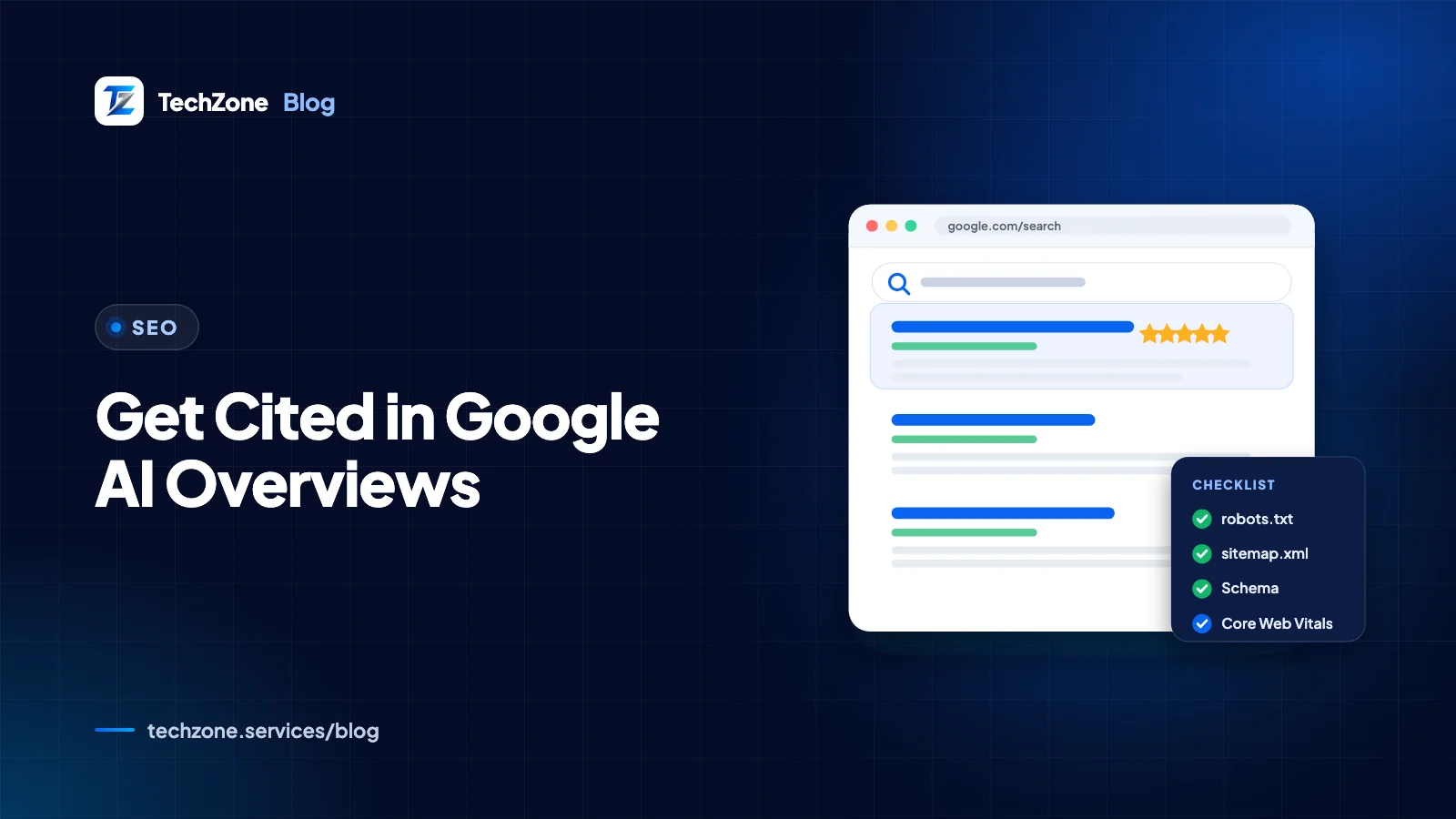
Google lists the normal Search requirements: the page must be indexed and allowed to show a snippet. Its newer guidance adds one site-level condition: your Search Console property must be included in Search generative AI features, which is the default setting.
Check these five things
- Indexed: inspect the URL with Search Console’s URL Inspection tool and confirm it’s indexed under the canonical URL you expect.
- Snippet-eligible: make sure no
nosnippetor very lowmax-snippetrule appears in the page’s robots meta tag or X-Robots-Tag HTTP header. - Included in AI features: open Settings → Search generative AI and confirm the property includes your site’s links and content. Child properties inherit a parent’s setting unless someone overrides it.
- Crawlable: robots.txt, your CDN and your hosting must let Googlebot fetch the page and the files it needs. Google-Extended doesn’t affect Search, so blocking it won’t remove you from AI Overviews.
- Readable: put important information in text, not only in images or video, and keep structured data consistent with what visitors see.
Those five checks cover the technical side of how to get into AI Overviews; the rest comes down to content and reputation. If your core pages aren’t indexed yet, fix that first, and use our 90-day SEO plan for small businesses to set the order.
How snippet controls affect AI features
| Control | Where you set it | Effect on AI features |
|---|---|---|
noindex | Robots meta tag or X-Robots-Tag header | The page leaves Google Search entirely, AI features included |
nosnippet | Robots meta tag or X-Robots-Tag header | No text snippet anywhere, and the content can’t be a direct input for AI Overviews or AI Mode |
max-snippet:[number] | Robots meta tag or X-Robots-Tag header | Caps snippet length and how much content can feed AI Overviews and AI Mode; 0 equals nosnippet |
data-nosnippet | HTML attribute on a span, div or section | Keeps the marked text out of snippets; Google lists it among the controls for AI features |
| Search generative AI control | Search Console → Settings | Removes the whole property from AI Overviews, AI Mode and Discover’s AI features without affecting regular results |
Watch out
SEO plugins and theme settings can apply nosnippet or a low max-snippet value sitewide. If a strong page never shows in snippets or AI answers, check its page source and your SEO plugin’s robots meta settings first.
How to rank in Google AI Overviews: which content gets cited?
Google’s guidance favors non-commodity content: pages with a unique point of view, first-hand experience and details beyond common knowledge, organized under clear headings. Generic tip lists that anyone could write compete with thousands of near-identical pages.
Answer first, then go deeper
Open each section with a one- or two-sentence answer to the question in its heading, then add reasoning, numbers and exceptions. Readers can skim, and Google gets a clean passage it can show as a snippet. Google says you don’t need a special writing style for AI, so write for people.
Cover the follow-up questions on the same page
Before writing, list the questions a buyer would ask next, the way fan-out does. For a page on rooftop solar for homes, that might be system size, cost factors, net metering approval, installation time and maintenance. Answer the important ones on the page rather than spinning each into a thin page of its own: Google says producing content for every query variation mainly to influence AI responses violates its scaled content abuse policy.
Add what only you know
- Your own numbers: the price ranges you quote, typical lead times, the areas you serve.
- Photos and short videos of real jobs, products or premises, which Google’s AI features can also show.
- Named authors with relevant experience, and a visible date when the page was last reviewed.
- Specific cases: what went wrong on a job and how you fixed it.
Example
Commodity: “7 tips for choosing a solar installer.” Non-commodity: “What we check on a roof before quoting a 5 kW system, with photos from recent jobs.” Google’s guide draws the same contrast with a homebuying example.
Our step-by-step template for SEO blog posts builds this structure into every article you write.
Does structured data help you appear in AI Overviews?
Not directly. Google says structured data isn’t required for its generative AI features and there’s no special schema for them. Keep using it for what it does well: rich result eligibility and machine-readable facts that match your visible content.
One change catches many sites out: Google stopped showing FAQ rich results on May 7, 2026, according to its documentation changelog. Keep FAQ sections where they help readers, but don’t expect the markup to win extra space. Our guide to schema markup for small businesses lists the types still worth adding.
How do local businesses show up in AI Overviews and AI Mode?
Google says AI responses can include information about local businesses, and that an up-to-date Google Business Profile can help your business appear in both AI answers and regular results. For a service business, the profile and your service pages are the two assets to get right.
- Complete your Business Profile: primary category, services, service areas, hours, photos and a description that matches your website. Our Google Business Profile optimization checklist walks through each section.
- Give each core service its own page with local detail: areas covered, typical timelines and the local conditions you deal with.
- Keep your business name, address and phone number identical on your site and your profile.
- Ask satisfied customers for honest reviews; fake or paid reviews break Google’s policies.
AI Mode also reaches well beyond the US. Google’s AI Mode help page lists Pakistan, the UAE and the UK among supported countries, and Urdu and Arabic among supported languages. Test your key queries in the languages your customers actually search in, not only in English.
How can you track whether AI Overviews cite your pages?
Pair Search Console’s Generative AI performance report with a short weekly query sheet. The report shows which pages earn impressions in AI Overviews and AI Mode; your sheet shows which queries and competitors are involved, which the report can’t.
What the Search Console report shows
Open the Generative AI performance report in Search Console’s Performance section. It shows impressions from AI Overviews and AI Mode grouped by page, country, device or date, with a filter for text and multimodal searches. There’s no query dimension, and Search Labs experiments aren’t included. Clicks from AI features appear in the regular Performance report under the Web search type.
Set up a weekly query sheet
- Pick 15 to 25 queries: your main services, each service plus your city, and the questions customers ask before buying.
- Once a week, search each one in a private browser window, on the device type and in the location your customers use.
- Record whether an AI Overview appears, whether it links to you and which other sites it cites. Then open AI Mode for the same query and note the same things.
- Once a month, compare the sheet with the Generative AI report and improve the pages that rank but aren’t cited.
| Date | Query | AI Overview? | Linked to you? | Other sites cited | AI Mode: linked? | Next action |
|---|---|---|---|---|---|---|
| 6 Oct | solar installation cost islamabad | Yes | No | Two installers, one news site | Yes | Add a cost-factors table to the pricing page |
| 6 Oct | net metering application steps | No | n/a | n/a | No | Write a step-by-step guide |
AI answers can vary by location, device and signed-in state, so treat each check as a sample and look for patterns over a month or more. Log what you changed on each page too, so you can connect edits to results.
Which AI Overviews tactics can you safely ignore?
Much of the AI Overviews SEO advice that sounds new is either standard SEO or something Google says it ignores. Its AI optimization guide lists these tactics as unnecessary for Google Search.
| Tactic | What Google says | Do this instead |
|---|---|---|
| Adding llms.txt or other AI files | Google Search ignores them; they neither help nor harm | Fix crawling, indexing and snippet eligibility |
| Chunking pages into tiny sections | Not required; Google can find the relevant part of a page | Organize with clear headings for readers |
| Rewriting in an “AI style” or stuffing long-tail variations | Not needed; AI systems understand synonyms and meaning | Write naturally and cover real follow-up questions |
| Special schema for AI | None exists, and structured data isn’t required | Use standard schema for rich results |
| Buying or seeding mentions | Inauthentic mentions help less than they seem; spam systems apply | Earn real reviews, links and press |
| Tools claiming internal Google metrics | No third-party tool has access to Google’s ranking or AI systems | Use Search Console as the source of truth |
ChatGPT and Perplexity do need a few extra steps, such as allowing their crawlers and getting indexed in Bing; our guide to getting recommended by ChatGPT and Perplexity covers them. Whatever AI search advice you hear, including ours, check it against Google’s documentation; a good SEO partner will show you Search Console data to back up its claims.
How TechZone can help
TechZone can audit your site against every requirement above, from indexing and snippet settings to the Search generative AI control, then rewrite key service pages and articles answer-first with the first-hand detail Google’s guidance asks for. For local businesses, we align your Google Business Profile with your service pages, and we can set up the weekly tracking sheet next to your Search Console data. Our SEO audit service turns these checks into a fix list ordered by impact. See our SEO and Google Business Profile services or book a free 30-minute call to discuss your site.
Frequently asked questions
Can I opt out of AI Overviews without leaving Google Search?
Yes. The Search generative AI control in Search Console lets a site exclude its links and content from AI Overviews, AI Mode and generative AI features in Discover without affecting regular search results. Google says changes generally take a few days to apply. The nosnippet rule also blocks AI use of a page, but it removes the page’s regular text snippets too.
Why does my page rank on page one but not appear in the AI Overview?
A page-one ranking doesn’t guarantee an AI Overview citation. Many queries don’t trigger an AI Overview at all, and those that do can cite pages found through related fan-out searches instead. A restrictive nosnippet or max-snippet rule can also keep a page out. Check the page’s snippet settings, then make sure it answers the question and its likely follow-ups directly.
How long does it take to appear in AI Overviews after updating a page?
AI Overviews can only use an updated page after Google recrawls it, and Google says crawling can take anywhere from several days to several months. Requesting indexing with the URL Inspection tool in Search Console can speed up discovery, but it doesn’t guarantee inclusion. Watch the page in the Generative AI performance report for a few weeks after the change.
Do AI Overviews reduce clicks to websites?
The effect of AI Overviews on clicks varies by query and by site. Google says clicks from results pages with AI Overviews tend to be higher quality, meaning visitors are more likely to spend more time on the site. The practical answer for a business is to measure: compare Search Console clicks and impressions with engagement and key events in Google Analytics.
Does page speed affect whether AI Overviews cite a page?
Google hasn’t named page speed as a special factor for AI Overviews. Its documentation lists a good page experience among the SEO fundamentals that remain worthwhile for AI features, alongside crawlability, internal links and helpful content. A fast, stable page also serves the visitors who click through from an AI Overview, so treat speed as part of normal SEO rather than an AI tactic.
Sources and further reading
- AI features and your website – Google Search Central
- Optimizing your website for generative AI features on Google Search – Google Search Central
- Robots meta tag, data-nosnippet, and X-Robots-Tag specifications – Google Search Central
- Search generative AI control – Search Console Help
- Generative AI performance report (Search) – Search Console Help
- Get AI-powered responses with AI Mode in Google Search – Google Search Help