
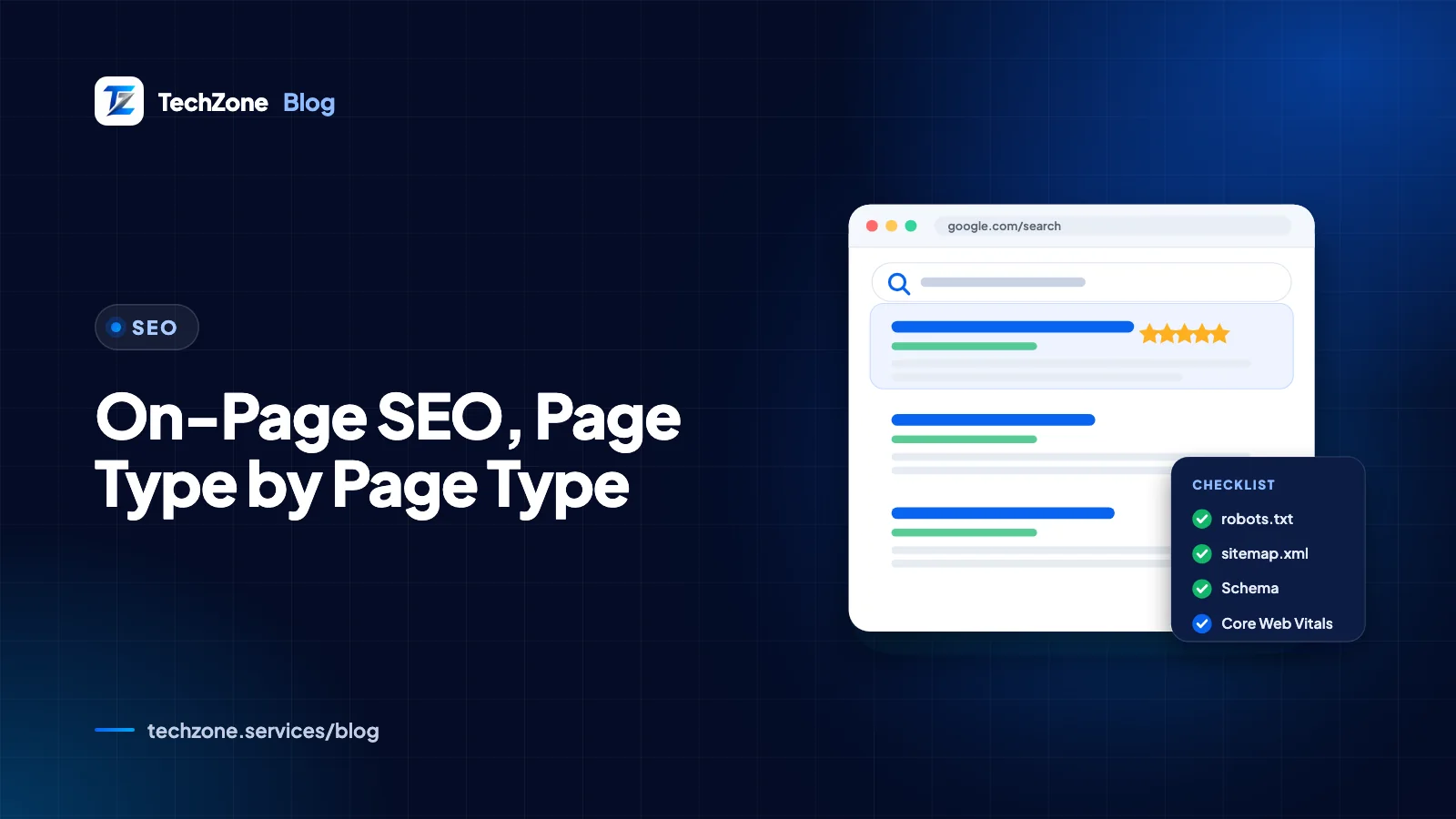
An on-page SEO checklist confirms that each page matches what searchers want and says so clearly: a specific title tag and meta description, one H1, a direct answer up front, descriptive headings, internal links, image alt text, accurate schema and visible proof of who stands behind the page. Service, location, blog and product pages each need extra checks.
Most checklists treat every URL the same, which is how service pages end up optimized like blog posts. This on-page SEO checklist for 2026 starts with a core that applies everywhere, then adds checks for each page type, title and meta description formulas with before-and-after examples, and the habits Google’s own documentation says you can drop.
It covers what’s on the page itself. Crawling, indexing, redirects and speed are site-wide technical issues, handled in our SEO audit checklist, and on-page work is one stage of a wider SEO plan for small businesses.
Key takeaways
- Match each page to the intent Google already rewards for its query before you touch the title tag.
- Google sets no length limit for titles or meta descriptions but truncates both to fit the screen, so front-load key words.
- Open every page with a direct answer or offer, then back it with visible proof: author, reviews, photos and contact details.
- Location pages need genuinely local content; near-identical city pages can fall under Google’s doorway abuse policy.
- Skip meta keywords, word-count targets and heading-order worries; Google’s SEO Starter Guide says none of them matter for ranking.
What does an on-page SEO checklist cover on every page?
Every page, whatever its type, should pass the same core checks before you add anything type-specific. Run each important URL through this table; the sections after it cover the parts people most often get wrong.
| Element | What good looks like | Common mistake |
|---|---|---|
| Search intent | Page type matches what already ranks for the target query | A blog post aimed at a query where Google shows service pages |
| Title tag | Unique and specific; main topic first, brand last | “Home”, or one title reused across many pages |
| Meta description | A unique one- or two-sentence pitch with specifics | Blank, duplicated, or a string of keywords |
| URL | Short, readable words separated by hyphens | /index.php?id=482 instead of words |
| H1 and headings | One clear H1; H2s that follow the reader’s questions | Several competing H1s, or headings used only for styling |
| Opening | The answer or offer in the first two or three sentences | Company history before the point |
| Internal links | Descriptive anchors to and from related pages | “Click here” links, or pages nothing links to |
| Images | Descriptive file names and alt text; compressed files | IMG_2041.jpg with empty alt text |
| Schema | Markup that matches the visible content | Plugin defaults nobody has checked |
| Trust signals | Who is behind the page, proof and contact details | No way to tell who wrote the page or stands behind it |
Match intent first. Search your target keyword, note whether the top results are service pages, guides, product listings or a local map, and build that page type. If you haven’t chosen the keyword yet, start with our guide to keyword research for small businesses. On a large site, fix the pages that bring leads or sales first; an SEO review of your key pages can rank the fixes for you.
How do you write a title tag and meta description that earn the click?
Give each page a unique title that names its main topic first and your brand last, and a meta description that pitches the page in one or two specific sentences. Google sets no length limit for either, but it truncates both to fit the device, so put the words that matter first.
Google builds the title link it shows from several sources, including the title element, the main visible heading and anchor text, so a title that contradicts your H1 invites a rewrite. Snippets come mainly from page content; Google uses your meta description when it describes the page better for that search. Write titles in the page’s own language and script too: Google may replace an English title on an Urdu page.
| Page type | Formula | Before | After |
|---|---|---|---|
| Service page | Service + location + differentiator | Brand | Services | Apex Plumbing | Emergency Plumber in Leeds, 24/7 Call-Outs | Apex Plumbing |
| Location page | Service in area | Brand | Lahore | BrightSmile Dental | Dental Implants in Gulberg, Lahore | BrightSmile Dental |
| Blog post | The question or outcome, stated plainly | Our Thoughts on Boilers | How Long Does a Combi Boiler Last? Signs It’s Time to Replace |
| Product page | Product + key attributes | Store | Product 1045 | Handwoven Jute Rug, 5×8 ft, Natural | Loom and Leaf |
| Category page | Category + qualifier | Store | Shop | Men’s Leather Sandals: Peshawari and Kolhapuri | Style Street |
A meta description formula
Use what the page offers + one specific detail or proof + the next step. Google recommends a unique description for each page and says descriptions that are just lists of keywords are less likely to be shown.
- Before: “Plumber, plumbers Leeds, emergency plumber, boiler repair, cheap plumber.”
- After: “Leak, burst pipe or no hot water? Apex Plumbing covers all of Leeds seven days a week and quotes a fixed call-out fee before arriving. Call or book online.”
- Blog posts: summarize the answer and who it’s for; Google notes that descriptions can carry byline details such as the author and date.
- Product pages: bring together the facts shoppers compare, such as material, size and delivery options.
How should the H1, headings and opening answer work together?
The H1 names the page’s topic in plain words, the first two or three sentences deliver the answer or offer, and H2s split the rest into the questions a reader asks next. That order serves skimming visitors first and search features second.
- One visible H1 that says what the page is, close to the title tag but written for someone already on the page. Google recommends making the main title the most prominent text, for example in the first visible H1.
- An answer-first opening. A service page names the service, the area and how to book; a blog post answers its headline question in a short paragraph before expanding.
- Question-style H2s where they fit naturally, each opening with a one- or two-sentence answer.
- Logical heading levels. Google says heading order doesn’t matter for ranking, but screen-reader users navigate by headings, so keep them in order.
What about AI Overviews and AI Mode?
Google says its AI features have no additional requirements and need no special optimization: a page must be indexed and eligible to show with a snippet, and normal SEO applies. Its guidance lists fundamentals such as keeping important content in text and making structured data match the visible text. An answer-first page with specific, first-hand detail is simply easier to quote accurately.
How do you show E-E-A-T on the page?
Make it obvious who is behind the page, why they’re qualified and how to reach them. Google says E-E-A-T (experience, expertise, authoritativeness and trustworthiness) isn’t a ranking factor on its own, but its systems look for signals of it, and trust matters most.
- Who: a byline on articles, linked to an author page with real background. Google strongly encourages accurate authorship information where readers expect it.
- Experience: original photos of your team and work, project details, and specifics only a practitioner would know.
- Proof: reviews, case studies, certifications and memberships you can document, placed near the claims they support.
- Contact details: business name, phone, address or service area, and hours that match your Google Business Profile.
- Transparency: prices or price ranges where possible, clear policies on store pages, and honest update dates on articles.
Google gives these signals even more weight on “Your Money or Your Life” topics that affect health, finances or safety. For clinics, law firms and financial advisers, treat this section as mandatory.
On-page SEO for service pages: what should each one include?
A service page exists to turn the right visitor into a call, message or booking. Target one service per page (in one location if you work locally) and answer the questions a buyer asks before getting in touch.
- Title and H1 name the service and the place: “Commercial Cleaning in Dubai Marina”, not “What We Do”.
- The first screen says what you do, who it’s for and where, with a visible call, WhatsApp or booking button.
- What’s included and excluded, the process step by step, and typical timelines.
- Pricing: a price, a “from” price, or the factors that set it, so visitors don’t leave to find out elsewhere.
- Proof beside the call to action: reviews, a relevant case study, certifications, and guarantees you actually offer.
- A short visible FAQ that handles objections. It still helps visitors, even though Google stopped showing FAQ rich results in May 2026.
- Internal links in from the home page, navigation and related posts, and links out to case studies and the contact page.
- LocalBusiness or Service markup that matches the page; our guide to schema markup for small businesses explains which types to use.
How do you optimize location pages without creating doorway pages?
Build a location page only where you have a branch or genuinely serve customers, and fill it with content about that place. Google’s spam policies treat pages aimed at specific cities that funnel visitors to one page, and substantially similar pages, as doorway abuse.
- Real local details: the branch address, phone and hours, or the specific areas you cover, matching your Google Business Profile.
- Local proof: projects in that area, reviews from local customers, photos of the team or premises.
- Local specifics: directions, parking, or local conditions and rules that affect the service.
- A unique title and H1 naming the service and the place, plus an embedded map for physical branches.
- Links from a locations hub page and from the relevant service pages.
Watch out
Don’t paste a block of city names into a footer or page to rank in each one: Google’s spam policies list blocks of text naming the cities and regions a page wants to rank for as keyword stuffing. Swapping only the city name across otherwise identical pages is the doorway pattern to avoid.
What extra checks do blog posts and product pages need?
Blog posts need clear authorship, honest dates and links to the pages that bring revenue. Product and category pages need unique descriptions, complete facts and crawlable links to every product.
Blog posts
- A byline linked to an author bio, and a visible published or updated date.
- The headline question answered in the opening paragraph, with the rest organized under descriptive H2s.
- Contextual links to the related service or product page, plus links from older posts to the new one.
- Article or BlogPosting markup that lists the same author and dates shown on the page.
- Updates that change the substance. Google’s helpful content guidance flags changing dates to look fresh when the content hasn’t substantially changed.
For the writing itself, from outline to publishing, follow our step-by-step blog post template.
Product pages
- A unique description written for buyers, not the manufacturer’s text copied across retailers.
- The facts shoppers compare, in text: price, sizes, materials, delivery and returns.
- Several original photos with descriptive file names and alt text.
- Product markup that matches the visible price and availability.
Category pages
- A short, useful introduction above the product grid, not a keyword block buried below it.
- Plain links to every product in the category. Google’s ecommerce navigation guidance warns that products reachable only through site search may not be found, because Googlebot generally doesn’t submit searches.
- A title and H1 that name the category the way shoppers search for it.
- Links to best sellers from the home page and other prominent pages; Google treats pages with more internal links as relatively more important.
Which on-page SEO habits can you drop?
Several staples of the typical on-page SEO checklist don’t matter to Google, according to its own SEO Starter Guide. Put that time into content and proof instead.
- Meta keywords: Google Search doesn’t use the keywords meta tag.
- Word-count targets: content length alone doesn’t matter for ranking. Cover the topic fully, then stop.
- Heading order and count: good for accessibility, irrelevant to how Google ranks the page.
- Keyword density: there’s no target percentage, and excessive repetition is keyword stuffing, which breaks Google’s spam policies.
- Keywords in the domain or URL: Google says they have hardly any effect beyond appearing in breadcrumbs. Readable URLs still help people.
How TechZone can help
TechZone’s SEO team can run this on-page SEO checklist across your key pages and hand you a fix list ordered by impact, or make the changes directly on WordPress, Elementor, Shopify and WooCommerce sites. That includes rewriting titles, meta descriptions and openings, adding proof and trust details, fixing internal links and setting up schema that matches each page. Many projects start with an SEO audit, so the first weeks go on the fixes that matter most. Our SEO services cover on-page work alongside local and technical SEO; to review a page together, book a free 30-minute call.
Frequently asked questions
What is the difference between on-page and off-page SEO?
On-page SEO covers everything you control on the page itself: content, title tag, meta description, headings, internal links, images and structured data. Off-page SEO covers signals from elsewhere, mainly links and mentions on other websites, reviews and your Google Business Profile. Technical SEO, the third part, makes sure search engines can crawl, render and index the site in the first place.
How long does it take for on-page SEO changes to show?
On-page SEO changes appear in Google only after the page is recrawled and reprocessed. Google says updates to the sources it uses for title links may take a few days to a few weeks to be noticed. Ranking changes depend on competition and the overall quality of the page, so compare the page’s Search Console data over the following months rather than days.
Should the title tag and H1 be the same?
The title tag and the H1 don’t have to be identical, but they should describe the same topic. The title tag is written for search results and browser tabs, so it can include the location and brand, while the H1 is written for visitors already on the page. If the two contradict each other, Google may choose other text from the page for its title link.
How many internal links should a page have?
Google says there is no magic number of internal links for a page, though if a page feels overloaded with links, it probably is. Every important page should be linked from at least one other page on the site, with descriptive anchor text. Service and product pages deserve links from the home page, the main navigation and related articles.
Do keywords belong in image alt text?
A keyword belongs in image alt text only when it genuinely describes what the image shows. Google uses alt text, along with computer vision and the page content, to understand images, and warns that stuffing alt attributes with keywords creates a poor experience and can look spammy. Describe the image for someone who can’t see it, such as “technician cleaning a split AC filter”.
Sources and further reading
- Influencing Title Links in Google Search – Google Search Central
- How to Write Meta Descriptions – Google Search Central
- SEO Starter Guide: The Basics – Google Search Central
- Creating Helpful, Reliable, People-First Content – Google Search Central
- Spam Policies for Google Web Search – Google Search Central
- AI Features and Your Website – Google Search Central