
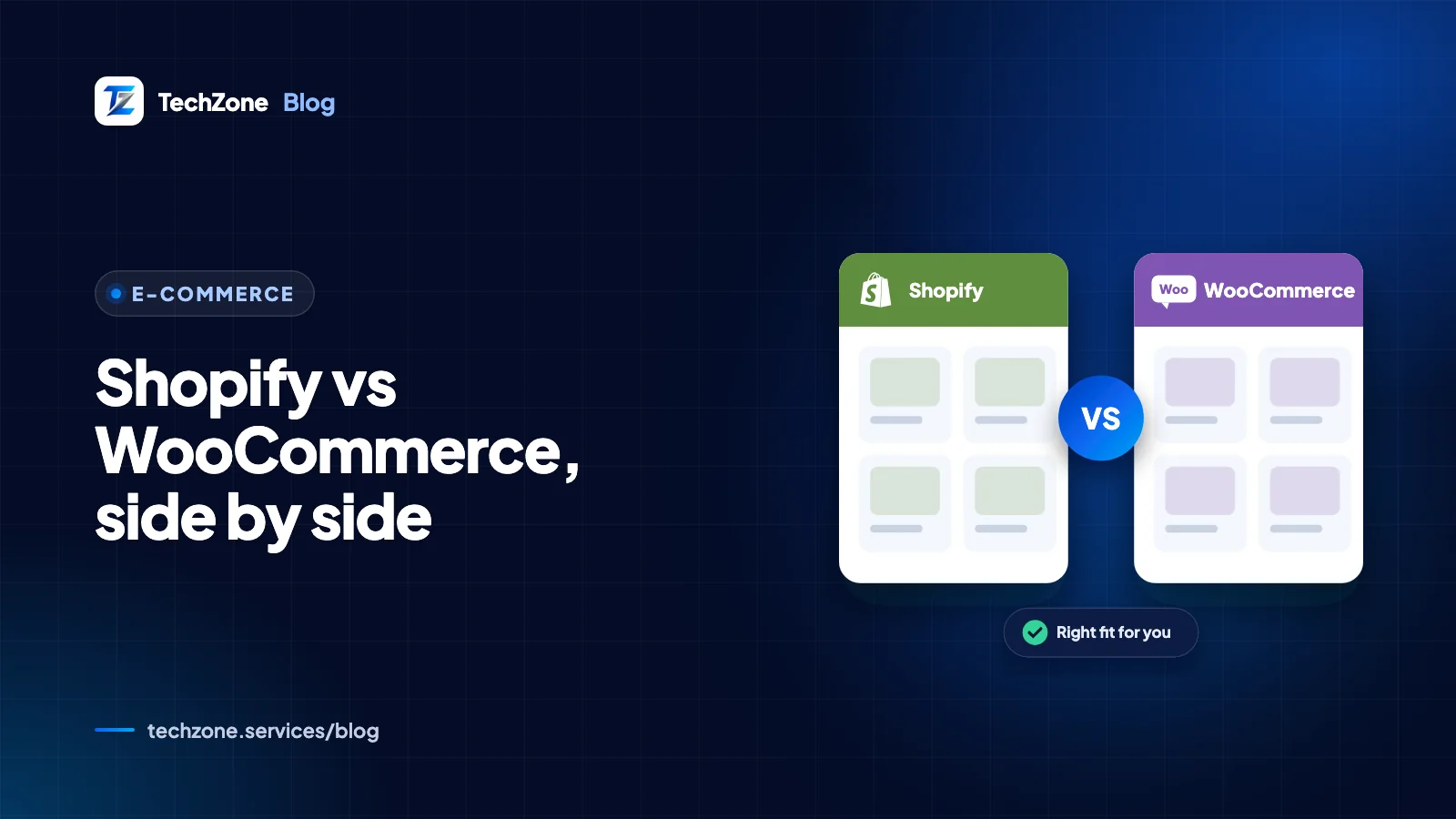
Choose Shopify if you want a hosted store that runs with little technical upkeep and Shopify Payments is available in your country. Choose WooCommerce if you want full ownership, deep customization and freedom to use any payment gateway, and you have someone to manage hosting, updates and security.
Both platforms run serious stores. The real difference is who is responsible for what: Shopify is a hosted software-as-a-service (SaaS) platform you subscribe to, while WooCommerce is a free, open-source plugin that turns a self-hosted WordPress site into a store you own and maintain.
This guide compares them on setup, total cost, payments, customization, SEO, scalability, maintenance, extensions and international selling, with notes for sellers in markets where Shopify Payments isn’t offered, such as Pakistan.
Key takeaways
- Shopify is hosted SaaS: quicker to launch and easier to maintain, with less control over code, checkout and URL structure.
- WooCommerce is a free WordPress plugin: full ownership and flexibility, but you handle hosting, updates, security and backups.
- Shopify charges a third-party transaction fee, set by your plan, when payments go through a provider other than Shopify Payments.
- As of 2026, Shopify Payments isn’t offered in Pakistan, so Pakistan-based Shopify stores rely on third-party providers or manual methods like COD.
- Compare total cost over two to three years, including apps, extensions, hosting and developer time, not just the monthly price.
What is the main difference between Shopify and WooCommerce?
Shopify is a hosted platform you pay for monthly; WooCommerce is free software you install on your own WordPress site. That one difference decides who handles hosting, security and updates, and how your costs are structured.
With Shopify, you sign up, choose a theme, add products and connect payments. Shopify runs the servers, the checkout and platform updates, and you add features with apps from the Shopify App Store. Themes are built with Shopify’s Liquid template language.
With WooCommerce, you need a domain, hosting and a WordPress installation before adding the plugin, then a theme, payment gateways, shipping and tax settings. Setup takes more effort, but the code is open source and runs on a server you control, so almost anything can be changed.
In practice, a simple Shopify store can go live without anyone touching a server. A WooCommerce store needs someone comfortable with hosting, WordPress and plugin configuration.
How do Shopify and WooCommerce compare side by side?
Shopify trades control for convenience; WooCommerce trades convenience for control. The table summarizes the differences that matter most.
| Factor | Shopify | WooCommerce |
|---|---|---|
| Platform type | Hosted SaaS on a subscription | Free, open-source WordPress plugin on your own hosting |
| Setup effort | Low: no hosting or installation | Moderate: hosting, WordPress, plugin, theme and configuration |
| Cost structure | Plan subscription, paid apps, optional premium theme, payment fees | Hosting and domain, paid extensions and themes, payment fees, maintenance time |
| Payments | Shopify Payments where available; third-party providers add a Shopify transaction fee set by your plan | Any supported gateway; WooCommerce takes no revenue share |
| Customization | Themes (Liquid) and apps; deeper checkout customization reserved for Shopify Plus | Full access to code, database and checkout |
| Ownership | Store data is exportable; theme and apps stay on Shopify | You own the code, the data and the choice of host |
| SEO control | Solid defaults: automatic sitemap, editable robots.txt.liquid, fixed URL paths | Full control through WordPress permalinks, templates and SEO plugins |
| Scalability | Shopify manages infrastructure; Shopify Plus for high volume | Scales with your hosting, caching and database setup |
| Maintenance and security | Platform handled by Shopify; you manage apps, staff accounts and settings | You handle WordPress, plugin and theme updates, backups and security |
| Apps and extensions | Shopify App Store; many apps bill monthly | WooCommerce Marketplace and WordPress.org plugin directory |
| Multi-currency | Built-in local-currency pricing; full features need Shopify Payments | One base currency; multi-currency needs an extension |
Which is cheaper, Shopify or WooCommerce?
Neither is automatically cheaper. Shopify bundles hosting and software into a predictable subscription, while WooCommerce’s software is free but you pay separately for hosting, extensions and the time to maintain it. Compare total cost over two to three years, not the headline price.
What you pay for on Shopify
- A monthly or annual plan. Check Shopify’s official pricing page (listed in the sources below) for current rates and what each plan includes.
- Paid apps for features your plan doesn’t cover, such as product reviews, bundles or advanced search.
- A premium theme, if a free theme doesn’t fit your brand.
- Payment processing fees, plus third-party transaction fees if you don’t use Shopify Payments.
What you pay for on WooCommerce
- Hosting and a domain. WooCommerce’s official pricing page outlines the typical cost areas; hosting costs rise with traffic and performance needs.
- Paid extensions and themes, typically billed as yearly subscriptions.
- Payment processing fees from your gateway; WooCommerce itself takes no revenue share.
- Developer or agency time for updates, backups, security and fixes, which is the cost easiest to underestimate.
Apps and extensions are where both budgets creep. Each one can also slow your storefront, which hurts conversions in a less visible way; our article on Core Web Vitals explains the link between speed and revenue.
How do payments, fees and multi-currency selling work?
On Shopify, payments work best with Shopify Payments, which is only available in certain countries. WooCommerce works with any supported gateway and adds no platform fee, but selling in several currencies needs an extension.
Shopify Payments and third-party transaction fees
Shopify Payments is Shopify’s built-in payment processor. As of 2026 it is available in markets including the United States, United Kingdom, Canada, Australia and the United Arab Emirates, but not Pakistan. Check Shopify’s supported-countries list against your business location before you decide.
If you accept payments through a third-party provider instead, Shopify charges a third-party transaction fee, at a rate that depends on your plan, on top of the provider’s own processing fees. Shopify’s Help Center states that manual payment methods, such as cash on delivery (COD) and bank deposits, don’t incur this fee.
For sellers in Pakistan
Because Shopify Payments isn’t offered in Pakistan, a Pakistan-based Shopify store relies on third-party providers or manual methods such as COD. Payments through a third-party provider carry Shopify’s transaction fee plus the provider’s fee, and Shopify’s full local-currency features require Shopify Payments. WooCommerce lets you connect any gateway that offers a WooCommerce plugin with no platform fee. Either way, confirm which providers work with your bank before you commit.
Selling in multiple currencies
Shopify’s international sales tools let you create markets for specific countries or regions, each with local currency, language and domain settings. According to Shopify’s documentation, only stores using Shopify Payments can use every part of its local-currency pricing.
WooCommerce supports one base currency per store. To show prices and take orders in other currencies, you add an extension, such as the multi-currency feature in WooPayments (offered only in WooPayments’ supported countries) or a third-party currency plugin, plus a translation plugin such as WPML or Polylang for other languages.
Selling from Pakistan? Our step-by-step guides cover starting a Shopify store in Pakistan and setting up WooCommerce in Pakistan, including cash on delivery.
Which platform gives you more control over design, data and SEO?
WooCommerce gives you more control over everything, because you own the code and the server. Shopify gives most stores enough control, within limits Shopify sets.
Customization and ownership
Shopify themes can be customized heavily in Liquid and apps add features, but you can’t change the platform itself. Checkout UI extensions on the information, shipping and payment steps are available only on Shopify Plus. You can export products, customers and orders as CSV files, but your theme and apps don’t move with you.
WooCommerce is open source, so a developer can change templates, checkout flow, pricing logic or integrations directly, and you can move the whole site to another host. That freedom suits complex catalogs, B2B pricing and custom integrations, which is where an experienced web development team makes the difference.
SEO control
Both platforms can rank well; the difference is how much you can tune. Shopify generates a sitemap.xml automatically, lets you edit titles, meta descriptions, URL handles and image alt text, and allows robots.txt changes through a robots.txt.liquid template. Its URL paths are fixed, though, with products under /products/ and collections under /collections/.
WooCommerce inherits WordPress’s flexibility: custom permalinks, full control over templates and structured data, SEO plugins such as Yoast SEO or Rank Math, and strong blogging tools for content-led SEO. The trade-off is that speed depends on your hosting and plugin choices. Our technical SEO checklist applies to either platform.
Which is easier to maintain, secure and scale?
Shopify is easier, because hosting, security patches and scaling are part of the subscription. WooCommerce can run large stores too, but only with good hosting and someone clearly responsible for keeping it updated.
Maintenance and security
On Shopify, your job is managing staff accounts, apps and settings. On WooCommerce, you or your developer must keep WordPress core, WooCommerce, the theme and every plugin updated, run backups, and keep PHP and the database current. As of 2026, WooCommerce’s documentation recommends PHP 8.3 or newer, MySQL 8.0 or newer (or MariaDB 10.6 or newer), HTTPS and at least 256 MB of memory for WordPress.
Scalability
Shopify absorbs traffic spikes on its own infrastructure, and Shopify Plus adds features for high-volume and multi-store businesses. A WooCommerce store scales with its hosting setup: managed WooCommerce hosting, object caching, a CDN and a tuned database. High-Performance Order Storage (HPOS), enabled by default for new stores since WooCommerce 8.2, keeps orders in dedicated database tables to reduce load on busy stores.
Apps and extensions
The Shopify App Store, the WooCommerce Marketplace and the WordPress.org plugin directory cover most needs, from reviews to subscriptions. On either platform, check each add-on’s support, update history and performance impact, and remove what you don’t use. If you also sell on Amazon, plan inventory and order sync between your store and the marketplace early; Amazon and e-commerce integrations are easier to get right before launch than after.
Should you choose Shopify or WooCommerce?
Choose Shopify for speed and low upkeep; choose WooCommerce for control and flexibility. Use these lists to see which description fits your business.
Choose Shopify if…
- You want to launch quickly without managing hosting, updates or security.
- Shopify Payments is available in your country, so you can avoid third-party transaction fees.
- Your team is non-technical and wants to run the store day to day without a developer.
- Your products and processes fit what themes and existing apps already do.
- You expect traffic spikes from sales or campaigns and want the platform to handle them.
Choose WooCommerce if…
- You already run a WordPress site or rely on content marketing and blogging.
- You need custom checkout logic, complex products, B2B pricing or deep integrations.
- You want full ownership of your code and data, and freedom to change hosts.
- You sell from a market where Shopify Payments isn’t available, such as Pakistan, and want local gateways without a platform fee.
- You have a developer or agency lined up for updates, security and backups.
Chosen Shopify? Start with our Shopify store setup checklist. Already on WooCommerce and thinking of moving? See how to handle a WooCommerce to Shopify migration without losing your rankings.
How TechZone can help
TechZone builds and customizes both Shopify and WooCommerce stores, so our recommendation starts from your products, target countries, payment options and team, not from a platform preference. For Shopify builds, theme customization and app setup, see our Shopify development service; WooCommerce stores are built by our WordPress web development team. If you also sell on marketplaces, our Amazon and e-commerce services can connect the two. Contact us with your catalog size, target markets and payment needs, and we’ll recommend the platform that fits.
Frequently asked questions
Can I move my store from WooCommerce to Shopify, or back, later?
Moving a store between WooCommerce and Shopify is possible in either direction. Products, customers and order history can be moved with CSV files or migration apps, but themes, extensions and custom code must be rebuilt on the new platform. Set up 301 redirects from old URLs to new ones to help preserve search rankings and bookmarks, and test checkout thoroughly before switching domains.
Do I need a developer to run a Shopify or WooCommerce store?
Day-to-day work such as adding products, processing orders and running discounts can be done without a developer on both Shopify and WooCommerce. A Shopify store mainly needs a developer for custom theme work, custom apps or integrations. A WooCommerce store usually needs technical help more often, because hosting, updates, plugin conflicts, backups and security are the store owner’s responsibility.
Can I keep my WordPress website and use Shopify for the store?
A WordPress website can be combined with Shopify. One option is Shopify’s Buy Button sales channel, which embeds products and a checkout on an external site such as a WordPress blog. Another is running the full Shopify store on a subdomain and linking to it. The trade-off is two platforms to maintain, two sets of logins and a less unified site structure.
Which platform is better for selling digital products or subscriptions?
Both Shopify and WooCommerce can sell digital products and subscriptions. WooCommerce supports downloadable products in its core plugin and offers subscriptions through extensions such as WooCommerce Subscriptions. Shopify handles both through apps, including Shopify’s own Digital Products and Subscriptions apps. For complex memberships, licensing or usage-based billing, WooCommerce’s open code usually gives more room to customize.
Is Shopify or WooCommerce more secure?
Shopify and WooCommerce can both run secure stores, but responsibility differs. Shopify secures its hosting, platform and checkout, so merchants mainly protect staff accounts and vet the apps they install. WooCommerce security depends on the store owner: prompt updates to WordPress, WooCommerce, themes and plugins, reputable hosting, HTTPS, two-factor authentication for admin accounts and regular off-site backups.
Sources and further reading
- Shopify Pricing: Find the Right Plan for Your Business — Shopify
- WooCommerce Pricing Puts You In Control — WooCommerce
- Supported countries for Shopify Payments — Shopify Help Center
- Third-party transaction fees on your Shopify bills — Shopify Help Center
- Pricing in local currencies — Shopify Help Center
- Server Recommendations — WooCommerce Documentation