
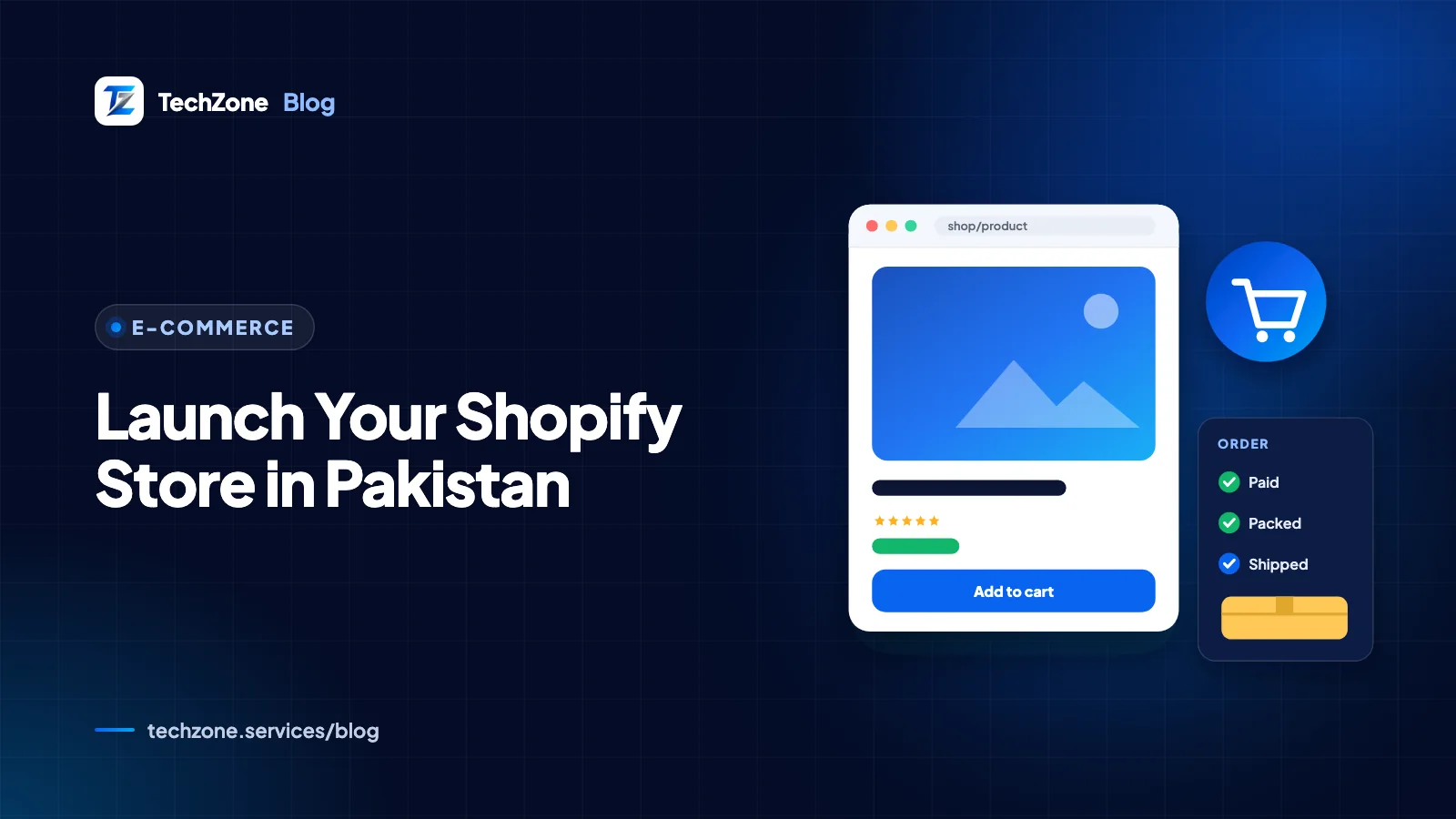
To start a Shopify store in Pakistan, pay for your plan with a Visa, Mastercard or Amex card enabled for international payments, set your store currency to PKR, connect a .pk or .com domain, turn on cash on delivery as a manual payment method, add a card gateway from Shopify’s provider list, and connect a courier app.
Shopify Payments isn’t available in Pakistan, so payments are where most local guides go vague. This one shows what to switch on, where to find it in the admin, and which choices carry Shopify fees.
Still choosing a platform? Read Shopify vs WooCommerce first. If you pick WooCommerce, our guide to WooCommerce in Pakistan covers that setup.
Key takeaways
- Shopify bills Pakistani stores in US dollars and doesn’t accept prepaid or virtual cards, so use a bank card enabled for international online payments.
- Shopify Payments isn’t available in Pakistan: you accept cards through a third-party provider and cash through manual payment methods.
- Shopify charges no third-party transaction fee on manual payments such as cash on delivery or bank transfer.
- Make the shipping phone number required at checkout, because couriers and COD order confirmation both depend on it.
- Orders paid through third-party gateways are processed in your store currency, so buyers abroad pay in PKR.
What do you need before you start a Shopify store in Pakistan?
You need a card Shopify will accept, a brand name and domain, product photos and PKR prices, and accounts with at least one courier and one payment provider. Gather these first; the store setup itself goes quickly once they’re ready.
| Item | Why you need it | Notes |
|---|---|---|
| Visa, Mastercard or Amex card with international payments on | Pays your Shopify subscription and any paid apps | Prepaid and virtual cards aren’t accepted |
| Business email and mobile number | Account login, order notifications and customer contact | Use an address on your own domain once it’s connected |
| Brand name and domain | Your store’s address and identity | .pk, .com.pk or .com; see the domain section below |
| Product photos, descriptions and PKR prices | Your catalog | Include weights, because couriers charge by weight |
| Courier account | Booking, delivery and COD cash collection | Sign up with the courier before installing its app |
| Payment provider account | Card payments at checkout | Providers ask for identity and business documents; requirements vary |
| Business registration and tax advice | Opening merchant accounts and staying compliant | Ask an accountant about registration with FBR and SECP for your business type |
How do you pay for a Shopify plan from Pakistan?
Pay with a Visa, Mastercard, American Express, Diners Club or Discover credit card, or a co-branded debit card with international capabilities that’s set up for recurring payments. Shopify doesn’t accept prepaid or virtual credit cards, and bills Pakistani stores in US dollars, because PKR isn’t one of its local billing currencies.
- Ask your bank to enable international online and recurring transactions on the card before you pick a plan.
- Add or change the card in Settings > Billing.
- Budget for the exchange rate and any bank charges on foreign-currency payments, since the bill arrives in USD.
- Check current plan prices on Shopify’s pricing page for Pakistan rather than relying on figures in older guides.
Plan choice matters more than the headline price if you’ll take card payments through a third-party gateway. Shopify charges a third-party transaction fee on those orders, and the rate depends on your plan. Cash on delivery and bank deposits are exempt.
Should you use a .pk domain or a .com?
Use a .pk or .com.pk domain if you sell only in Pakistan and want a local signal, and a .com if you plan to sell abroad or want one address everywhere. You can also register both and redirect one to the other.
| Option | Best for | Where to buy | Rules and costs |
|---|---|---|---|
| .pk | Short, local brand names | PKNIC or an authorized PKNIC reseller | At least four characters before .pk; Rs 2,100 per year for Pakistan-based registrants, billed two years at a time |
| .com.pk | Businesses and individuals selling in Pakistan | PKNIC or an authorized PKNIC reseller | PKNIC lists it for general business or individual use; same fee |
| .com | Selling in Pakistan and abroad | Any domain registrar | Price varies by registrar |
Prices are from PKNIC as of September 2026. To connect a domain bought outside Shopify, go to Settings > Domains, click Connect existing domain and add the DNS records Shopify shows at your registrar or reseller. PKNIC doesn’t allow a registered domain name to be changed later, so check spelling before you pay.
How to set up a Shopify store in Pakistan in PKR
Set your currency, checkout fields and policies before you add a single product. The currency is the setting you most want right from day one, because Shopify warns about risks if you change it after your first order.
- Currency: go to Settings > General, and under Store defaults > Currency display, choose Change store currency and select Pakistani rupee (PKR).
- Store details: in the same page, enter your business address in Pakistan, your time zone and your weight unit, so shipping rates and order times are correct.
- Checkout fields: in Settings > Checkout, set the customer contact method to Phone number or email and the shipping address phone number to Required.
- Policies: write refund, exchange and shipping policies in plain language and link them in your footer.
- Theme and products: add products with weights and clear photos, then choose a theme that suits your catalog.
Our Shopify store setup checklist lists every step before launch, from legal pages to test orders.
Which Shopify payment gateway options work in Pakistan?
Because Shopify Payments isn’t offered in Pakistan, you combine a third-party card provider with manual methods such as cash on delivery and bank transfer. Shopify’s payment gateways page lets you filter providers by country, and your admin shows the providers available to your store.
| Option | How it works in Shopify | Shopify transaction fee | Best for |
|---|---|---|---|
| Card payments through a third-party provider | Activated in Settings > Payments with your provider account details | Yes, rate depends on your plan | Buyers who prefer to pay upfront by card |
| Cash on delivery (COD) | Manual payment method; the order stays unpaid until you mark it paid | No | First-time buyers who don’t want to pay upfront |
| Bank transfer | Manual payment method with your account details in the payment instructions | No | Repeat customers and larger orders |
| Mobile wallet transfer (for example JazzCash or Easypaisa) | A custom manual payment method with your wallet account details | No | Buyers who want to pay upfront without a card |
How to add a card payment provider
Go to Settings > Payments. If Shopify Payments isn’t available in your country, click Choose a provider in the Payment providers section, select the provider, enter your account credentials, click Activate and save. Before you sign up, confirm the provider onboards businesses registered in Pakistan; some list Pakistan as a place buyers can pay from but don’t accept Pakistani merchants. Also compare the provider’s own fees, settlement times and refund process.
Selling to customers outside Pakistan
Local-currency pricing on Shopify works only with Shopify Payments or Adyen. With other third-party providers, orders are processed in your store’s default currency, so a buyer in Dubai or London pays in PKR and their bank converts it. If international sales become a real share of revenue, talk to your provider, bank and accountant about cross-border card acceptance, payouts and shipping before you market abroad.
How do you set up cash on delivery on Shopify?
Cash on delivery is a manual payment method you switch on in your payment settings. It takes a few minutes, and Shopify doesn’t charge third-party transaction fees on manual payments.
- Go to Settings > Payments.
- In the Payment providers section, select Cash on Delivery (COD) from the manual payment methods.
- In Additional details, write what shows next to the option at checkout, for example: “Pay in cash when your parcel arrives. Delivery in 3 to 5 working days.”
- In Payment instructions, write what customers see after ordering, for example: “We’ll call or WhatsApp you to confirm your order before dispatch.”
- Activate the method. COD orders appear as unpaid; mark each one as paid on the order page once the courier remits the cash.
The delivery time in the example is a placeholder: use the times your courier actually achieves. COD brings one big cost, parcels refused at the door and returned to you. Confirming orders before dispatch helps, and our guide to reducing RTO on COD orders in Pakistan covers the full playbook.
How do you ship orders with Pakistani couriers?
Set your delivery rates in Shopify, open a merchant account with a courier, then install an app that books shipments from your Shopify orders. The app saves you retyping addresses and sends tracking numbers back to each order.
- Rates: in Settings > Shipping and delivery, create a Pakistan shipping zone with flat or weight-based rates, and a free-shipping threshold if your margins allow it.
- Single-courier apps: the Shopify App Store has booking apps for couriers including PostEx, TCS and Leopards. Check who built each app: the PostEx app is published by PostEx, while the TCS Courier Pakistan app is made by a third-party developer.
- Multi-courier apps: apps such as Universal Courier Pakistan and Courierify book with several couriers from one screen, which helps if you split orders by city or price.
- What to test: bulk booking, label printing, loadsheets, automatic tracking updates and a report that matches COD cash received against orders.
Pakistan note
If your buyers message you on WhatsApp before and after they order, make that easy: put your WhatsApp number on product pages and in the footer, and use it for order confirmation and delivery updates. Our WhatsApp marketing guide covers doing this within WhatsApp’s rules.
How do you build trust with Pakistani shoppers?
Show buyers they can reach a real business and won’t lose money if something goes wrong. A new store has no reputation yet, so every page has to answer the question “is this legitimate?”
- Offer cash on delivery, and say so on product pages, not only at checkout.
- State delivery times and charges by city, and the courier you use.
- Publish a clear exchange and return policy, including who pays return delivery.
- Show a phone number, WhatsApp link and business address or city.
- Use your own product photos and short videos rather than supplier images.
- Collect reviews from real buyers after delivery, and reply to questions quickly.
How TechZone can help
TechZone is based in Islamabad and sets up Shopify stores for Pakistani brands, including the Shopify store for makeup brand Radiance MD by DSK in our portfolio. Our Shopify store development services cover theme setup, PKR and checkout settings, payment provider and COD setup, courier app integration and launch testing. We agree scope, timeline and cost in a written proposal before starting. Book a free 30-minute consultation or message us on WhatsApp at +92 371 7767407.
Frequently asked questions
Is Shopify available in Pakistan?
Shopify is available to sellers in Pakistan: you can open a store, pay the subscription with an accepted international card and sell to Pakistani customers. The main difference from countries like the UK or UAE is that Shopify Payments isn’t offered in Pakistan, so card payments go through a third-party provider and cash on delivery is set up as a manual payment method.
Can I use JazzCash or Easypaisa on my Shopify store?
You can accept JazzCash or Easypaisa transfers on a Shopify store by creating a custom manual payment method with your wallet account details and instructions, then marking each order paid when the money arrives. Automatic wallet payments at checkout depend on whether a payment provider available to your store supports them, so ask providers directly before you sign up.
Do I need a registered company to start a Shopify store in Pakistan?
The documents you need to start a Shopify store in Pakistan depend less on Shopify than on your payment provider and courier, which usually ask for identity and business documents before opening merchant accounts. Tax obligations depend on your business type and turnover, so speak to an accountant about registration with FBR, and with SECP if you form a company, before you scale.
How much does it cost to start a Shopify store in Pakistan?
The cost of a Shopify store in Pakistan is the monthly plan billed in US dollars, a domain, any paid theme or apps, and payment and courier charges per order. Check Shopify’s pricing page for Pakistan for current plan prices, PKNIC for .pk domain fees, and your courier’s rate card, then add a budget for product photos.
Can I dropship from Pakistan with Shopify?
Dropshipping from Pakistan with Shopify is possible, either with local suppliers who ship COD orders for you or with international suppliers through dropshipping apps. The same payment limits apply, since Shopify Payments isn’t available in Pakistan. Check delivery times and return handling carefully, because long waits and unclear returns can lead to more refused COD parcels.
Sources and further reading
- Supported countries for Shopify Payments – Shopify Help Center
- Manual payment methods – Shopify Help Center
- Available payment methods for your Shopify bills – Shopify Help Center
- Paying Shopify bills in your local currency – Shopify Help Center
- Guidelines and restrictions for selling in local currencies – Shopify Help Center
- Domain structure – PKNIC