
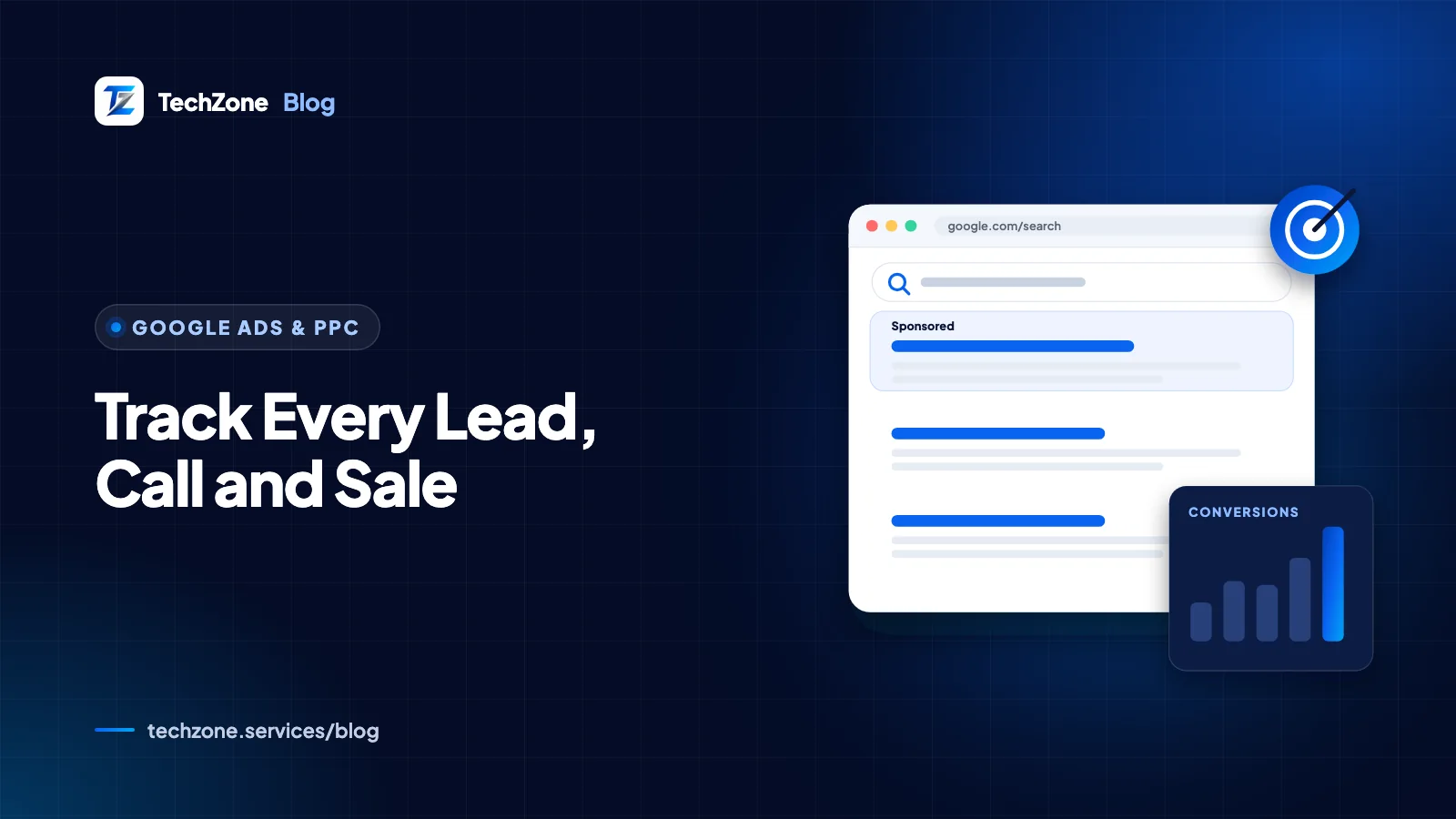
Google Ads conversion tracking records the actions people take after clicking your ad, such as submitting a form, calling you, opening a WhatsApp chat or buying. To set it up, create a conversion action under Goals, track it with the Google tag, Google Tag Manager or an imported GA4 key event, then test it before you trust the numbers.
It matters because conversion-based bid strategies optimize toward whatever you mark as a conversion. A form counted twice, or a page view counted as a sale, teaches Google to find more of the wrong people. Google even labels a bid strategy Misconfigured when the right conversions aren’t set up.
Key takeaways
- Mark only revenue-linked actions as primary conversions: qualified leads, calls, WhatsApp clicks and purchases. Keep everything else secondary for reporting.
- Use one tracking path per action: the Google tag, Google Tag Manager or a GA4 import. Two primary versions of one action double-count.
- Google forwarding numbers aren’t available in Pakistan or the UAE, so track tap-to-call clicks there or import calls from a call-tracking system.
- For visitors in the EEA, Google requires consent mode signals (ad_user_data and ad_personalization) to keep conversion measurement and remarketing working.
- Test every new conversion action with Tag Assistant, then watch its status: Active, Needs attention, Misconfigured, Awaiting conversions or Removed.
What should you track as a Google Ads conversion?
Track the actions that lead to revenue, and decide up front which ones Google should bid toward. Google splits conversion actions into primary actions, which appear in the Conversions column and drive bidding, and secondary actions, which appear only in All conversions for reporting.
| Business type | Primary conversions | Secondary (observe only) | Count |
|---|---|---|---|
| Lead generation in the UK, US, Canada or Australia | Lead form submitted, calls from ads | Email link clicks, brochure downloads | One |
| Lead generation in Pakistan or the UAE | Lead form submitted, WhatsApp chat clicks, tap-to-call clicks | Directions clicks, price list views | One |
| Online store (Shopify, WooCommerce) | Purchase, with the order value | Add to cart, begin checkout | Every |
Google recommends counting Every conversion for sales, because each sale adds value, and One for leads, because a second form from the same person after the same click rarely means a second customer. Add a value wherever you can: the real order value for sales, or an estimated value per lead based on your close rate.
Leave micro-actions such as scroll depth, time on page or contact page visits out of your primary goals. Bidding toward them finds people who scroll, not people who buy.
How do you set up Google Ads conversion tracking?
Create a conversion action in Google Ads, then choose how its tag fires. The flow starts at Goals → Summary → + Create conversion action.
- Choose Conversions on a website, enter your domain and select Scan to detect any existing Google tag or Analytics property.
- Pick the category that matches the action, such as Submit lead form, Contact or Purchase.
- Choose how to track it: a Google tag event (Automatically without code for thank-you page URLs, or Manually using code for button clicks and dynamic values), Google Tag Manager, or an existing Google Analytics event.
- Set the value, the count (Every or One), the click-through conversion window (30 days by default) and attribution, then save and install the tag.
| Method | Best for | Watch out for |
|---|---|---|
| Google tag (gtag.js) | Simple sites; thank-you page conversions need no extra code with a URL rule | Click tracking needs an event snippet and an onclick call on each button |
| Google Tag Manager | Several tags, button and WhatsApp clicks, forms that don’t change the URL | The container also needs the Google tag and a Conversion Linker tag |
| GA4 key event import | Actions you already measure well in GA4 | Imported actions start as secondary, and data can take up to 24 hours to arrive |
Using Google Tag Manager
Add a Google Ads Conversion Tracking tag with the Conversion ID and Conversion Label from your conversion action, then attach a trigger: a thank-you page view, a form submission or a link click. If you leave the value field empty, Tag Manager sends a value of 0, so map order values from the data layer on stores.
Importing GA4 key events
Mark the event as a key event in GA4 (Admin → Data display → Events), link GA4 to Google Ads, and keep auto-tagging on in Google Ads (Admin → Account settings → Auto-tagging). Then select the event when creating the conversion action, and set it to primary if you’ll bid on it. New to GA4? Start with our GA4 setup guide for beginners.
How do you track phone calls and WhatsApp clicks?
Google offers five ways to count calls, and the right one depends on your country. The two most complete need Google forwarding numbers, available in a limited list of countries that includes the US, the UK, Canada and Australia, but not Pakistan or the UAE.
| Method | What counts as a conversion | Needs a Google forwarding number? |
|---|---|---|
| Calls from ads | Calls from call assets that last at least the minimum length you set | Yes |
| Calls to a number on your website | Calls to a forwarding number shown to ad visitors on your site | Yes |
| Clicks on your number on a mobile site | Taps on a phone link; Google sees the tap, not the call | No |
| Clicks on call ads and assets | Clicks that Google estimates led to a meaningful call | No |
| Imported calls | Calls you qualify in a call-tracking tool or CRM, with values | No |
To create one, start the usual flow, choose Conversions from phone calls and the Phone call lead category. Call reporting, which assigns forwarding numbers, is switched on under Account settings.
Pakistan and UAE note
Because Google forwarding numbers aren’t offered in Pakistan or the UAE, count taps on your tel: links and clicks on call assets instead. If phone sales matter, log qualified calls in a call-tracking tool or CRM and import them.
Tracking WhatsApp clicks
WhatsApp click-to-chat links use https://wa.me/ followed by your full number in international format. In Google Tag Manager, enable the built-in Click URL variable, create a Click – Just Links trigger where Click URL contains wa.me (and any other WhatsApp link format your site uses), and fire your Google Ads conversion tag on it.
Count WhatsApp clicks as One, and remember they measure intent to chat, not a confirmed lead. Script-based WhatsApp widgets need a trigger on the button element instead. For turning chats into sales, see our WhatsApp marketing guide for Pakistan and UAE businesses.
How do you track form leads on a WordPress site?
The most reliable method is to send people to a dedicated thank-you page after a successful submission and count views of that URL. Most WordPress form plugins let you set a redirect or confirmation page in the form’s settings.
- Thank-you page redirect (best): use the Automatically without code option with a rule such as URL contains /thank-you/. Keep the page out of menus and your sitemap so casual visitors don’t trigger it.
- Forms that show an on-page message: no new URL loads, so fire the conversion from Google Tag Manager on the plugin’s submission event, or with an Element Visibility trigger on the success message.
- Site Kit by Google: its plugin conversion tracking, under Site Kit → Settings → Connected Services → Ads or Analytics → Edit, records actions from supported plugins such as Contact Form 7, WPForms, Ninja Forms, Mailchimp and WooCommerce.
Whichever method you use, submit a real test form and check that exactly one conversion fires. Failed validation, spam filters and page reloads are the usual culprits.
What are Google Ads enhanced conversions, and do you need consent mode?
Enhanced conversions add first-party data, such as the email or phone number a customer typed into your form or checkout, to your conversion tags. The data is hashed with SHA256 and matched to Google accounts to improve measurement accuracy. Consent mode, which passes visitors’ cookie choices to Google tags, is required for EEA traffic.
- Turning it on: in June 2026 Google combined enhanced conversions for web and for leads into one on/off switch under Goals → Settings. New users must agree to the customer data terms; existing users who had accepted them were migrated automatically.
- Enhanced conversions for leads: captures hashed contact details on your lead form, then matches them when you upload qualified or closed leads from your CRM through Data Manager, the Google Ads API or Zapier. Include the GCLID whenever you have it.
Consent mode for UK and EEA traffic
Google’s EU user consent policy covers visitors in the EEA, the UK and Switzerland: you need valid consent for cookies where the law requires it and for using personal data to personalize ads. For EEA traffic, Google also requires consent mode signals, ad_user_data and ad_personalization, to keep using measurement, ad personalization and remarketing features.
The simplest route is a Google-certified consent management platform (CMP), which sends the signals for you. Basic consent mode blocks Google tags until the visitor chooses. Advanced mode loads them straight away and sends cookieless pings when consent is denied, which supports more detailed conversion modeling.
How do you track conversions on Shopify and WooCommerce?
Use the platform’s official Google integration for purchases, and add custom tracking only for what it doesn’t cover.
- Shopify: connect Google Ads through the Google & YouTube sales channel, which Shopify says provides conversion measurement for your ads. Skip the old Additional scripts box: Shopify’s deadline to replace Thank you and Order status page customizations was August 26, 2026, and remaining stores were upgraded automatically. Extra tracking belongs in a pixel under Settings → Customer events.
- WooCommerce: the Google for WooCommerce plugin adds Google tagging and conversion tracking for purchases. If Tag Manager or another plugin also sends purchases, keep only one, and pass the order number as
transaction_idso Google ignores duplicates when a customer reloads the order page.
If most of your orders are cash on delivery, compare Google Ads purchases with delivered orders every month. The purchase tag fires when the order is placed, not when the parcel is accepted, so refused COD orders still show up as conversions.
How do you test Google Ads conversion tracking?
Test with a real conversion, not just by checking that the tag is present. Tag Assistant is built into the Google Ads conversions table.
- Go to Goals → Summary, find the action in the table and hover over its tracking status.
- Select Troubleshoot, then Continue to open Tag Assistant in a new window.
- Enter your website URL, connect, and complete the action yourself: submit the form, tap the number or place a test order.
- Select Finish. Tag Assistant reports what fired, and verified actions update in Google Ads after about 30 minutes.
For Tag Manager setups, run Preview mode first and confirm the conversion tag fires once, on the right trigger, with the right value. Cancel test orders afterward so they don’t inflate revenue. Tracking checks like these are part of our Google Ads management service.
Why is Google Ads conversion tracking not working?
Check the action’s status first, then the usual setup errors. In mid-2026 Google replaced older labels such as Inactive and No recent conversions with Misconfigured, Awaiting conversions and Removed, so older forum answers may use different names.
| Status | What it means | What to do |
|---|---|---|
| Active | Everything is working as intended | Spot-check it after site changes |
| Needs attention | There are issues to fix, but conversions are still recording | Hover over the status and work through the listed items |
| Misconfigured | Conversions have stopped because of a setup error or broken tag | Hover for the fix steps; check the tag survived your last site update |
| Awaiting conversions | No conversions in 7 days: the action is new, campaigns are paused or traffic is low | Allow 48 hours for new actions; confirm ads send people to tagged pages |
| Unverified | The tag hasn’t fired yet | Run a test with Tag Assistant; after 24 hours, treat it as a setup error |
Common errors and how to fix them
- Double counting: one action is primary twice, for example a Google Ads tag and an imported GA4 key event for the same form. Keep one primary and set the other to secondary.
- Conversions that never happened: a URL rule that’s too broad, such as URL contains /contact, counts contact page visits as leads. Match the thank-you page only.
- Lost click IDs: auto-tagging must be on, and redirects must not strip the
gclidparameter from landing page URLs, or Google can’t attribute conversions to your ads. - Tag errors: Google names a wrong
send_tovalue, currency symbols or commas in the value, and JavaScript errors as common causes. - EEA conversions dropping after a banner change: check in Tag Assistant that your CMP passes consent signals.
Once tracking works, judge campaigns on cost per lead and cost per sale, not clicks. Our digital marketing KPIs guide covers UTM tagging and reporting, and our Google Ads guide for small businesses shows where conversions fit into campaign strategy.
How TechZone can help
TechZone sets up and audits Google Ads conversion tracking for lead-generation websites and online stores. We choose the primary conversions with you, install them with the Google tag or Tag Manager, track calls and WhatsApp clicks, configure enhanced conversions and consent mode, and test every action before your campaigns rely on it. If your numbers look wrong or a bid strategy shows Misconfigured, our digital marketing team can find the cause. See Google Ads management for how an engagement with us runs. Book a free 30-minute consultation to review your setup.
Frequently asked questions
How long does it take for Google Ads conversions to show up?
A new Google Ads conversion action usually verifies within a few hours of its tag first firing, and conversions tested with Tag Assistant update in Google Ads after about 30 minutes. Conversions imported from Google Analytics can take up to 24 hours to appear. If a conversion action still shows Unverified after 24 hours, the tag setup is wrong rather than slow.
Can you track Google Ads conversions without a website?
Partly. In countries where Google forwarding numbers are available, calls from call assets on your ads can count as conversions once they pass a minimum call length you set. Elsewhere, including Pakistan and the UAE, Google can count clicks on call ads and assets that it estimates led to a meaningful call. A simple landing page adds form and WhatsApp tracking.
Does Google Ads conversion tracking work if visitors reject cookies?
Partly. When a visitor declines cookies, Google Ads can’t observe that visitor’s conversion directly. With consent mode in advanced mode, Google tags send cookieless pings that support conversion modeling, so Google can estimate some conversions it couldn’t measure. Enhanced conversions can also help by matching hashed customer data to Google accounts, within the consent the visitor gave.
What conversion window should you use in Google Ads?
Match the conversion window to how long customers take to decide. The default click-through conversion window in Google Ads is 30 days, and it can be set from 1 day up to 30, 60 or 90 days depending on the conversion source. Quick purchases rarely need more than the default, while high-value services with long sales cycles may justify 60 or 90 days.
Do you need Google Tag Manager for Google Ads conversion tracking?
No. Google Tag Manager is optional for Google Ads conversion tracking. Thank-you page conversions can be tracked with the Google tag alone, often without editing code, by using a URL rule. Tag Manager becomes worth it when you track several click events such as calls and WhatsApp taps, use forms that don’t change the URL, or manage tags for more than one ad platform.
Sources and further reading
- Set up your web conversions – Google Ads Help
- Google forwarding number – Google Ads Help
- Updates to your enhanced conversions settings – Google Ads Help
- Updates to consent mode for traffic in European Economic Area (EEA) – Google Ads Help
- Conversion Tracking: Troubleshooting conversion tracking status – Google Ads Help
- Upgrading and replacing your Thank you and Order status pages – Shopify Help Center