
A realistic first AI project for business is a narrow, repetitive task that involves a lot of text or data, has a measurable baseline, and keeps a person reviewing the output. Good examples include answering FAQs from your own documents, routing leads, or extracting fields from invoices. Avoid anything that must be right every time without review.
First AI projects often stall because they start with a tool instead of a problem, and months later nobody can say whether it saved time.
This guide covers good and poor first candidates, a scoring table, a pilot plan, and the privacy, build-or-buy and cost questions to settle before you spend.
Key takeaways
- Choose a narrow, repetitive, text- or data-heavy task where you can measure today’s time, cost or error rate first.
- Strong first projects include FAQ assistants grounded in your documents, lead routing, document extraction, internal search and drafting with human review.
- Postpone fully autonomous decisions, tasks that need guaranteed accuracy without review, and ideas that depend on data you cannot access.
- Score each idea on value, feasibility, data readiness and risk, then pilot the winner with one success metric and human review.
- Use the NIST AI Risk Management Framework as a checklist for privacy, security and oversight, even for a small pilot.
What makes an AI project a good first choice?
A good first AI project is small enough to finish, common enough to matter and easy to check. It targets one task your team repeats weekly or daily, where the input is mostly text or data and a person can quickly judge the output.
Run each idea through five tests:
- Narrow scope: one task, one team, one channel. “Answer returns questions on the website” beats “improve customer service.”
- Repetitive volume: saving a few minutes each time adds up because the task happens often.
- Text or data heavy: emails, tickets, forms, PDFs and spreadsheets are where large language models (LLMs) are most useful.
- Measurable baseline: you can record today’s handling time, response time or error rate, so improvement can be proven.
- Errors are catchable: a wrong output costs minutes to fix, not a lost customer, a lawsuit or a safety incident.
Which first AI projects tend to work well?
The strongest first projects take high-volume reading and writing work off staff while a person keeps the final say. Six patterns suit most small and mid-sized businesses:
Customer-support FAQ assistant grounded in your documents
This assistant answers common questions from your help articles, policies and product sheets rather than the model’s general knowledge. The technique is retrieval-augmented generation (RAG): the system searches your content, then the model answers from what it found. Google Cloud’s RAG overview explains how this grounding helps reduce made-up answers.
It should hand off to a person when the answer is not in your content. On a website, load the chat widget carefully, since heavy third-party scripts slow pages (see why Core Web Vitals affect revenue).
Lead qualification and routing
AI reads contact-form submissions and emails, pulls out the service, budget, timeline and location, and sends each lead to the right person with a short summary. Your sales team still decides who to call.
Document and email extraction and summarization
Invoices, purchase orders, forms and long email threads hold details someone currently retypes. A model extracts those fields into your system and summarizes threads, flagging low-confidence results for a person.
Internal knowledge search
An internal assistant that searches approved documents and cites the source file saves staff from digging through shared drives. It must respect existing file permissions.
Content drafting with human review
First drafts of product descriptions, support replies or proposal sections are a safe start because an editor reviews every piece. Give the model your style guide and approved examples, and treat the output as a draft, never finished copy.
Report automation
For recurring sales or operations reports, a script pulls the numbers and a model writes a plain-language summary of what changed for a manager to check. Keep calculations in code or your database, not the model, so figures stay exact.
If your first project is in marketing, see our guide to AI in digital marketing for small businesses and these marketing automation workflows.
Which AI projects should wait until later?
Postpone any project that needs the AI to act alone, be right every time or use data you cannot reach yet.
- Fully autonomous decisions. Approving refunds, rejecting applicants or sending contracts without a person signing off. The OWASP Top 10 for LLM applications lists “excessive agency” (more permissions or autonomy than needed) among its key risks.
- Guaranteed accuracy without review. Legal wording, medical or financial guidance and safety instructions. Language models can produce confident but wrong answers, so this work needs expert review.
- Projects without data access. If the information sits in paper files, a system with no export or API, or one employee’s head, fix access first.
- “Use AI somewhere” mandates. With no named task, owner or metric, a project cannot succeed or fail, so it drifts.
How do you score and compare AI project ideas?
Score three to six candidate tasks from 1 to 5 on value, feasibility, data readiness and risk (higher means safer). The highest total is usually your best first pilot, unless any single score is a 1.
| Criterion | Question to ask | Scores 1 when… | Scores 5 when… |
|---|---|---|---|
| Value | What does this task cost in time or delay today? | Rare or quick task | Daily task that eats staff hours or slows replies |
| Feasibility | Can AI do this reliably with review? | Needs deep judgment or perfect accuracy | Reading, sorting, extracting or drafting text |
| Data readiness | Can the system reach clean, current data? | Scattered, outdated or locked away | Digital, current and reachable by API or export |
| Risk (higher = safer) | What if the output is wrong? | Legal, financial or safety harm | Minor rework a reviewer catches |
Here is how scoring might look for a hypothetical services company:
| Idea | Value | Feasibility | Data | Risk | Total |
|---|---|---|---|---|---|
| Lead summary and routing from contact forms | 4 | 5 | 4 | 4 | 17 |
| Website FAQ assistant grounded in help articles | 4 | 4 | 4 | 4 | 16 |
| Invoice field extraction into an accounting sheet | 3 | 4 | 3 | 3 | 13 |
| Autonomous refund approvals | 3 | 2 | 3 | 1 | 9 |
Lead routing goes first, the FAQ assistant becomes project two, and refund approvals are out because risk scored a 1.
What does a realistic AI pilot plan look like?
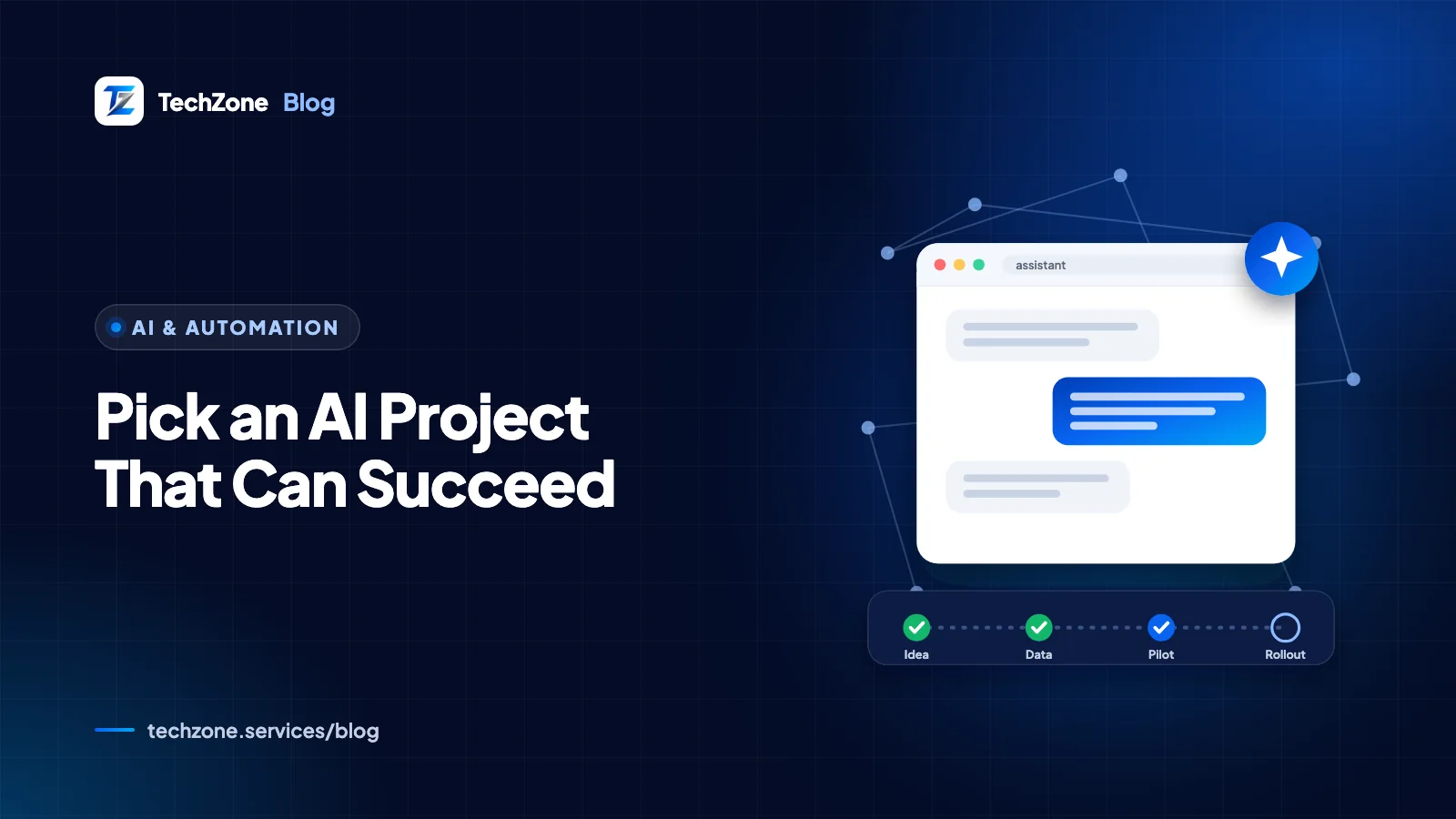
A realistic pilot tests one task on real examples, with one success metric and a person reviewing outputs, over weeks rather than months. Treat it as an experiment you may stop.
1. Define one success metric
Pick the number that decides whether the pilot continues: first-response time, minutes per invoice, share of drafts accepted with light edits, or accuracy on a test set. Anthropic’s evaluation guidance recommends criteria that are specific and measurable, not vague goals like “good performance.”
2. Measure the baseline
Record the current figure before building, or pull it from your helpdesk, CRM or time logs. Without it, “it feels faster” is your only result.
3. Build a narrow prototype
For a well-scoped task with accessible data, two to four weeks is a reasonable prototype target, though integrations and data cleanup can stretch it. Use real, anonymized examples and add no features until the core task works.
4. Keep a human in the loop
A person approves every customer-facing output. Log reviewer edits, because they show where the system fails and whether it is improving.
5. Evaluate against real cases
Build a test set from real examples, including awkward ones: vague questions, very long inputs and attempts to make the assistant ignore its instructions. Rerun it whenever you change the prompt, model or documents.
6. Roll out in stages
If the pilot hits its target, expand one step at a time: more volume, another channel, a second team. Keep monitoring accuracy and cost after launch.
How do you handle data privacy, security and responsible AI?
Decide what data the AI may see, where it is processed and who checks its output before you build. The NIST AI Risk Management Framework (AI RMF) gives a free structure for those decisions.
NIST released AI RMF 1.0 in January 2023 for voluntary use. It has four functions: Govern (policies and accountability), Map (context and risks), Measure (testing and tracking) and Manage (acting on findings). Its Generative AI Profile, NIST AI 600-1 (July 2024), covers risks specific to generative models.
For a first project, that means:
- Minimize data. Send the model only the fields the task needs, and mask personal details where you can.
- Check provider terms. Confirm how your AI provider stores data, whether it trains on it, and where it is processed. Terms change, so read current policy pages.
- Control access. An internal assistant should follow the same document permissions as your file system.
- Treat outside text as untrusted. OWASP’s 2025 list ranks prompt injection and sensitive information disclosure as the top two LLM risks, so customer messages and emails must never override your instructions.
- Log and disclose. Keep records of inputs, outputs and edits, and tell customers when they are talking to AI.
- Follow local data law. For personal data of people in the UK, the ICO’s guidance on AI and data protection covers lawful basis, accuracy, transparency and data protection impact assessments (DPIAs); the ICO says that guidance is under review after the Data (Use and Access) Act.
Should you buy an AI tool or build a custom integration?
Buy first if an AI feature in a tool you already use covers the task. Build a custom integration when the task depends on your own data, rules or systems that off-the-shelf tools cannot reach.
| Option | Good fit when | Trade-offs |
|---|---|---|
| AI features in tools you already use (for example Microsoft 365 Copilot, Gemini in Google Workspace, or AI add-ons in your helpdesk or CRM) | The task lives inside one tool and generic behavior is enough | Per-user or plan-based licensing, limited control over data flow, features vary by plan |
| No-code automation with AI steps (Zapier, Make, n8n) | Connecting a few tools with a simple AI step, such as classify then route | Gets fragile as logic grows; watch usage pricing and error handling |
| Custom integration with AI APIs (OpenAI API, Anthropic Claude, Google Gemini) | The task needs your data, permissions, rules or a custom interface | More upfront effort; you own testing, monitoring and maintenance |
A custom build is mostly custom software development around a model: connecting your CRM or database, indexing your documents, adding approval screens and logging. The model call is often the smallest part.
What drives the cost of a first AI project?
Costs vary too much for one price to mean anything, so estimate from these drivers and check current pricing pages as of 2026:
- Usage fees: most AI APIs charge per token (small chunks of text), so volume, document length and model choice drive the bill.
- Licenses: off-the-shelf tools usually charge per user or plan tier.
- Integration work: connecting your CRM, helpdesk or database is typically where most build effort goes.
- Data preparation: cleaning and updating documents so answers stay current.
- Evaluation and review time: staff hours to build test sets and check outputs.
- Hosting and maintenance: vector databases, servers, monitoring and updates.
Ask any vendor to separate one-time build costs from monthly running costs, estimated from your real volumes.
For a vendor-neutral overview of the options, see our AI marketing tools guide.
How TechZone can help
TechZone helps businesses pick one AI task worth automating and build it with guardrails. Our AI solutions team can review your workflow, score candidate projects with you, check data and privacy requirements, and build a pilot tested on your real examples, with human review where accuracy matters. If a chatbot is part of the plan, our AI chatbot development service explains how we build and test one. When the task needs deeper links into your CRM, database or internal tools, our developers build that integration too. If you have a shortlist of ideas, or one task that eats too many hours, tell us about it for a straight answer on whether AI fits.
Frequently asked questions
Do you need a lot of data to start an AI project for business?
Most first AI projects for business do not need large training datasets, because they use existing hosted models rather than training new ones. What an AI project does need is an organized, current set of the documents or records the task relies on, plus a few dozen real examples to test against. Training or fine-tuning a custom model is rarely necessary for a first pilot.
What is the difference between an AI chatbot and an AI agent?
An AI chatbot answers questions in a conversation, usually from approved content. An AI agent can also take actions, such as looking up an order, updating a CRM record or sending an email, through tools it has been given permission to use. For a first project, limit an AI agent to read-only actions or require human approval before it changes anything.
Who should own an AI pilot inside a small business?
An AI pilot should be owned by the manager of the process it changes, not by IT alone. That owner defines the success metric, names the people who review outputs, approves the data rules and makes the final go or no-go decision. A technical partner or developer builds and tests the system, but the business owner decides whether the AI pilot is worth keeping.
How do you know when an AI pilot has failed?
An AI pilot has failed if it misses its success metric after reasonable adjustments, if reviewers spend as long fixing outputs as doing the task by hand, or if staff quietly stop using it. Stopping a failed AI pilot is a valid result. The baseline measurements, test set and data cleanup still make the next project faster to evaluate.
Does letting staff use ChatGPT or a similar tool count as an AI project?
Letting staff use ChatGPT or a similar general assistant is a useful experiment, but it becomes an AI project only when there is a defined task, approved data rules and a way to measure results. Before staff paste business information into any AI tool, check whether the account type uses inputs for training and choose a business plan with admin controls where possible.
Sources and further reading
- AI Risk Management Framework — NIST
- Artificial Intelligence Risk Management Framework: Generative Artificial Intelligence Profile (NIST AI 600-1) — NIST
- 2025 Top 10 Risk & Mitigations for LLMs and Gen AI Apps — OWASP Gen AI Security Project
- Guidance on AI and data protection — Information Commissioner's Office (ICO)
- What is Retrieval-Augmented Generation (RAG)? — Google Cloud
- Define success criteria and build evaluations — Anthropic (Claude Developer Platform docs)