
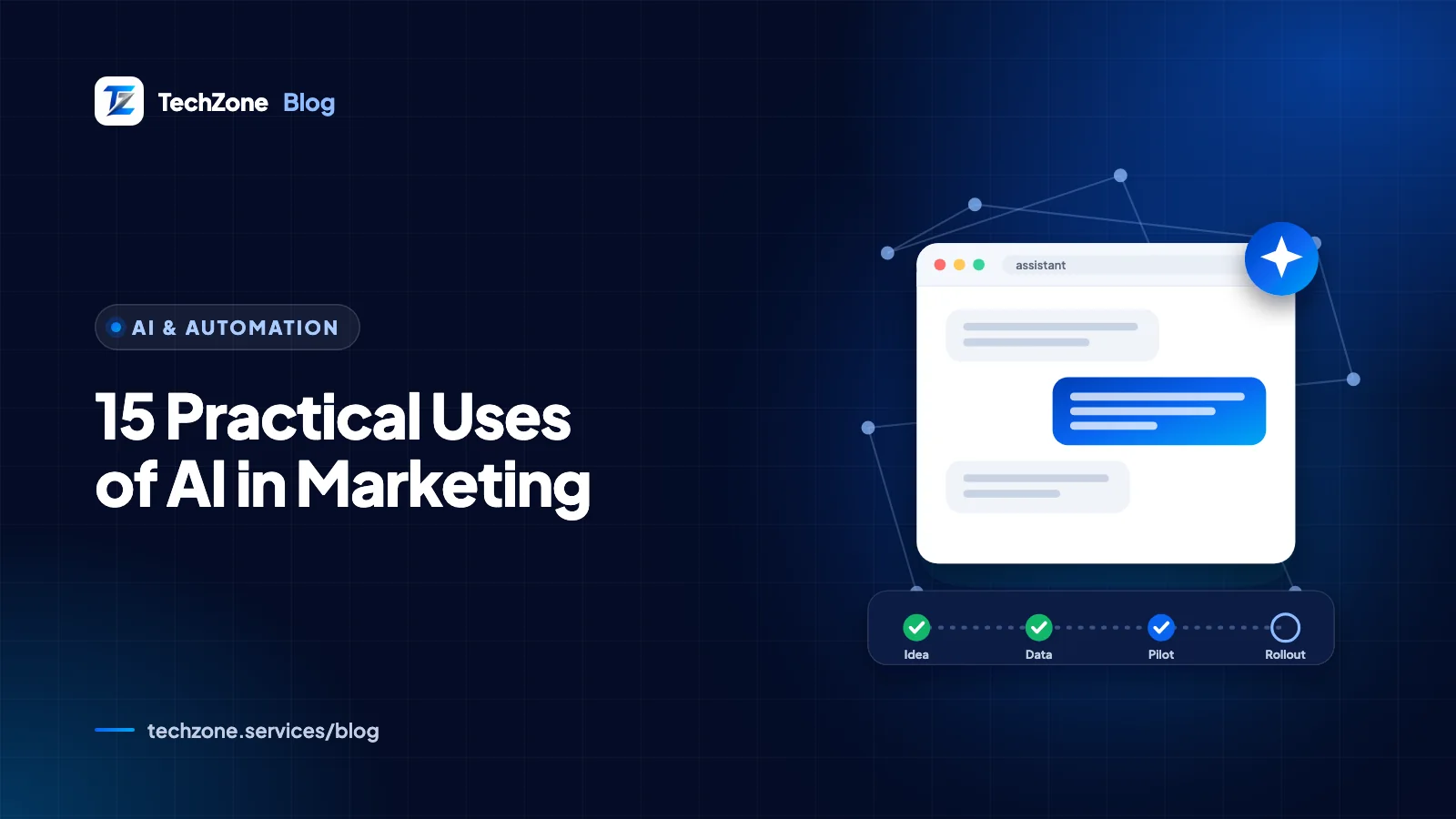
AI in digital marketing for small business works best as a time-saver on repeat tasks: researching customers, drafting content for a person to edit, supporting SEO, bidding in ad platforms, personalizing email and WhatsApp follow-ups, answering routine questions and summarizing reports. The 15 uses below are grouped by function, each with a tool category, an example and the main risk.
Adoption is no longer unusual. In the U.S. Chamber of Commerce’s 2025 survey of 3,870 U.S. small businesses, 58% said they use generative AI, up from 40% in 2024. The gap now is between businesses that use AI with a plan and review step, and those that paste output straight onto their website.
This guide covers what to use AI for. For specific products, see our AI marketing tools stack; for AI projects in operations rather than marketing, read how to choose a realistic first AI project.
Key takeaways
- Use AI for drafts, variations, sorting and summaries; keep people responsible for strategy, facts, final copy and customer promises.
- Google allows AI-assisted content that helps people, but mass-produced pages made to manipulate rankings break its spam policies.
- Ad platform AI such as Smart Bidding learns from your conversion tracking, so fix tracking before handing it more control.
- Automated WhatsApp messages need opt-in, and chatbots need a clear handoff to a person for anything they can’t answer.
- Start with two or three uses, set a data policy and a review step, and measure time saved and results for 90 days.
How are small businesses using AI in digital marketing?
Mostly for production and analysis, not strategy. The strongest uses turn material you already have, such as reviews, notes, exports and existing pages, into drafts, variations and summaries a person then checks. The table lists all 15 uses covered in this guide.
| # | Use | Tool category | Main risk |
|---|---|---|---|
| 1 | Mining reviews and call notes for customer language | General AI assistant | Privacy |
| 2 | Competitor and ad research | General AI assistant | Copying competitors |
| 3 | First drafts of pages and posts | General AI assistant | Accuracy and generic copy |
| 4 | Repurposing content for social media | Assistant or scheduler with AI | Brand voice |
| 5 | Images and short video | Design and video tools with AI | Misleading visuals |
| 6 | Keyword clustering and content briefs | General AI assistant | Invented search volumes |
| 7 | Titles, meta descriptions and schema drafts | General AI assistant | Invalid or inaccurate code |
| 8 | Smart Bidding | Google Ads, Meta Ads Manager | Optimizing to bad tracking |
| 9 | AI Max, Performance Max and Advantage+ | Google Ads, Meta Ads Manager | Irrelevant traffic |
| 10 | Ad copy variations | Assistant or ad platform | Policy breaches |
| 11 | Email drafting and segmentation | Email platform with AI | Wrong audience |
| 12 | Automated email and WhatsApp follow-ups | CRM, email platform, connector | Consent |
| 13 | FAQ chatbots on your website and WhatsApp | Chatbot or AI agent | Wrong answers |
| 14 | Drafting replies to reviews and messages | Assistant or inbox tool with AI | Canned tone |
| 15 | Analytics insights and report summaries | GA4, Clarity, assistant | Misreading data |
Research and planning (uses 1 and 2)
AI speeds up research by reading and sorting large amounts of text you would otherwise skim. It can’t tell you what customers think if you don’t feed it what they said.
1. Mining reviews and call notes for customer language
Paste anonymized reviews, survey answers, sales call notes or common WhatsApp questions into an assistant and ask for recurring praise, complaints, objections and the exact phrases customers use. Those phrases become headlines, FAQ entries and ad copy.
Example: a dental clinic pastes 60 of its public Google reviews and finds that patients repeatedly mention short waiting times, a point missing from its website. Risk to manage: customer names and phone numbers. Strip them before pasting, and use a business plan that doesn’t train on your data.
2. Competitor and ad research
Summarize competitors’ service pages, offers and public ads from the Meta Ad Library or Google’s Ads Transparency Center, then ask what they all claim and what none of them offer.
Example: an HVAC company compares the landing pages of five local competitors and notices none of them publish response times, so it leads with its own. Risk to manage: copying. Use research to find gaps, not to rewrite a competitor’s page in your name.
Content creation with human editing (uses 3 to 5)
AI is fast at first drafts and variations, and weak at first-hand experience, current facts and your opinions. The workflow that holds up is: you supply the substance, AI drafts, a person edits and fact-checks.
3. First drafts of pages and posts
Record a ten-minute voice note explaining a service, transcribe it and ask an assistant to turn it into a structured draft using your headings. You keep the expertise; AI saves the blank-page time.
Example: a law firm’s partner explains the steps of a property purchase on a voice note, and the draft becomes a guide she corrects in 20 minutes instead of writing from scratch. Risk to manage: accuracy and sameness. Google’s guidance says using generative AI to create many pages without adding value may violate its scaled content abuse policy. Our article on whether Google penalizes AI content covers where the line sits.
4. Repurposing content for social media
Turn one article, case study or video into several posts for different networks, then schedule them. Schedulers such as Buffer now include AI assistants for rewriting posts.
Example: a furniture store turns one buying guide into a carousel outline, three short captions and a question post for Instagram. Risk to manage: brand voice. Give the assistant three real posts you liked as style examples and cut anything you wouldn’t say out loud.
5. Images and short video
Design tools with AI can remove backgrounds, resize one design for every placement, extend a photo’s edges and cut long videos into short clips with captions.
Example: a salon resizes one promotion design for Stories, feed and WhatsApp status in minutes instead of rebuilding it three times. Risk to manage: misleading visuals. Keep product and before-and-after photos real. If you sell through Google Merchant Center, AI-generated product images must carry IPTC metadata marking them as AI-generated.
SEO support (uses 6 and 7)
AI helps with the organizing and drafting parts of SEO, while search data and validation still come from Google’s own tools. Our guide to using ChatGPT for SEO has 12 prompt templates and a verification checklist.
6. Keyword clustering and content briefs
Export keywords from Keyword Planner or Search Console, ask an assistant to group them into topics one page could satisfy, then turn each group into a brief with questions to answer.
Example: an accountant groups 200 exported keywords into 14 topics and discovers three service pages were targeting the same searches. Risk to manage: invented numbers. Assistants without a keyword data source guess search volumes; keep the volumes from your export.
7. Titles, meta descriptions and schema drafts
Generate ten title options to choose from, draft meta descriptions, or produce JSON-LD structured data from details you supply.
Example: a restaurant drafts LocalBusiness markup with its real hours and address, then checks it in Google’s Rich Results Test before adding it. Risk to manage: invalid code or details that don’t match the page. Validate every schema draft and keep markup consistent with what visitors see.
Advertising: Smart Bidding, AI Max and creative (uses 8 to 10)
In paid ads, the AI you need is already inside Google Ads and Meta Ads Manager. Your job is to feed it accurate conversion data and set the limits it works within.
8. Smart Bidding
Smart Bidding is Google’s family of conversion-based bid strategies, such as Maximize conversions, Target CPA and Target ROAS. Instead of one fixed bid per keyword, Google sets a bid at auction time using signals such as device, location and time of day.
Example: a cleaning company switches from manual bids to Maximize conversions after it starts tracking booked-quote forms and calls, rather than page views. Risk to manage: optimizing to the wrong signal. If you count newsletter sign-ups and real inquiries as equal conversions, the system will chase the cheaper one.
9. AI Max, Performance Max and Advantage+
These features expand where and to whom your ads show. AI Max for Search campaigns adds search term matching beyond your keywords, AI-written ad text and final URL expansion; Performance Max runs one campaign across Google’s inventory; Meta’s Advantage+ automates audiences, placements and creative.
Example: an online store tests AI Max on one Search campaign using Google’s built-in experiment, rather than switching it on everywhere at once. Risk to manage: irrelevant traffic and off-brand text. Use negative keywords, brand exclusions and URL exclusions, and review search terms weekly. Our guide to AI Max for Search campaigns covers the controls.
10. Ad copy variations
Ask an assistant for headline and description variations built from your real selling points, then load the best into responsive search ads or Meta ads to test.
Example: a driving school generates 20 headline options around its weekend lessons, automatic cars and female instructors, and tests six. Risk to manage: claims you can’t support. Remove superlatives and guarantees that aren’t true, because ad platforms and consumer law both penalize misleading claims.
Email, WhatsApp and customer service (uses 11 to 14)
AI makes follow-up faster and more personal, but it also sends mistakes at scale. Keep a person approving templates and anything that makes a promise.
11. Email drafting and segmentation
Email platforms including Mailchimp, Klaviyo and Brevo now build AI into writing and audience suggestions.
Example: a skincare brand asks its email platform for five subject lines, then segments customers who bought a cleanser 60 days ago for a refill reminder. Risk to manage: sending the wrong message to the wrong segment. Preview each segment’s size and a sample of its contacts before you send.
12. Automated email and WhatsApp follow-ups
Trigger-based workflows reply to new leads, remind people of appointments, ask for reviews and follow up on quotes. Our guide to marketing automation for small business lists the eight workflows to build first.
Example: a physiotherapy clinic sends a WhatsApp confirmation and a reminder 24 hours before each appointment, with a reschedule link. Risk to manage: consent. WhatsApp’s Business Messaging Policy requires opt-in permission, and outside the 24-hour customer service window only approved message templates can be sent.
13. FAQ chatbots on your website and WhatsApp
AI chat agents such as Tidio’s Lyro answer routine questions from your own content: hours, prices, delivery areas and booking steps.
Example: a courier company’s chatbot answers delivery-area and tracking questions after hours, and passes pricing disputes to a person in the morning. Risk to manage: wrong answers given with confidence. Limit the bot to your approved content, tell customers they are chatting with an automated assistant, and make handoff to a person easy.
Pakistan note
Customers in Pakistan often message in Roman Urdu or mix English and Urdu in one sentence. Before a chatbot goes live, test it with real past messages in the way your customers actually write, and send anything it misreads to a person.
14. Drafting replies to reviews and messages
AI can suggest replies to reviews, comments and direct messages; some schedulers, including Buffer, include AI reply suggestions.
Example: a hotel manager asks for a draft reply to a detailed negative review, then adds the specific fix the team made before posting it. Risk to manage: canned replies. Edit every draft so it mentions the actual situation, and never include a customer’s booking or health details in a public reply.
Analytics and reporting (use 15)
AI helps you notice changes and explain them faster, but the numbers still need checking at the source.
15. Analytics insights and report summaries
In GA4, Analytics Intelligence spots unusual changes and emerging trends without being asked, and custom insights let you choose which metrics to watch and how often. Microsoft Clarity adds AI summaries of session recordings and heatmaps. An assistant can also turn a monthly export into a plain-language summary.
Example: a store owner gets a GA4 insight that mobile conversions dropped on one day, checks recordings in Clarity and finds a broken checkout button. Risk to manage: over-trusting predictions. GA4’s predictive metrics need at least 1,000 returning users who triggered a purchase or churn condition, and 1,000 who didn’t, within the last 28 days, so many small sites won’t qualify. Confirm any AI summary against the underlying report.
How to use AI in digital marketing: adoption steps for a small team
Start small, protect your data, and measure. A team that adopts two uses properly gets more from AI than one that tries all fifteen at once.
- Pick two or three uses from the table where your team spends the most hours each week.
- Set up business accounts for the AI tools you choose, so your data isn’t used for model training by default, and give each person their own login.
- Write a one-page AI policy: what data can be pasted, what always needs human review, who approves publishing, and when to disclose AI use to customers.
- Build shared resources: a brand voice note with real examples, a prompt library and a fact sheet of approved claims and prices.
- Measure for 90 days: time per task before and after, plus one business metric per use, such as inquiries, reviews or cost per lead.
- Review and expand: keep what saved time without adding errors, drop what didn’t, then add the next use.
If you’re weighing an AI project outside marketing, such as a support assistant trained on your documents or automated document processing, our guide to choosing a realistic first AI project covers scoring, pilots and costs.
How TechZone can help
TechZone helps small businesses put AI to work in marketing with a plan and a review step. We identify the two or three uses that will save you the most time, set up the tools and integrations, write your prompt library and AI policy, and build custom assistants or automations where off-the-shelf tools fall short. Our AI solutions service covers these projects end to end. See AI chatbots for websites and WhatsApp for one of the most common first projects. Book a free 30-minute consultation to find your first AI marketing wins.
Frequently asked questions
Is AI marketing affordable for a small business?
AI marketing is affordable for most small businesses because many uses run on tools they already pay for, such as Google Ads, Meta Ads Manager, Shopify and email platforms, which include AI features. General assistants and design tools offer free plans for testing. The bigger cost is usually the time to set up workflows and review output, so budget for that as well.
Will AI replace my marketing team or agency?
AI is unlikely to replace a small business marketing team or agency, but it changes the work. AI handles drafts, variations, sorting and summaries quickly, while people still set strategy, check facts, understand customers, approve what is published and take responsibility for results. Teams that use AI well usually spend less time on production and more on planning and testing.
Do I have to tell customers when I use AI in marketing?
Disclosure rules depend on the country and the use. Google suggests adding AI disclosures where readers would reasonably ask how content was created, and telling customers when they are chatting with an automated assistant builds trust. Check local consumer protection and advertising rules for specific requirements, especially for chatbots, AI-generated images of people and endorsements.
What is the biggest mistake small businesses make with AI marketing?
The biggest mistake small businesses make with AI marketing is publishing AI output without a review step. Unchecked content can contain wrong facts, invented statistics, promises the business can’t keep or text that sounds like every competitor. A second common mistake is pasting customer data into personal AI accounts without checking how that data is stored and used.
Which AI skills should a small business owner learn first?
A small business owner should first learn to write clear prompts with context, examples and constraints, and to check AI output against real sources. After that, learning how the AI features in Google Ads, Meta Ads Manager and GA4 use conversion data pays off quickly, because those systems make bidding and targeting decisions on the owner’s behalf every day.
Sources and further reading
- Empowering Small Business: The Impact of Technology on U.S. Small Business (2025) – U.S. Chamber of Commerce
- Google Search's guidance on using generative AI content on your website – Google Search Central
- About Smart Bidding – Google Ads Help
- How AI Max for Search campaigns works – Google Ads Help
- [GA4] Predictive metrics – Analytics Help
- WhatsApp Business Messaging Policy – WhatsApp