
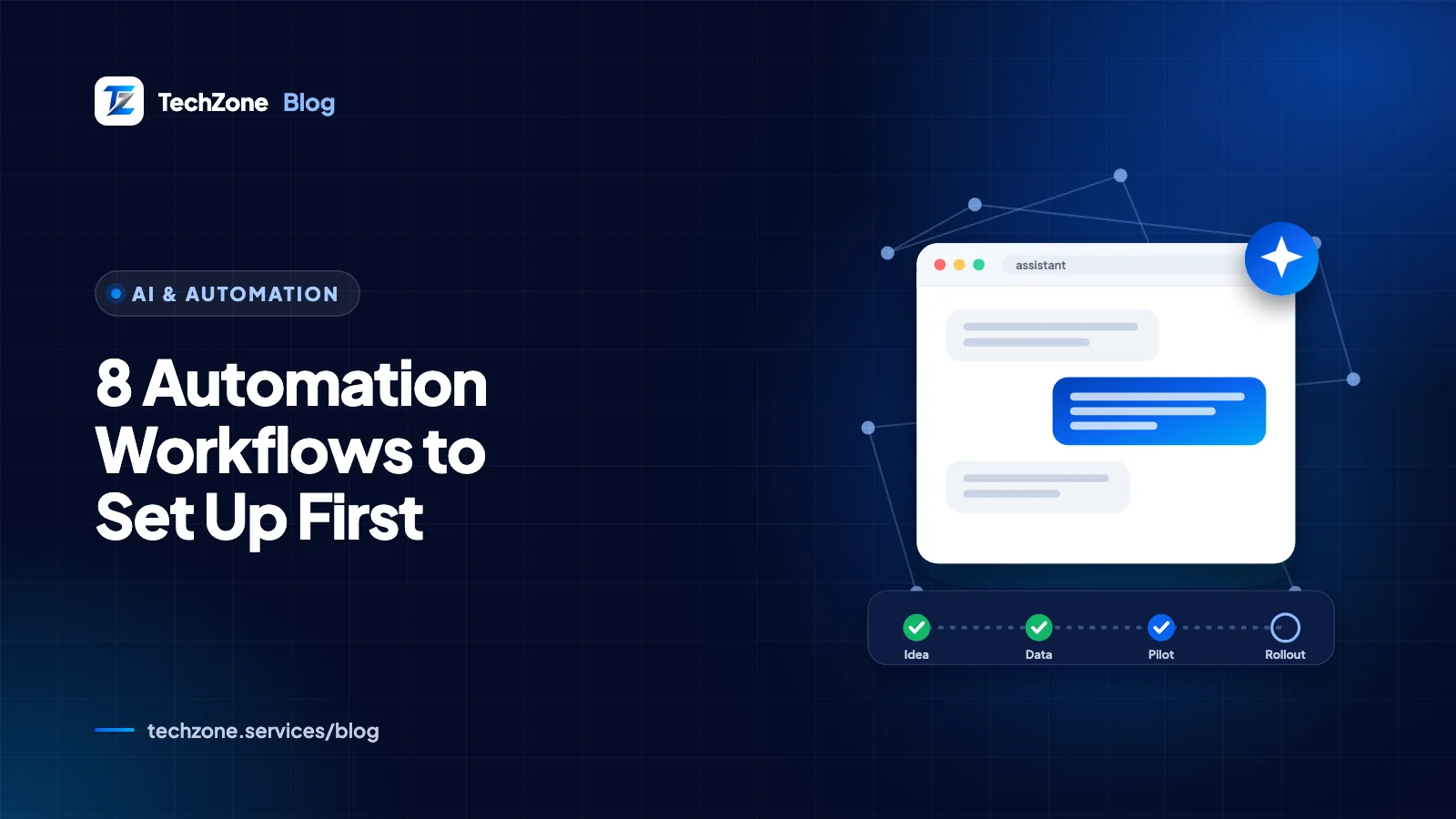
Marketing automation for small business means setting rules that send the right message, or alert the right person, when a customer does something: fills in a form, books, buys or goes quiet. Start with eight workflows: new lead follow-up, welcome series, abandoned cart or quote, appointment reminders, review requests, re-engagement, post-purchase and internal lead alerts.
Each workflow below has a trigger, steps, timing and one number to watch. You don’t need an enterprise platform: a CRM or email platform plus a connector such as Zapier, Make or n8n covers all eight for most small teams.
Key takeaways
- Automate moments that already happen every week: new inquiries, bookings, purchases and finished jobs.
- Every workflow needs a trigger, a delay, a message, an exit rule and one metric that shows whether it works.
- New leads need speed: send an instant reply and alert a person, rather than relying on a single email.
- WhatsApp requires opt-in, and outside the 24-hour customer service window you can only send approved message templates.
- Send review requests to every customer; Google bans incentives and asking only the customers you expect to be happy.
What is marketing automation for a small business?
It is a set of if-this-then-that rules that run your routine follow-ups for you. Each rule has a trigger (a form is submitted), conditions (the lead asked for a quote), actions (send a reply, create a task) and an exit (stop when the lead books a call).
You need three things to run one: a contact database, usually a CRM or email platform; the channels you message on, such as email, WhatsApp or SMS; and, when those don’t talk to each other, a connector that passes data between them. AI now helps draft the messages and sort replies, but the workflow logic is what saves the time. For the wider picture of where AI fits, see our guide to AI in digital marketing for small business.
Which 8 marketing automation workflows should you set up first?
Set up the workflows tied to moments that already happen every week, starting with new lead follow-up. The timings below are sensible starting points, not rules; adjust them to how quickly your customers decide.
| Workflow | Trigger | Steps and timing | Metric to watch |
|---|---|---|---|
| 1. New lead follow-up | Form submitted, missed call or first WhatsApp message | Instant reply confirming the next step; task for a person; follow-ups on day 2 and day 5 if there is no reply | Time to first reply; leads that become calls or visits |
| 2. Welcome series | Newsletter, account or lead-magnet sign-up | Three emails over about 10 days: what you promised, your most useful content or bestsellers, then proof and one clear offer | Clicks; first inquiry or purchase |
| 3. Abandoned cart or quote | Checkout started but not finished, or a quote sent with no reply | Cart: a reminder within hours, another the next day. Quote: check in on day 2, answer common objections on day 7, close the loop on day 14 | Recovered orders; quotes accepted |
| 4. Appointment reminders | Booking confirmed | Confirmation with a calendar link, then reminders 24 hours and 2 hours before, each with a reschedule link | No-show rate |
| 5. Review requests | Job marked complete or order delivered | Thank-you message with your Google review link a day later, and one reminder about a week after | New reviews per month |
| 6. Re-engagement | No purchase, booking or email click for a period that fits your buying cycle | Two or three messages: what’s new, a reason to come back, then a stay-subscribed check; suppress anyone who doesn’t respond | Contacts reactivated |
| 7. Post-purchase | Order paid or service delivered | Confirmation, then a how-to or care guide, then a cross-sell or refill reminder timed to how long the product lasts | Repeat purchases |
| 8. Internal lead alerts | High-value form answer, a reply to a campaign, or a quote request | Instant alert to the owner by WhatsApp, Slack or email with the lead’s details, plus a CRM task with a deadline | Response time on your best leads |
How do you set up each workflow so it actually works?
Write down the trigger, the exit rule and the metric before you write any message. Most broken automations fail on the exit: a customer books a call and still receives the follow-ups that were meant to get them to book.
Lead follow-up and internal alerts
These two belong together. The instant reply tells the customer what happens next, and the alert makes sure a person actually does it. Promise only a response time you can meet, such as a call within two working hours, and include the lead’s source in the alert so whoever answers knows the context.
Welcome series and re-engagement
Deliver what the sign-up promised in the first message, and give each email one call to action. At the other end of the list, re-engagement ends with a clear choice: people who don’t respond stop receiving campaigns, which keeps your list and your reports honest.
Abandoned cart or quote
Online stores should switch on their platform’s built-in abandoned checkout automation first; our guide to email flows every Shopify store needs covers the store versions in detail. For service businesses, the equivalent is the quote follow-up, which is often the easiest win because the prospect has already asked for a price.
Appointment reminders and post-purchase
Reminders should carry everything needed to turn up: time, address or map link, what to bring and a one-tap reschedule option. Post-purchase messages work best when they help first, with setup or care advice, and sell second.
Review requests
Send the same request with the same Google review link to every customer. Google’s Maps content policy prohibits offering incentives for reviews and selectively soliciting positive reviews, so don’t build a branch that sends happy customers to Google and unhappy ones to a private form. Our guide to getting more Google reviews has request templates for WhatsApp, SMS and email.
Should you use email, WhatsApp or SMS for each workflow?
Use email for anything long or scheduled, and WhatsApp or SMS for short, time-sensitive messages the customer expects. Email automation for small business carries the longer sequences, and many workflows work best on two channels: an email confirmation plus a WhatsApp or SMS reminder.
| Channel | Best for | Rules to know |
|---|---|---|
| Welcome series, quote follow-ups, post-purchase guides, re-engagement | Unsubscribe link in every marketing email; consent rules vary by country | |
| Lead replies, booking and order confirmations, reminders, review requests | Opt-in required; outside the 24-hour customer service window, only approved message templates | |
| SMS | Reminders and urgent updates | Keep it short; US automated marketing texts need prior express written consent |
| Internal (Slack, WhatsApp, email) | Lead alerts and task reminders for your team | Send lead details only to people who need them |
The WhatsApp Business app handles greetings, away messages and quick replies, but automated, triggered flows need the WhatsApp Business Platform, usually through a provider that connects it to your CRM. Our WhatsApp marketing guide for small businesses explains the app, the platform and template approval.
Pakistan note
In Pakistan and the UAE, many customers expect to hear from a business on WhatsApp rather than email. Build lead replies, order confirmations and reminders for WhatsApp first, and keep email for longer content. Cash-on-delivery stores can use a WhatsApp order confirmation to check the order before dispatch.
Which marketing automation tools does a small business need?
Start with one platform that covers most of the eight workflows natively, and add a connector only for the gaps. Every extra tool is another place where contact data can fall out of sync.
| Tool category | Examples | Role in the workflows |
|---|---|---|
| CRM | HubSpot, Zoho CRM, Pipedrive | Stores contacts and deal stages; triggers follow-ups, tasks and alerts |
| Email platform | Mailchimp, Brevo, Klaviyo for online stores | Welcome, re-engagement and post-purchase sequences |
| Messaging | WhatsApp Business app or Platform, an SMS provider such as Twilio | Confirmations, reminders and quick replies |
| Booking | Calendly, Google Calendar booking pages | Appointment triggers and reminders |
| Connector | Zapier, Make, n8n | Moves data between tools that have no native integration |
A simple decision rule: if your CRM or email platform can run six or more of the eight workflows on its own, use it and connect the rest. If your tools are scattered, a connector such as Zapier, Make or n8n can link a form to your CRM, your CRM to WhatsApp and a finished job to a review request. For a full stack by job, see our list of AI marketing tools for small business.
What consent and data rules apply to marketing automation?
Get permission for marketing messages, identify yourself, and make opting out easy and fast. The details differ by country and channel, so check the rules for every market you message.
| Market or channel | What the rules require |
|---|---|
| UK (PECR) | Consent before marketing emails or texts to individuals, unless the soft opt-in applies: existing customers who bought or negotiated for similar products and were offered a simple opt-out when you collected their details and in every message |
| US email (CAN-SPAM) | No prior consent required, but you must identify the message as an ad, avoid misleading headers and subject lines, include a valid physical postal address and honor opt-outs within 10 business days |
| US texts (TCPA) | Prior express written consent for automated marketing texts; people can revoke consent by any reasonable method |
| Canada (CASL) | Express or implied consent; implied consent from a purchase lasts up to 2 years, or 6 months after an inquiry; identify yourself and process unsubscribes within 10 business days |
| WhatsApp (all markets) | Opt-in permission before messaging; approved templates outside the 24-hour window; honor opt-out requests made on or off WhatsApp |
Order confirmations and appointment reminders are usually treated differently from marketing, but a reminder that also pushes an offer can become marketing. Record when, where and how each contact gave consent, because several of these rules expect you to prove it. The EU, Australia, the UAE and Pakistan have their own rules; check them with a local advisor before messaging customers there.
Watch out
Don’t load purchased lists, scraped numbers or contacts from WhatsApp groups into an automation. They haven’t agreed to hear from you, and the complaints and blocks can damage your sender reputation and your WhatsApp account.
How do you measure whether marketing automation is working?
Give each workflow one business metric, record it for a month before launch, and compare after. Open rates alone won’t tell you whether a workflow earns its keep.
- Tag every link with UTM parameters so Google Analytics 4 credits visits to the right workflow.
- Mark the actions that matter, such as form submissions, calls and WhatsApp clicks, as GA4 key events.
- Watch the warning signs every month: unsubscribes, spam complaints, blocks and replies saying a message arrived at the wrong time.
- Test one change at a time, such as the delay before a reminder, if your platform supports split tests.
Example link for the second email of a welcome series:
https://www.example.com/services/?utm_source=newsletter&utm_medium=email&utm_campaign=welcome-email-2
Example: a contractor sends 40 quotes a month and 10 are accepted. After adding the quote follow-up, an average of 13 a month are accepted over the next three months. The workflow is worth three extra jobs a month, which is the figure to weigh against the tool’s cost and setup time.
How TechZone can help
TechZone designs and builds automation workflows for small businesses: lead follow-up, reminders, review requests and alerts that connect your website forms, CRM, email platform and WhatsApp. We map your current process first, set up only the workflows that fit it, and include consent capture and tracking from the start. Our AI and automation services cover off-the-shelf setups and custom integrations. See AI chatbots for websites and WhatsApp for one of the most common first projects. Book a free 30-minute consultation to pick your first three workflows.
Frequently asked questions
How much does marketing automation cost for a small business?
Marketing automation costs depend on your contact count, the number of users and the channels you message. Several CRM, email and connector tools have free plans that can run basic workflows, while WhatsApp and SMS messages usually carry per-message charges from the platform or provider. Price the tools on their current pricing pages and add setup time before comparing against the result.
Is marketing automation worth it for a very small business?
Marketing automation is worth it for a very small business once the same follow-up happens several times a week, such as replying to inquiries, confirming bookings or asking for reviews. A one-person business often benefits most, because nobody else is there to send those messages on a busy day. Start with one workflow, measure it, then add the next.
What is the difference between marketing automation and a CRM?
A CRM stores your contacts, conversations and deals, while marketing automation sends messages and creates tasks based on what those contacts do. Many CRMs now include automation features, and many email platforms include basic contact management, so the line has blurred. For a small business, one tool that does both well is usually easier to run than two.
Can AI write my automated marketing emails?
AI assistants can draft automated marketing emails, subject lines and message variations quickly, and many email platforms now build this in. A person should still check every message for accuracy, tone and promises the business can keep, because an automated email is sent to many people without further review. Treat AI drafts as a first version, not the final copy.
How many emails should a welcome series have?
A welcome series for a small business usually works with three to five emails spread over one to two weeks. The first email should deliver whatever the sign-up promised, and each later email should have one purpose, such as showing your best content, answering a common question or making one offer. Stop the series as soon as the subscriber buys or books.
Sources and further reading
- CAN-SPAM Act: A Compliance Guide for Business – Federal Trade Commission
- Electronic mail marketing – Information Commissioner's Office (ICO)
- Getting consent to send email – Canada's Anti-Spam Legislation, Government of Canada
- 47 CFR 64.1200: Delivery restrictions – Electronic Code of Federal Regulations
- WhatsApp Business Messaging Policy – WhatsApp
- Maps user contributed content policy: prohibited and restricted content – Google Maps Help