
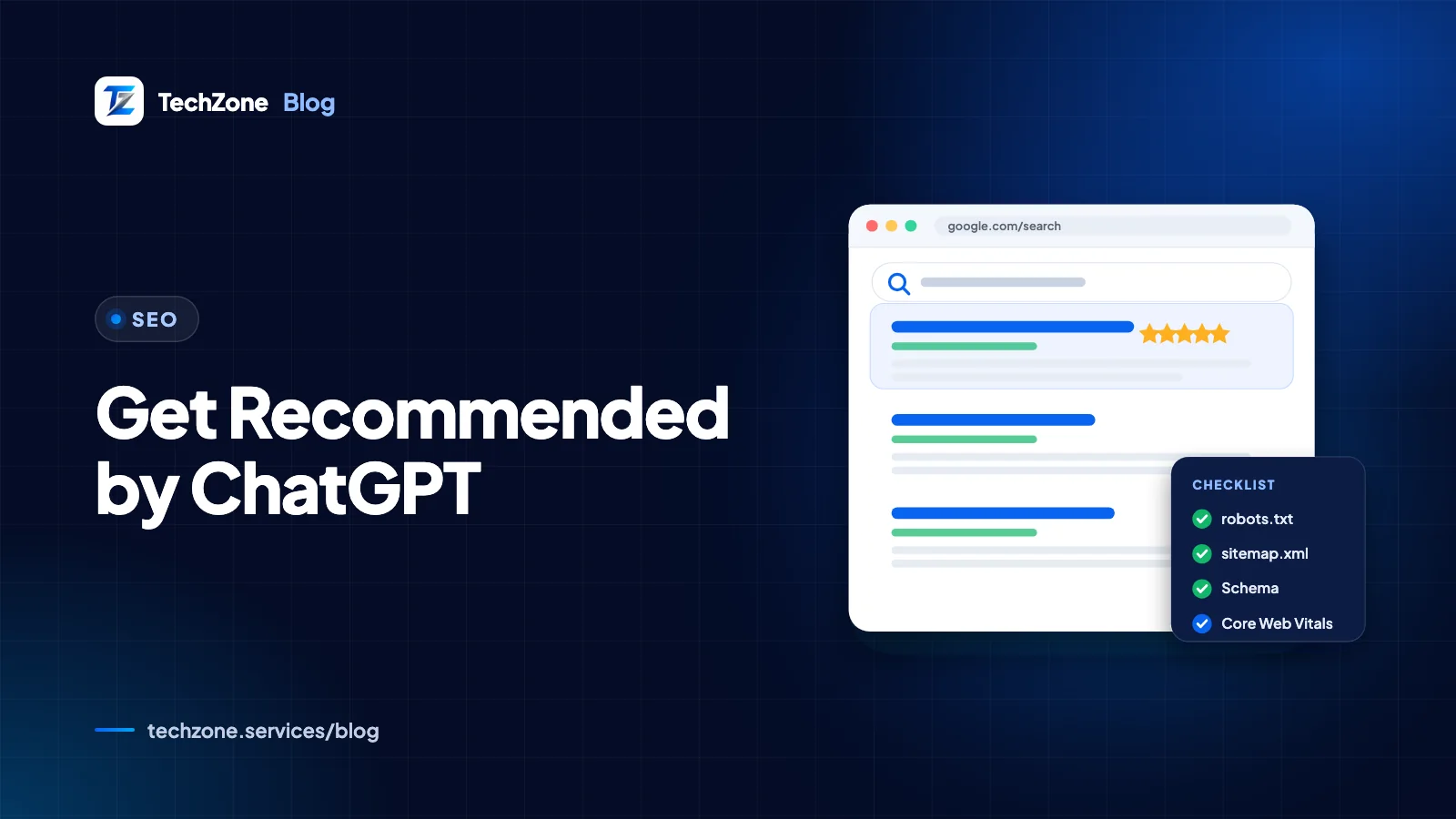
To get your business recommended by ChatGPT and Perplexity, let their search crawlers (OAI-SearchBot and PerplexityBot) reach your site, get indexed in Bing as well as Google, keep your business facts identical everywhere, and earn genuine mentions on the sites these tools cite. Then run the same set of buyer prompts every month to track progress.
Owners often search for “how to get my business on ChatGPT” as if it worked like a directory. It works more like a search engine that writes its answers: no setting or payment guarantees a recommendation, so your job is to be easy to find, easy to verify and mentioned by sources these tools trust. Most of that work strengthens your Google rankings too.
This guide covers ChatGPT and Perplexity, with notes on Copilot and Gemini. For Google’s own AI features, see our guide to ranking in Google AI Overviews; for the terminology, read our plain-English comparison of SEO, GEO and AEO.
Key takeaways
- Allow OAI-SearchBot and PerplexityBot in robots.txt and your firewall; GPTBot is OpenAI’s training crawler and a separate choice.
- Set up Bing Webmaster Tools and IndexNow: Copilot answers come from Bing, and ChatGPT search uses third-party search providers.
- Keep your name, address, phone, services and description identical on your site, Google Business Profile, Bing Places and directories.
- Earn real mentions in reviews, directories, local press and comparison articles, since AI answers summarize what other sites say.
- Run 10 to 20 fixed buyer prompts every month and log mentions, citations and the sources each tool relies on.
How do ChatGPT and Perplexity decide which businesses to recommend?
When a question needs current information, both tools search the web, read the most relevant sources and write an answer that cites them. Whether you’re recommended depends on whether their search systems can find your pages and whether trusted sources describe you consistently.
ChatGPT search combines OpenAI’s own crawler, OAI-SearchBot, with third-party search providers. OpenAI’s help center says it may rewrite your prompt into several searches and uses your approximate location, based on your IP address, to localize results. Perplexity surfaces sites crawled by PerplexityBot and cites its sources in every answer, so Perplexity SEO starts with letting that crawler in.
Without a live search, a chatbot falls back on what its model learned during training, which you can’t update quickly. That is why the practical answer to how to get your business recommended by ChatGPT comes down to crawler access, search indexes and what the wider web says about your business.
| Tool | Crawler to allow for search | Where answers get web results | Where to see your visibility |
|---|---|---|---|
| ChatGPT | OAI-SearchBot | OAI-SearchBot’s crawl plus third-party search providers | GA4 AI Assistant channel; monthly prompt test |
| Perplexity | PerplexityBot | PerplexityBot’s crawl | Referral visits in GA4; monthly prompt test |
| Microsoft Copilot | Bingbot | Bing search | Bing Webmaster Tools AI Performance report |
| Gemini app | Googlebot; blocking Google-Extended stops grounding use in Gemini Apps | Google Search | GA4 AI Assistant channel; monthly prompt test |
User-triggered fetchers work differently. ChatGPT-User and Perplexity-User visit a page when someone asks about it, and both companies say robots.txt may not apply to those visits. OpenAI adds that ChatGPT-User isn’t used to decide what appears in search; for both tools, the search crawlers above do that job. Google’s crawler documentation explains the Google-Extended token.
Can ChatGPT and Perplexity crawl your website?
Check rather than assume. A robots.txt rule, a security plugin or a CDN bot setting can shut out AI search crawlers without anyone noticing, and OpenAI says a site that opts out of OAI-SearchBot won’t appear in ChatGPT search answers, though it may still show up as a plain navigational link.
Step 1: Read your robots.txt
Open yoursite.com/robots.txt and look for rules naming OAI-SearchBot or PerplexityBot, or a blanket Disallow: / under User-agent: *. If you want AI search visibility but would rather keep your content out of OpenAI’s model training, a file like this does both:
# Example robots.txt: allow AI search crawlers,
# opt out of OpenAI model training (optional)
User-agent: OAI-SearchBot
Allow: /

User-agent: PerplexityBot
Allow: /

User-agent: GPTBot
Disallow: /

User-agent: *
Allow: /

Sitemap: https://www.example.com/sitemap.xml
The GPTBot rule is optional and affects training only. OpenAI says its search systems pick up robots.txt changes in about 24 hours, and Perplexity says changes can take up to 24 hours to show.
Step 2: Check your CDN, firewall and security plugins
Bot protection can block crawlers before robots.txt is even read. On Cloudflare, review Security settings → Configure AI bot policies, which treats Search, Agent and Training bots separately, and the per-crawler list in AI Crawl Control. From September 15, 2026, Cloudflare’s defaults for new domains block Training and Agent bots on pages with ads while leaving Search crawlers allowed.
On other hosts and WordPress security plugins, allowlist the crawlers using the IP ranges OpenAI and Perplexity publish, since a user-agent string alone is easy to fake. Perplexity’s documentation includes step-by-step rules for Cloudflare and AWS firewalls.
Step 3: Confirm visits in your logs
Ask your host for raw access logs, or check your CDN’s analytics, and search for OAI-SearchBot and PerplexityBot. Requests to your key pages that return a 200 status are the proof that matters.
Why does Bing matter for ChatGPT and Copilot?
Microsoft Copilot gets its web results from Bing, and ChatGPT search relies partly on third-party search providers, so a site Bing barely knows starts at a disadvantage in both. Bing Webmaster Tools is quick to set up if you already use Google Search Console.
- Import your site into Bing Webmaster Tools. On the My Sites page, choose Import and sign in with your Google Search Console account; the sites and sitemaps you select arrive already verified.
- Turn on IndexNow. It tells Bing and other participating search engines when pages are added, updated or removed; Google doesn’t take part. WordPress, Shopify and Wix support it natively or through plugins, and Cloudflare offers a built-in integration.
- Watch the AI Performance report. It shows how often your pages are cited in Microsoft Copilot, Bing’s AI-generated summaries and select partner experiences, with the grounding queries behind those citations.
- Claim Bing Places for Business. Microsoft recommends it to keep your address, hours and contact details current for AI answers to local questions.
Are your business facts consistent across the web?
They need to be, because an AI answer can only be as accurate as the sources it reads. If your website, Google Business Profile and directory listings disagree about your address, services or hours, you hand these tools conflicting facts to reconcile.
| Place | What to check |
|---|---|
| Your website | About and contact pages state your business name, address, phone, service areas and what you do in plain sentences |
| Structured data | Organization or LocalBusiness markup that matches the visible text |
| Google Business Profile | Name, categories, services, hours and description match the website |
| Bing Places and Apple Business Connect | The same details, claimed and verified |
| Directories and associations | Industry directories, chambers of commerce and local listings use the same name and phone format |
| Social profiles | LinkedIn, Facebook and Instagram bios describe the same services and locations |
This is the same profile and citation work that underpins local SEO, so doing it once serves Google Maps and AI tools alike. Our guides to local citations and optimizing your Google Business Profile go through the details.
Pakistan note
If you serve overseas clients from Pakistan, say so plainly on your site: where you’re based, which countries you serve and your working hours in PKT. Write your phone number in one international format (+92) everywhere. Explicit, consistent facts give AI tools something concrete to repeat when someone asks which Islamabad firms work with UK clients.
How do third-party mentions affect AI recommendations?
For “best” and “which company” questions, AI tools summarize what other sites say, so independent mentions add something your own website can’t: someone else vouching for you. You can’t buy that, but you can earn more of it deliberately.
Let the citations show you where to be
Run a prompt such as “best accountant for small businesses in Dubai” in ChatGPT and Perplexity, then open the sources each answer cites. The domains that keep appearing, whether directories, review sites, news sites or forum threads, are the sources shaping answers in your market. That list becomes your target list.
Earn mentions that hold up
- Reviews: ask every satisfied customer for an honest review on Google and on the review site your industry uses.
- Directories: get listed, with complete and consistent profiles, on the directories that show up in your citations.
- Roundups and comparisons: send the authors of “best of” lists accurate facts, your pricing approach and proof, and ask to be considered.
- Local press and associations: share useful data or expert commentary, and join your industry body or chamber of commerce.
- Communities: answer questions on Reddit, LinkedIn or industry forums under your own name, following each community’s rules on self-promotion.
Skip shortcuts such as fake reviews or planted forum posts. Google’s AI guidance says inauthentic mentions aren’t as helpful as they might seem, and review platforms remove fake content. For outreach that also earns backlinks, see our list of safe link building tactics for small businesses.
What content makes ChatGPT and Perplexity cite your site?
Pages that answer buyer questions definitively, with specifics a model can quote, give these tools something to cite: prices or price factors, process, timelines, service areas and proof. Vague marketing copy gives them nothing.
- Service pages that state what’s included, who it’s for, how long it takes and what affects the price.
- Pricing or cost-factor pages, even if you publish only ranges or the variables behind a quote.
- Comparison pages that compare options honestly, including when you’re not the right fit.
- FAQ answers written in full sentences that repeat the subject, so each one stands alone.
- Case studies with verifiable details: the client (with permission), the problem, what you did and what changed.
Structure helps as well. Microsoft’s Bing team recommends clear headings, tables and FAQ sections so AI systems can find and reference key information accurately, and advises keeping content fresh. Show a visible “last updated” date and ping IndexNow when you change an important page.
If your site is thin on these pages, start with our 90-day SEO plan for small businesses; strong service pages help in Google and in AI answers alike.
How do you check if your business gets recommended by ChatGPT?
Use a fixed set of prompts, run them the same way every month, and log the results in a spreadsheet. Individual answers vary, so the trend across months tells you whether your work is paying off.
Build your prompt set
| Prompt type | Example prompt | What it tests |
|---|---|---|
| Category | Best [service] in [city] | Whether you appear in local recommendations |
| Problem | How do I [problem you solve] in [city]? | Whether your advice content gets cited |
| Comparison | [Your business] vs [competitor] | How you’re described next to rivals |
| Brand facts | What does [your business] do, and where is it based? | Whether the facts are accurate |
| Trust | Is [your business] a good choice for [need]? | Which reviews and sources shape opinions |
| Price | How much does [service] cost in [city]? | Whether your pricing pages are used |
Run the test the same way every month
- Use ChatGPT with search turned on, Perplexity, and if you can, Gemini and Copilot. Start a fresh or temporary chat each time so earlier conversations and memory don’t color the answers.
- Put the city in the prompt. ChatGPT localizes search with your approximate location, so a test run from Lahore won’t show what a customer in Dubai sees.
- Log each result: date, tool, prompt, whether you’re mentioned, how you’re described, which of your URLs are cited, which competitors appear, which sources are cited and any factual errors.
- Compare month to month, and note the date of each change you make, such as a new directory listing or a rewritten service page.
Back the manual test with analytics. In GA4, open Reports → Acquisition → Traffic acquisition and look at the AI Assistant channel, which groups visits from tools such as ChatGPT, Gemini and Copilot. ChatGPT also adds utm_source=chatgpt.com to the links it sends, which makes those visits easy to isolate.
How TechZone can help
TechZone can run the checks in this guide for you: robots.txt and firewall rules for AI crawlers, Bing Webmaster Tools and IndexNow, consistent business facts across your website, Google Business Profile, Bing Places and directories, and service pages rewritten to answer buyer questions clearly. We can also set up the monthly prompt test and GA4 reporting so you can see what changes over time. Our SEO audit service turns these checks into a fix list ordered by impact. Learn more about our SEO and Google Business Profile management, or contact us to talk through your market.
Frequently asked questions
How do I correct wrong information ChatGPT gives about my business?
To correct wrong information in ChatGPT, fix the sources it draws on. Update your website, Google Business Profile, Bing Places and any directory the answer cites, and ask directory owners to fix outdated listings. Then report the error with the thumbs-down feedback option in ChatGPT. Recheck the same prompt a few weeks later, because corrections show up only after sources are recrawled.
How long does it take ChatGPT to pick up changes to my website?
ChatGPT picks up content changes only after OAI-SearchBot or the search providers it uses revisit the page, and OpenAI’s crawler documentation gives a timeline only for robots.txt changes. Keep your XML sitemap current, submit changed URLs through IndexNow so Bing hears about them quickly, and rerun your test prompts a few weeks after any important update to your website.
Should I add an llms.txt file for ChatGPT and Perplexity?
An llms.txt file is optional. OpenAI’s and Perplexity’s crawler documentation explains access through robots.txt and doesn’t list llms.txt as a requirement for appearing in answers, and Google Search ignores llms.txt entirely. If you add an llms.txt file, keep it short and accurate, but spend your time first on crawler access, Bing indexing and clear service pages.
Do Google reviews help a business get recommended by AI tools?
Google reviews can help indirectly. Reviews are public descriptions of a business that AI search tools can read when they summarize what customers say, and Google notes that its own AI features can show what people say about products and services across the web. Detailed reviews are especially useful, because a review that mentions the service, location and outcome gives AI tools specifics to repeat.
Is ChatGPT search optimization different from Google SEO?
ChatGPT search optimization builds on Google SEO rather than replacing it. Both reward crawlable pages, clear answers and a trustworthy reputation. The differences are specific: allowing OAI-SearchBot, getting indexed in Bing, and paying closer attention to third-party mentions and consistent business facts across directories. A business that already does solid SEO usually needs only those extra steps.
Sources and further reading
- Overview of OpenAI Crawlers – OpenAI
- Perplexity Crawlers – Perplexity
- Introducing AI Performance in Bing Webmaster Tools Public Preview – Bing Webmaster Blog
- Easily Verify Your Site in Bing Webmaster Tools by Importing from Google Search Console – Bing Webmaster Blog
- FAQ – IndexNow.org
- Block AI Bots – Cloudflare bot solutions docs