
Google Ads for small business works best when you start narrow: one Search campaign, a short list of high-intent keywords, ads that match them, a landing page built for the inquiry, and conversion tracking from day one. You set your own budget and can pause at any time, so the real risk is wasted spend, not a long contract.
This guide explains how the ad auction decides who shows and what you pay, which campaign type to launch first, how to structure the account, choose keywords and write ads, how to set a budget and a bidding strategy, and what to check in the first month. It reflects Google Ads as it works in September 2026, including AI Max, which is now selected by default in new Search campaigns.
Where a topic deserves its own article, such as budgets, match types or conversion tracking, we summarize it here and link to the detailed guide.
Key takeaways
- Start with one Search campaign on high-intent keywords; add Performance Max or other types once conversion tracking shows what works.
- Google charges roughly what you need to beat the ad ranked below yours, so better ads and landing pages can cut your cost per click.
- Account currency, time zone and payments account type can’t be changed later, so set them correctly when you create the account.
- AI Max is selected by default in new Search campaigns; keep it or switch it off deliberately, based on your conversion data.
- In the first month, check daily in week one, then review search terms, negatives and ad copy every week.
How does Google Ads work for a small business?
Google Ads runs an auction every time someone searches. Your ad can take part if one of your keywords matches the search, and where it appears depends on Ad Rank, a score Google calculates at that moment. According to Google, Ad Rank draws on six factors:
- Your bid: the most you’re willing to pay for a click, set by you or by automated bidding.
- Ad and landing page quality: how relevant and useful your ad and page are for that particular search.
- Ad Rank thresholds: minimum quality bars an ad must clear to show at all, with higher bars for the top positions.
- Competitiveness: how close your Ad Rank is to the advertisers around you.
- Search context: the words used, the person’s location and device, the time, and what else appears on the page.
- Assets: the expected impact of extras such as sitelinks, call buttons and images.
On Search you pay when someone clicks, and usually less than your maximum bid. The actual cost per click is typically the minimum needed to clear the thresholds and outrank the advertiser directly below you. That is why a relevant ad and a matching page can win a better position without a bigger bid.
Google also gives each keyword a Quality Score from 1 to 10, based on expected clickthrough rate, ad relevance and landing page experience. Google describes it as a diagnostic tool rather than an input in the auction, so use it to find weak ads or pages, not as a number to chase.
Is it worth it? Google Ads for small business makes most sense where people already search for what you sell, where a customer is worth many times the cost of a click, and where someone can answer calls and messages quickly. If demand is thin or margins are tight, compare it with organic search first.
Which Google Ads campaign type should a small business start with?
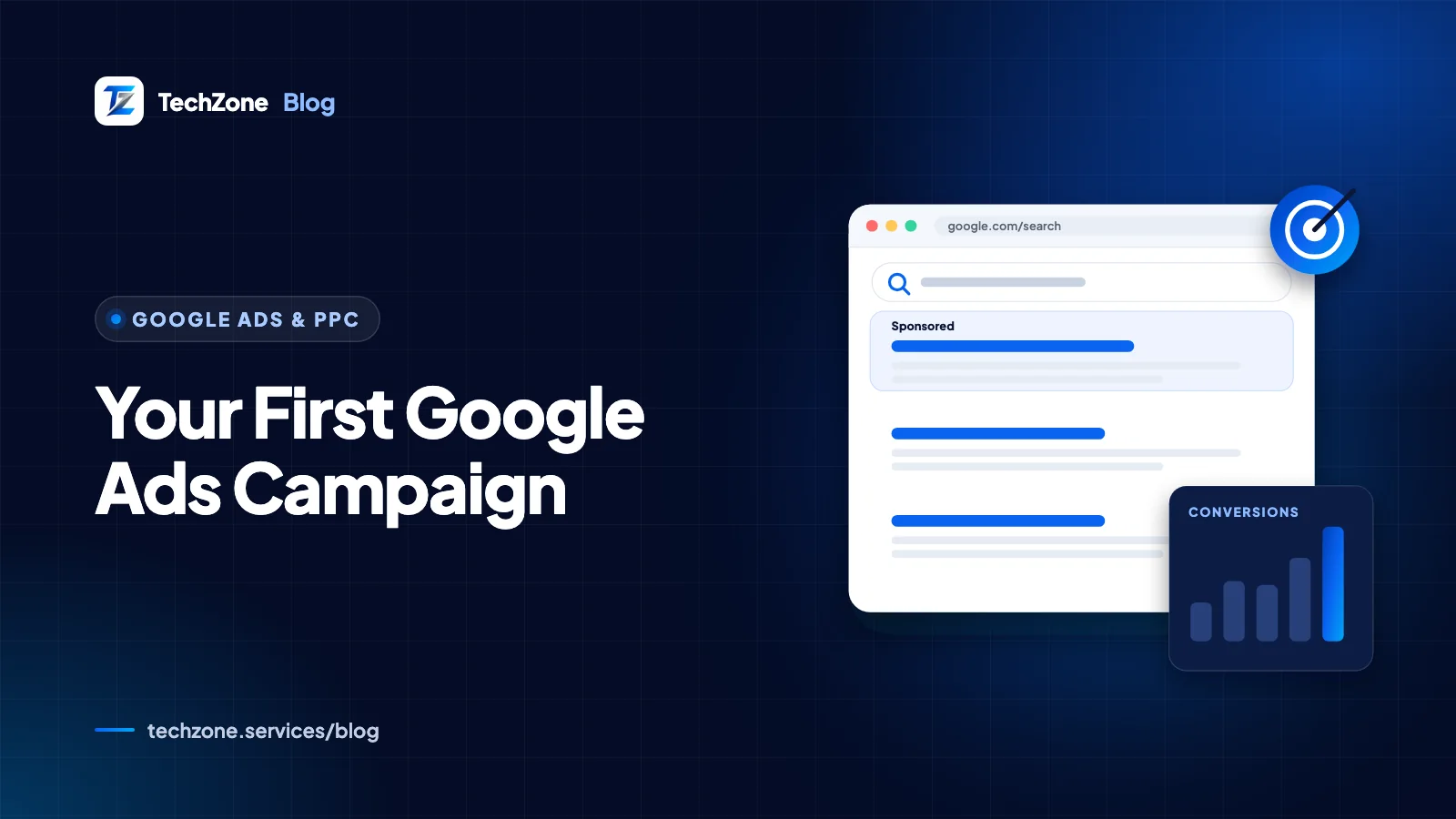
For most service businesses, a Search campaign is the right first campaign. It puts your ad in front of people actively looking for your service, gives you control at the keyword level, and shows you exactly which searches you paid for.
| Campaign type | Where ads show | Good first use | Watch out for |
|---|---|---|---|
| Search | Google search results, plus optional search partner sites | Service businesses and anyone with clear search demand | Needs tight keywords, negatives and a matching landing page |
| Performance Max | Search, YouTube, Display, Discover, Gmail and Maps from one campaign | Online stores with a product feed, or lead generation once tracking is reliable | Less control and visibility; needs conversion data and good creative |
| Shopping | Product listings in search results and the Shopping tab | E-commerce stores | Requires a Google Merchant Center account and a clean product feed |
| Demand Gen | YouTube (including Shorts), Discover and Gmail | Building demand with images and video | Rarely the best first campaign for a local service |
| Video | YouTube and video partner sites | Awareness and remarketing with video | Needs video assets and patience to measure |
| Local Services Ads | A separate unit at the top of Google search results | Eligible home, professional and health services | Only in selected countries and categories, such as the US and UK; you pay per lead |
| Smart campaigns | Search, Maps, YouTube and partner sites | Owners who want minimal setup | Far less control, and only available in Smart Mode |
Performance Max can work for small businesses, especially stores with a Merchant Center feed, but it needs trustworthy conversion data and enough budget to learn. Our guide to when Performance Max works for small businesses walks through that decision.
How to run Google Ads for small business: account setup
Create the account first and the campaign second. Google’s sign-up guide recommends exactly that and lets you skip the campaign prompts, so you don’t launch a rushed campaign just to finish registering.
- Sign up with a business Google account, add your business name and website, and choose the option to create an account without a campaign.
- Choose billing country, currency and time zone carefully. Google fixes the currency and time zone when the account is created; changing either means opening a new account. Your billing country also decides which payment methods and currencies you can use. Billing problems can get a new account suspended; see what to do if your Google Ads account is suspended.
- Pick the right payments account type. Organization and Individual are permanent choices, and the business name should match your registration documents, because advertiser verification checks it.
- Choose how you pay. Depending on country and currency, Google offers postpay (formerly automatic payments), prepay (formerly manual payments) or, for eligible businesses, monthly invoicing.
- Complete advertiser verification when asked. Google says all advertisers will eventually need to verify, and some ads can be restricted until the tasks are done by the deadline.
- Set up conversion tracking before your first click. Track form submissions, calls, WhatsApp clicks and purchases with the Google tag or by importing Google Analytics 4 key events, and mark the actions that matter as primary. Our guide to setting up Google Ads conversion tracking covers forms, calls and sales.
- Link Google Analytics 4 and your Google Business Profile, so you can see what happens after the click and use location assets in your ads.
Pakistan note
Currency options depend on your billing country, and the choice is permanent, so decide deliberately between PKR and any other currency offered. If you need valid tax invoices, Google asks for your NTN, your Sindh Sales Tax registration number where applicable, and a name and address that match your tax registration. Google’s billing entity and tax treatment for Pakistani accounts are changing during 2026; our budget guide explains what that means for your spend.
How should you structure your first Search campaign?
Keep it simple: one campaign per budget and location, and one ad group per service. A Google Ads account runs from the account, to campaigns (budget, bidding, locations, networks), to ad groups (keywords and the ads that answer them).
Example
A dental clinic in Dubai might run one campaign called “Dental – Dubai” with three ad groups: teeth whitening, dental implants and emergency dentist. Each ad group holds a small set of closely related keywords and ads that name that treatment, and sends clicks to that treatment’s page, not the home page.
| Setting | Starting point | Why |
|---|---|---|
| Networks | Keep Google search; leave Display Network unticked; test search partners later | Keeps the budget on people who are actively searching |
| Locations | Your real service area; consider the “Presence” option (people in or regularly in your locations) | The default also reaches people merely interested in the area, which suits travel more than local services |
| Languages | The languages your customers search in, such as English and Urdu, or English and Arabic | Your ads and keywords should be written in the languages you target |
| Ad schedule | All hours at first, or only the hours someone can answer calls | Calls that ring out are paid clicks with no return |
| Bidding | Maximize clicks for the first days, then Maximize conversions once tracking works | Explained in the budget section below |
| AI Max | Selected by default; limit or switch off search term matching until conversions are steady | Its matching features rely on conversion-based Smart Bidding |
| Budget | A daily amount you can hold steady for at least a month | Frequent changes restart automated bidding’s learning |
If you’re unsure about the AI Max setting, our explainer on AI Max for Search campaigns covers each feature and when to turn it on.
How do you choose keywords and match types?
Choose keywords that show buying intent for services you actually sell, in places you actually serve. “Emergency plumber Dubai Marina” is usually a customer; “how to fix a leaking tap” is usually someone planning to do it themselves.
- List each service and the words customers use for it, including local terms and the Roman Urdu or Arabic phrasing your customers type.
- Open Keyword Planner from the Tools menu and choose Discover new keywords. You need to finish account setup, including billing details, before it shows ideas.
- Set the location and language to your market, then check average monthly searches and the top of page bid range, which reflects what advertisers paid for top positions over the last 30 days.
- Group keywords by service into ad groups, starting with the terms closest to a purchase.
- Add obvious negative keywords before launch, such as jobs, salary, free and course, and keep adding them from the search terms report.
Match types decide how closely a search must relate to your keyword. Broad match reaches related searches, phrase match requires the meaning of your keyword, and exact match requires the same meaning or intent. Google recommends pairing broad match with Smart Bidding; on a small budget without conversion history, we usually start with phrase and exact. Our guide to Google Ads keyword match types compares them with example searches.
Negatives are the other half of keyword selection, and they matter more as matching gets broader. Our negative keywords guide includes starter lists by business type.
How do you write ads and choose landing pages that convert?
Repeat the searcher’s need, prove you can meet it, and say what happens next, then send the click to a page about that exact service. Search ads are responsive search ads: you supply the parts and Google assembles the combinations.
- Headlines: up to 15, each up to 30 characters. Cover the service and location, a proof point such as reviews or years trading, an offer, and a call to action.
- Descriptions: up to 4, each up to 90 characters, expanding on the benefit and answering doubts about price, response time or process.
- Pinning: pin only text that must always appear, such as a required disclaimer, because every pin reduces the combinations Google can test.
- Two or three ads per ad group: Google allows three enabled responsive search ads per ad group and recommends at least two with Good or Excellent Ad Strength.
Then add assets. They cost nothing to add and only show when Google predicts they will help, and Google suggests using four or more types:
- Sitelinks to pages such as pricing, reviews or booking.
- Callouts for short proof points, like “Same-day visits” or “Female doctors available”.
- Call assets, scheduled for the hours someone can pick up.
- Location assets from your linked Google Business Profile.
- Structured snippets listing services or brands, plus image assets where eligible.
The landing page should match the ad’s promise, load fast on a phone, show the phone number or WhatsApp button and a short form near the top, and give visitors reasons to trust you. If your service pages don’t do that, build a dedicated page before you raise bids; our Google Ads landing page checklist covers layout, speed and forms.
Google Ads for small business cost: what to spend and how to bid
Google Ads has no minimum spend; the right figure comes from your numbers. Start with what a new customer is worth, how many leads turn into customers, and Keyword Planner’s click cost estimates for your own market, then set a budget that buys enough leads to judge the campaign.
You set an average daily budget for each campaign. Google may spend up to twice that on a busy day, but for most campaigns it won’t bill more than 30.4 times the daily figure in a calendar month. Our guide to how much to spend on Google Ads sets out the full method with a worked example.
Which bidding strategy should you start with?
- Maximize clicks can gather first data in a new account, but it optimizes for clicks, not leads. Move on as soon as conversions are recording.
- Maximize conversions suits most accounts once tracking works; it aims to spend the full budget on the most conversions.
- Target CPA fits once you know your real cost per lead; Google suggests judging it over 30 days that include at least 30 conversions.
- Maximize conversion value or Target ROAS suit stores and businesses that pass real sale values back to Google Ads.
Two 2026 changes are worth knowing. From June 2026, Google started labeling “Maximize conversions with a Target CPA” simply “Target CPA” (and the same for Target ROAS), with no change in how bidding works. And since August 17, 2026, campaigns limited by budget that use Target CPA or Target ROAS aim closer to the target you set, so enter a target you would genuinely accept. Whatever you choose, allow a 7 to 14 day learning phase without changes.
Google Ads strategies for small businesses: your first 30 days
Check daily in the first week, then settle into a weekly routine. Early gains usually come from blocking wasted searches and fixing tracking, not from bid changes. If you would rather hand this routine to someone else, that is exactly what our Google Ads management covers.
| When | What to check | What to do |
|---|---|---|
| Day 1 | Ads approved, conversions recording, calls reaching a person | Fix disapprovals; submit a test inquiry and confirm it is recorded (allow a few hours) |
| Days 2 to 7 | Search terms report every day | Add irrelevant searches as negatives; pause keywords that attract the wrong people |
| Week 2 | Clicks, clickthrough rate and cost per click by keyword | Rewrite weak headlines; confirm location, language and schedule settings |
| Week 3 | Conversions and cost per conversion by ad group | Shift budget toward ad groups that produce leads; improve pages for the rest |
| Week 4 | Lead quality, with your sales team or CRM | Keep only real-customer actions as primary conversions; plan the next test |
At day 30, compare your cost per lead with the figure you said you could afford. If it’s in range, keep going and consider testing broader matching or AI Max. If not, fix the weakest link first: search terms, ad relevance, the landing page or how quickly you follow up. If the numbers never work, weigh the slower route in our comparison of SEO vs PPC.
How TechZone can help
TechZone manages Google Ads for small businesses in Pakistan and abroad. Every engagement begins with conversion tracking and a landing page that matches the ad, followed by a tightly scoped Search campaign and a weekly search term review. We also build pages for paid traffic, such as the landing website for Bahawalpur Water Transport in Dubai. If you would rather hand the account over, our Google Ads management covers setup, optimization and reporting. To talk through your account, book a free 30-minute consultation, or read about our digital marketing services; scope and cost are agreed in writing first.
Frequently asked questions
How long does it take for Google Ads to start working?
Google Ads can start showing within hours once ads are approved and billing is set up, but judging performance takes longer. Google says Smart Bidding needs a 7 to 14 day learning phase, and Performance Max should run at least six weeks before comparing results. Plan to evaluate a new Google Ads campaign on a full month of data, with conversion tracking working from the first day.
Can I run Google Ads myself without an agency?
Yes. Many small businesses run Google Ads themselves using Keyword Planner, the search terms report and Google’s help center. The cost is time: a new campaign needs daily checks in its first week and a weekly review after that. Owners often bring in help when conversion tracking gets complicated, when costs rise without more leads, or when there is no time for weekly search term reviews.
Can a business in Pakistan advertise to customers in the UK or UAE?
Yes. A Google Ads account can target any location Google Ads supports, regardless of where the business is based. Set the campaign’s locations and languages to the target market, write ads for that audience, and send clicks to a page that lists local contact options and prices in the local currency. The account’s own currency and time zone are fixed at setup, so choose them with reporting and billing in mind.
What is the difference between Google Ads and a Google Business Profile?
A Google Business Profile is a free listing that can appear in Google Maps and local results, while Google Ads is paid advertising charged mostly per click. The two work together: linking a Google Business Profile to Google Ads lets your ads show location assets with your address and directions, and a well-reviewed profile makes people more likely to trust your ads.
Should a small business bid on its own brand name?
Bidding on your own brand name protects the top of the page when competitors bid on your name, but it rarely brings in customers who weren’t already looking for you. Put brand keywords in a separate campaign with its own small budget, so brand clicks don’t hide how your non-brand keywords perform. If nobody else bids on your name, test pausing brand ads and watch whether total leads change.
Sources and further reading
- About Ad Rank – Google Ads Help
- Choose the right campaign type – Google Ads Help
- About your language, number format, time zone, and currency settings – Google Ads Help
- About responsive search ads – Google Ads Help
- Set up AI Max for Search campaigns – Google Ads Help
- About Target CPA bidding – Google Ads Help