
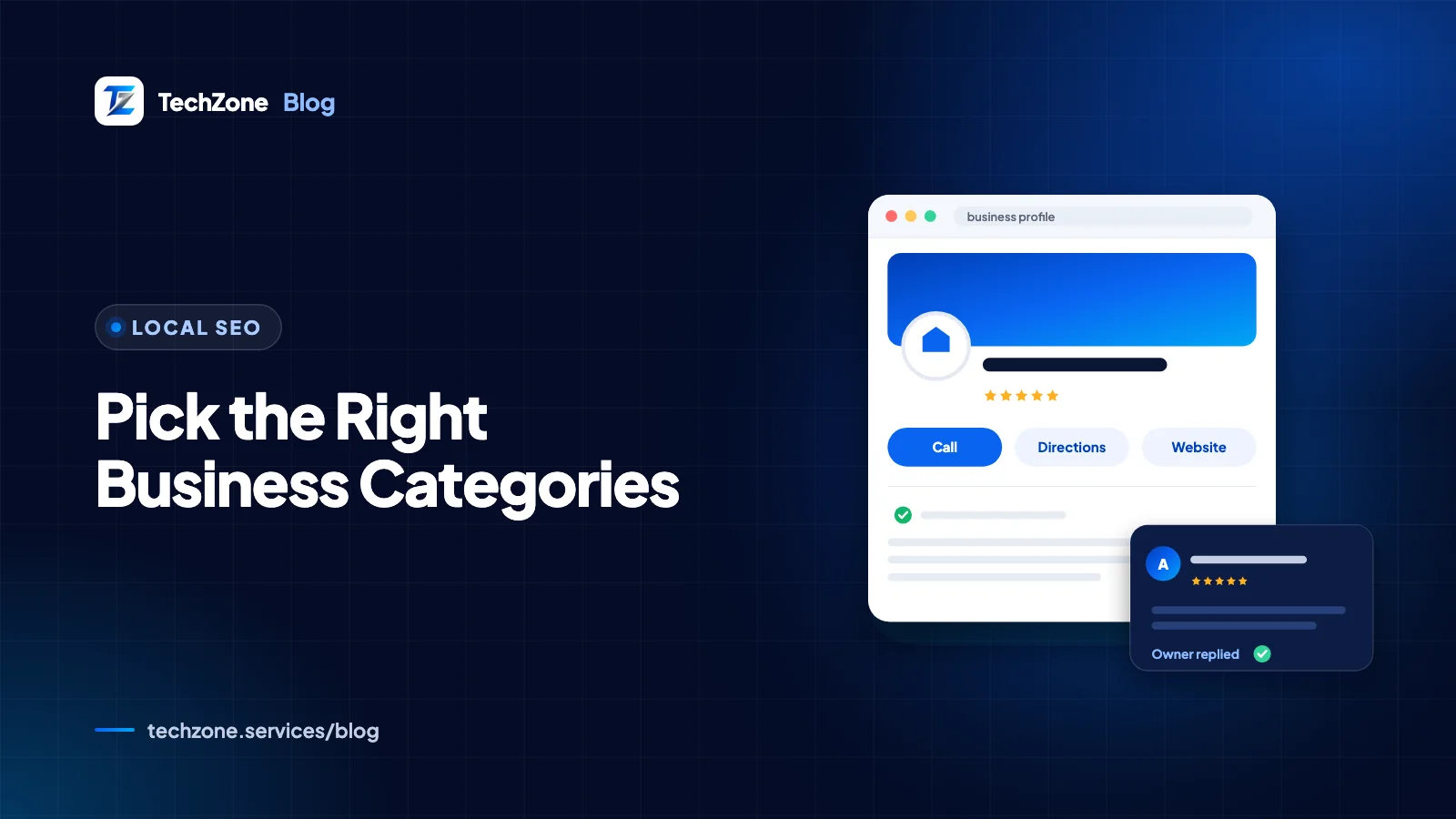
Google Business Profile categories tell Google what your business is. You choose one primary category, the most specific description of your core business, and up to 9 additional categories for other things your business genuinely is. Categories affect your local ranking and the features your profile gets, so choose them from Google’s list with care, never as keywords.
Google’s rule fits in one line: pick categories that complete the sentence “This business IS a,” not “this business HAS a,” and use as few as possible. This guide turns that rule into a method: choosing the primary category, deciding when a secondary category earns its place, researching competitors and testing a change without guessing.
Key takeaways
- Your primary category carries the most weight; choose the most specific option that describes your core business, such as Pizza restaurant rather than Restaurant.
- You can add up to 9 additional categories, but Google says to use as few as possible, and each must pass the IS-a test.
- Individual services, products and amenities belong in the services editor and attributes, not in extra categories.
- Adding or editing categories can trigger re-verification, so change one at a time and compare full months of Performance data.
What are Google Business Profile categories, and why do they matter?
Categories are labels from a fixed Google list that describe what your business is. They decide which searches your profile can match, which features it gets and, according to Google, how it ranks locally.
- Search matching: Google’s example is a business with the primary category Pizza restaurant, which may appear for searches such as restaurants, Italian restaurants or pizza.
- Ranking: Google states that the categories you select affect your local ranking.
- Features: some categories come with extra options. Hotels can show class ratings and amenities, restaurants can add menus and ordering or reservation links, and health and beauty businesses can add a booking button and a services list.
- Broader categories come free: Google says a specific category implicitly includes more general ones, so you can skip categories that are redundant with a more specific choice.
Local SEO specialists rate the primary category just as highly. In Whitespark’s 2026 Local Search Ranking Factors report, which ranks factors by the votes of its expert contributors, the primary category came first for local pack and Maps rankings.
How many categories can you add to Google Business Profile?
One primary category plus up to 9 additional categories, so 10 in total. The limit isn’t a target: Google’s guidelines tell you to use as few categories as possible to describe your overall core business.
That settles the common debate about filling every slot. Google gives no sign that more categories help, and categories that don’t describe your business put the profile out of line with its rules. Add a secondary category only when it passes all three of these tests:
- It completes the sentence “This business IS a…” for a real part of what you do.
- You’d be glad to be found by someone searching for exactly that type of business.
- Your website has a page that supports it, since Google also detects category information from your website and from mentions of your business elsewhere online.
How do you choose the primary category on Google Business Profile?
Choose the most specific category that describes the core of your business: what most customers come for and what you’d tell a stranger you are. If there’s no specific match, choose a more general one, because you can’t create your own.
- Define your core business. Write one sentence starting “We are a…” based on what brings in most of your customers, not your newest sideline.
- Search Google’s list. Go to Edit profile, open Business category and type candidate words into the primary category box. Only categories on Google’s list appear, so try synonyms: the English list has Physical therapist and Physical therapy clinic, but no Physiotherapist category.
- Pick the most specific match. Google’s own example is choosing Nail salon rather than a generic salon.
- Check the map results. Search for your main service in your area and note the categories shown on the top-ranking profiles (the next section explains how).
- Align your website. Make sure your home page title and main heading describe the same business as your primary category.
- Keep branches consistent. If several locations offer the same service, Google requires them to share the same primary category.
How do you research competitors’ categories?
Look at what the businesses already ranking for your main searches use, then decide what fits you. Treat it as research, not a template: a competitor’s category is only useful if it’s also true of your business.
- Search your core service plus your city on Google Maps and list the top five or so profiles.
- Note the category shown under each business name, which is typically its primary category.
- Secondary categories aren’t displayed on the public profile, but third-party local SEO tools, such as PlePer’s category tools and browser extension, can reveal them.
- Record what you find in a simple table: competitor, map position, primary category and secondary categories.
- Look for patterns. If most top-ranking competitors share a primary category that describes you better than your current one, test it; if they rank with a category that isn’t true of you, ignore it.
If you’d rather not run this research yourself, our local SEO specialists can do it as part of a profile review.
Which secondary categories should you add?
Add a secondary category for each distinct department or second type of business you operate, and nothing else. Google’s own example is a grocery store with a bakery and a deli: Grocery store as the primary category, with Bakery and Deli as additional ones.
- Not every service: Google says not to select a category for every product or service. A plumber doesn’t need a category per job; the services editor handles items like installing a faucet or repairing a toilet.
- Not amenities: a motel with a pool is a Motel, not a Swimming pool.
- Not businesses inside yours: if an independently run cafe operates in your health club, the cafe gets its own profile and you don’t add Cafe.
- Not the business you’re inside: a coffee shop operating inside a bookstore uses Coffee shop only, and the bookstore doesn’t add it either.
Google Business Profile category examples by business type
The table gives sensible starting points, using category names from Google’s English list as of September 2026. Names change and a few vary by country, so confirm each one in your own category box before you save.
| Business | Primary category | Secondary categories to consider | Usually leave out |
|---|---|---|---|
| Family dental practice | Dentist | Cosmetic dentist, Pediatric dentist, Emergency dental service (only if offered as distinct services) | Orthodontist, unless an orthodontist practices there |
| Pizzeria with dine-in and delivery | Pizza restaurant | Pizza delivery, Takeout restaurant | Italian restaurant, unless the menu goes well beyond pizza |
| Hair and beauty salon | Beauty salon | Hair salon, Nail salon, Eyelash salon | Day spa, unless you run spa facilities |
| Plumber working at customers’ homes | Plumber | Drainage service, Water damage restoration service (if you do that work) | A category for every job; use the services list |
| Digital marketing agency | Internet marketing service or Marketing agency | Website designer, Advertising agency, Graphic designer | Software company, unless you sell software products |
| Family law practice | Family law attorney | Divorce lawyer, Lawyer | Practice areas you don’t take on |
| Physiotherapy clinic | Physical therapy clinic | Physical therapist, Sports medicine clinic | Physiotherapy equipment supplier, which is a supply store category |
| Solar installation company | Solar energy company | Solar energy system service, Solar energy equipment supplier | Electrician, unless you take general electrical work |
| Wedding hall | Wedding venue | Banquet hall, Event venue, Caterer (only if you cater in-house) | Wedding photographer, unless it’s an in-house service |
Two gaps catch people out. When we checked in September 2026, the English list had no SEO agency or Digital marketing agency category, so agencies choose between options such as Internet marketing service and Marketing agency. And if you want to browse everything, third-party trackers such as PlePer publish the full list by country and language.
Which category mistakes should you avoid?
Check your profile for these mistakes, most of which come from treating categories as keywords:
- A broad primary category when a specific one exists, such as Restaurant for a pizzeria.
- Keyword categories added for services or features, which Google’s guidelines forbid.
- Filling all 10 slots with loosely related categories.
- Frequent switching of the primary category, for example by season. Each change is reviewed and can trigger re-verification, and constant changes make results impossible to measure.
- Inconsistent branches that use different primary categories for the same service.
- A website that says something else, such as a profile categorized as Family law attorney with a home page about general litigation.
Categories work best when every other local signal agrees with them; our local SEO checklist covers those signals, from citations to location pages.
How do you change a category and test the result?
Edit categories from your profile, then measure the effect over full months before changing anything else. Google warns that adding or editing a category may prompt it to ask you to verify the business again, so treat every change as a small, planned test.
Where to edit
Go to your Business Profile, select Edit profile, then the edit icon next to Business category. Type into the Primary category box and pick from the list, use Add another category for secondary ones, and select Save.
A simple test method
- Record a baseline. Note at least three months of Performance data: views, the search terms people used, calls, website clicks and direction requests.
- Change one category only. Log the date and exactly what changed.
- Wait at least one full month. Google updates the searches metric at the start of each month, so shorter windows can mislead.
- Compare like with like. Check the same metrics, plus a few core searches from different parts of your area, and allow for seasonal swings.
- Keep or revert. If calls, clicks and relevant search terms held steady or improved, keep the change; if they dropped, switch back and wait before the next test.
Watch for alerts in Edit profile, too. If Google receives reports that your information is inaccurate, it may update the profile and notify you, so review any category change it suggests rather than accepting it blindly.
Categories are one part of the profile: our Google Business Profile optimization checklist covers every other field, and our guide on how to rank higher on Google Maps shows where categories sit among the other ranking factors.
How TechZone can help
If you’re unsure which categories fit, or a change has cost you calls, our SEO and local SEO team can research the categories your top competitors use, map them to your real services and run a measured test with before-and-after reporting. We then check that your services list, description and website all point in the same direction. Book a free 30-minute consultation to review your current setup.
Frequently asked questions
Can I create a custom category on Google Business Profile?
No. You can only choose categories from Google’s list, and Google says that if the specific category you want isn’t available, you should select a more general one that still describes your business. Google’s help pages also describe sending feedback to request a new category, but there’s no guarantee a requested category will be added.
Does my Google Business Profile category change the icon on Google Maps?
Yes. Google’s documentation notes that the Google Maps icon shown for a business depends on the category it sets, which is why a restaurant, a hotel and a dentist appear with different icons on the map. That is one more reason to choose a primary category that matches what customers expect to find when they arrive.
Where can I find the full list of Google Business Profile categories?
Inside Google, the list lives in the category field: typing into it shows only the categories you’re allowed to choose. Google’s help pages don’t offer a downloadable list, so third-party trackers such as PlePer publish the full Google Business Profile categories list by country and language, including when each category was first seen.
Do all my business locations need the same primary category?
If the locations provide the same service, yes. Google’s guidelines require all locations of a business to share the one category that best represents it. Where you run different types of locations, such as retail stores and a distribution center, the rule applies within each group, so each group of locations can have its own primary category.
What is the difference between categories and attributes?
Categories describe what your business is, such as Bakery or Dentist, and affect which searches you match. Attributes describe features, such as Wi-Fi, outdoor seating, a wheelchair-accessible entrance or accepted payment methods. Google’s guidelines say not to use categories to describe attributes, so amenities like Wi-Fi or parking belong in the attributes section of your profile.
Sources and further reading
- Manage your business category – Google Business Profile Help
- Guidelines for representing your business on Google – Google Business Profile Help
- Edit your Business Profile – Google Business Profile Help
- Understand your Business Profile performance & insights – Google Business Profile Help
- 2026 Local Search Ranking Factors – Whitespark
- Google Business Profile Categories – Full List (2026) – PlePer