
Here is how to plan a mobile app from idea to MVP: validate the problem with real users, study competing apps, cut the feature list to a must-have MVP, map user flows, choose the platform and backend, check Apple’s and Google’s store requirements, then set a budget, analytics and launch plan before development starts.
Planning is where you control cost. A clear plan lets developers quote accurately, keeps the first release small enough to ship, and surfaces store rules, such as account deletion, while they’re cheap to handle.
Each step ends with a written output, and the checklist at the end collects them into a brief for any developer. The logic mirrors the website development process, with app store rules added.
Key takeaways
- Validate the problem with real target users before designing screens; a one-sentence problem statement keeps later decisions honest.
- An app MVP is the smallest stable release that lets one user group complete the core task; sort features into must, should, could and won’t.
- Open Apple and Google developer accounts early: organization accounts need a D-U-N-S number, which Google says can take up to 30 days.
- New personal Google Play accounts must run a closed test with at least 12 testers for 14 days before production access.
- Budget for maintenance from day one, because Apple and Google keep raising their SDK and target API requirements.
Step 1: Validate the problem, the audience and the competition
Prove that a specific group of people has a problem worth solving with an app, and that existing options leave a gap. The output is a one-page brief: problem, audience, business goal and competitors.
Write a one-sentence problem statement
Use this pattern: [audience] struggles to [task] because [obstacle], which costs them [time, money or frustration]. Example: “Salon clients in Lahore struggle to book a same-day appointment because they have to phone during busy hours and wait for a callback.” If you can’t fill in the pattern without vague words like “better” or “easier”, the idea needs more work.
Then add the business goal the app serves, such as more repeat bookings, fewer support calls or a new revenue stream, and the one number that will tell you it’s working.
Talk to the people who will use it
- Interview a handful of target users about how they handle the problem today. Don’t ask whether they’d download your app; people are polite about products that don’t exist.
- Check demand signals you already own: repeated customer requests, support tickets, WhatsApp messages and website searches.
- Test a landing page or clickable prototype first: sign-ups or deposits are stronger evidence than compliments.
- Ask whether it needs to be an app at all. If customers only need you once a year, a fast mobile website may serve them better.
Study competitor apps and their reviews
Search the App Store and Google Play for the tasks your users described, not competitor names. For each leading app, record its core tasks, business model, rating, last update and the recurring complaints in its one- to three-star reviews: a free list of what users want and don’t get. Finish with one line on the gap you’ll fill.
Step 2: How do you define an app MVP?
An app MVP (minimum viable product) is the smallest release that lets one user group complete the core task from start to finish, well enough to come back. It isn’t a demo: it must be stable, secure and publishable, just narrow.
Sort features with MoSCoW
List every feature idea, then sort each into Must have, Should have, Could have or Won’t have (this release). A feature is a must only if the core task fails without it. Build the musts, add shoulds only where they’re cheap, and park the rest for version two.
| Feature | Priority | Reason |
|---|---|---|
| Browse services and prices | Must | The core task starts here |
| Book a slot with a chosen stylist | Must | This is the core task |
| Sign in with phone number and one-time code | Must | Needed to manage and change bookings |
| Delete account in the app | Must | Apple and Google require it when users can create accounts |
| Staff screen to manage availability | Must | Without it, bookings can’t be trusted |
| Push reminder before the appointment | Should | Useful, but SMS or WhatsApp reminders can cover launch |
| Pay a deposit online | Should | Adds a payment gateway integration |
| Loyalty points | Could | Worth adding once there are repeat users |
| In-app chat with the salon | Won’t (this release) | WhatsApp already covers it |
Write user stories with acceptance criteria
Turn each must into a user story, such as “As a client, I want to see free slots for my stylist so I can book without calling.” Add acceptance criteria that define done, such as “a booked slot disappears for everyone else”. Developers estimate against these, so vague stories produce vague quotes.
Step 3: Map user flows and wireframes
A user flow shows every screen and decision on the way to finishing a task; a wireframe sketches each screen’s layout without visual design. Together they reveal missing screens before they become change requests.
- Map the core flow first: first launch, sign-up or guest access, the core task and the confirmation.
- Add the unhappy paths: no internet, a failed payment, an expired session, no search results and empty states.
- Place permission requests in context: ask for location or notifications when the user reaches the feature that needs them, not on first launch.
- Include the admin side: who approves, edits or refunds, and on which screen or panel.
- Prototype and test: link the wireframes into a clickable prototype in a tool such as Figma and watch a few target users try it.
This is the cheapest point to change your mind: moving a button in a prototype takes minutes, while in a finished app it means code, testing and a new store release. Our UI/UX design service covers flows, wireframes and prototype testing.
Step 4: Choose the platform, technology and backend
Decide which platforms you need at launch and what sits behind the app; both shape cost more than any single feature. The output is a short technical decision note.
Platform and framework
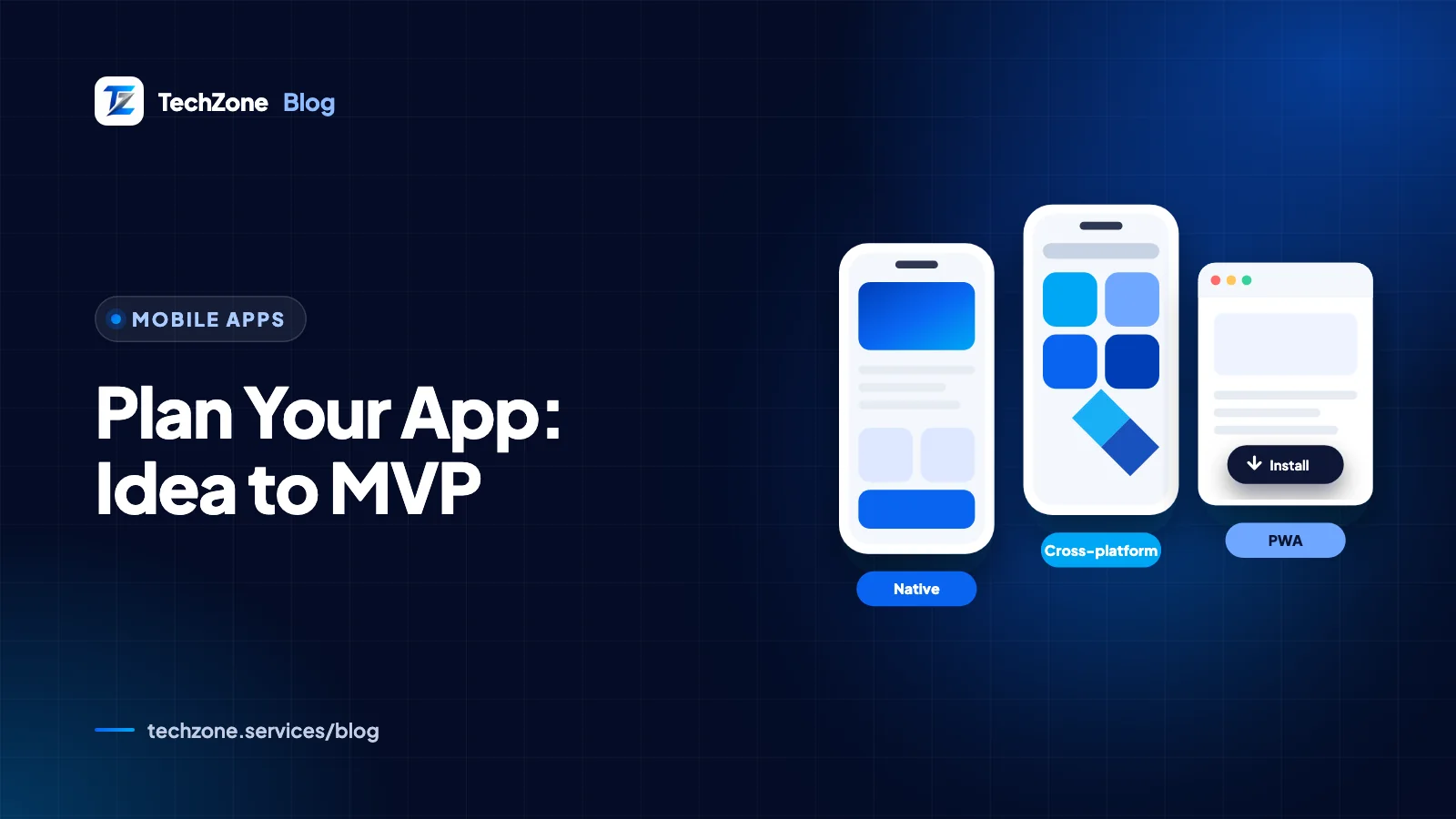
Choose between native apps, one cross-platform app or a progressive web app (our comparison of native, cross-platform and PWA apps covers this), then a framework, using our Flutter vs React Native comparison. For the plan, record whether you need iOS, Android or both at launch, the oldest OS versions you’ll support, and hardware features such as camera, location, Bluetooth or NFC.
Backend, admin panel and integrations
Behind the app sit a backend API, a database, an admin panel for staff and connections to other systems. List each one, who owns it and whether it already exists.
- Login: email, phone code, or Google and Facebook sign-in. If you use a third-party login for the main account, Apple requires an equivalent privacy-focused option, such as Sign in with Apple.
- Payments: Apple requires in-app purchase to unlock digital features and content, and Google Play Billing covers digital goods, while physical goods and real-world services use your own payment gateway.
- Notifications: push through Apple Push Notification service and Firebase Cloud Messaging, plus SMS, email or WhatsApp providers.
- Existing systems: POS, ERP, CRM, booking or inventory software, and whether each has a usable API.
Pakistan note
If your app sells physical goods or services in Pakistan, such as food, fashion or salon appointments, store billing doesn’t apply, so you can offer card payments, mobile wallets or cash on delivery. Add your payment provider’s integration and merchant approval to the plan.
Step 5: What do Apple and Google require before you launch?
Both stores need a verified developer account, a privacy policy, accurate data disclosures and, if users can create accounts, a way to delete them. Plan these now, because some take weeks and some add features to your MVP.
| Requirement | Apple App Store | Google Play |
|---|---|---|
| Developer account | Apple Developer Program: 99 USD per membership year, shown in local currency | Play Console: US$25 one-time registration fee |
| Company accounts | D-U-N-S number, a legal entity, a company-domain email and a public website | D-U-N-S number, organization website and verified contact details |
| Privacy | Privacy policy link in App Store Connect and inside the app, plus App Privacy details | Privacy policy link and a completed Data safety form |
| Account deletion | Must be offered within the app if users can create accounts | An in-app path plus a web link for deletion requests |
| Pre-launch testing | TestFlight for internal and external beta testers | New personal accounts: closed test with at least 12 testers for 14 days |
| Review | 90% of submissions reviewed in under 24 hours, on average | Production access review for new personal accounts typically takes seven days or less |
Apple also asks for a demo account and a working backend at review time if your app has a login, and expects more than a repackaged website.
Watch out
Open the developer accounts in your company’s name, not a freelancer’s. Google says a D-U-N-S number can take up to 30 days, and you can’t create an organization account without one, so apply during planning.
Step 6: What drives the cost and timeline of an app?
Scope drives cost: platforms, user roles, screens, integrations and custom design. Compare quotes against your written MVP scope, not headline prices, and ask every developer, including our app development team, to price the same document.
| Driver | Lower effort | Higher effort |
|---|---|---|
| Platforms | One platform, or one cross-platform codebase | Separate native iOS and Android apps |
| User roles | One type of user | Customers, staff, admins and vendors, each with their own screens |
| Design | Standard components with your branding | Custom illustration, animation and bespoke interactions |
| Backend | An existing API or a managed backend service | A new backend, admin panel and reporting built from scratch |
| Integrations | None, or one well-documented API | Payments, POS or ERP, maps and messaging together |
| Offline and real-time | Online-only screens | Offline sync, live tracking or chat |
Waiting times you can’t compress
- D-U-N-S number: up to 30 days.
- Google Play closed testing: 14 days for new personal accounts, then the production access review.
- App Store review: usually quick, but each rejection adds another fix-and-resubmit cycle.
- Third-party approvals: payment gateway merchant accounts and partner API access often need paperwork.
Budget for life after launch
Google Play requires new apps and updates to target Android 16 (API level 36) from August 31, 2026, and since April 28, 2026 Apple only accepts uploads built with Xcode 26 and the matching SDKs. These move every year, on top of bug fixes, package upgrades and server costs, so an app with no maintenance budget soon can’t be updated.
Step 7: Plan analytics, testing and launch
Decide what you’ll measure and how you’ll test before development starts, so tracking is built in from the start.
Define the numbers that matter
Pick one outcome metric tied to your business goal, such as bookings per week, plus supporting ones: installs, sign-up completion and retention. Google Analytics for Firebase is free, works with iOS, Android and Flutter apps, and reports on up to 500 distinct events you define, such as booking_completed. Mark the outcome event as a key event, and add crash reporting, such as Firebase Crashlytics, from the first test build.
Test before the stores do
- Test with your team on real, low-cost phones, not only emulators and flagship devices.
- Run a beta through TestFlight on iOS and a Play Console testing track on Android.
- Prepare store assets early: app name, description, screenshots, privacy policy URL and support contact.
Plan the launch
Decide how the first users will find the app: existing customers by email and WhatsApp, a QR code on your website and in store, and a clear store listing. Our guide to WhatsApp marketing for small businesses covers the WhatsApp side. Schedule the first update before launch, so week-one feedback has somewhere to go.
Mobile app planning checklist
Confirm every row before you request quotes or start development.
| # | Phase | Checklist item | Output |
|---|---|---|---|
| 1 | Validate | Problem statement and business goal written | One-page brief |
| 2 | Validate | Target users interviewed and demand tested | Interview notes and test results |
| 3 | Validate | Competitor apps and reviews analyzed | Competitor sheet with your gap |
| 4 | Scope | Features sorted into must, should, could and won’t | MVP feature list |
| 5 | Scope | User stories with acceptance criteria | A backlog developers can estimate |
| 6 | Design | Core and unhappy-path user flows mapped | Flow diagram |
| 7 | Design | Clickable prototype tested with target users | Prototype and feedback notes |
| 8 | Technology | Platforms, minimum OS versions and approach chosen | Technical decision note |
| 9 | Technology | Backend, admin panel and integrations listed with owners | Integration list |
| 10 | Stores | Developer accounts opened in the company’s name | Active Apple and Google accounts |
| 11 | Stores | Privacy policy, data disclosures, account deletion and payments planned | Compliance notes |
| 12 | Budget | Quotes compared on the same scope; maintenance budgeted | Approved budget and timeline |
| 13 | Launch | Events, key event and crash reporting defined | Tracking plan |
| 14 | Launch | Beta testing, store assets and launch channels ready | Launch plan |
How TechZone can help
TechZone plans and builds cross-platform mobile apps with Flutter. We start with a discovery session that turns your idea into an MVP scope, user flows and a technical plan, then agree scope, timeline and cost in a written proposal before development begins. See what’s included in our mobile app development services, or book a free 30-minute consultation and bring your idea: we’ll work through this checklist with you.
Frequently asked questions
How long does it take to plan a mobile app?
The time needed to plan a mobile app depends on how clear the idea is, how many people must sign off and how many systems the app connects to, so there’s no standard number of weeks. The slowest items are often outside your control, such as a D-U-N-S number or partner API access, so start those on day one and run them alongside the planning work.
Do I need a business plan before building an app?
An app doesn’t need a formal business plan, but it does need the answers one would contain: who pays, how the app makes or saves money, what it costs to run after launch, and which number proves it’s working. Write these down in a page or two. Developers, investors and your own team will make better decisions with them in hand.
Can I build an app MVP without coding?
No-code builders can produce a clickable prototype or a simple app MVP quickly, which is useful for testing demand. Check the limits before committing: platform lock-in, fees that grow with users, restricted custom features, and whether you can export your data and code. Many businesses validate with a no-code build or prototype, then build the production app with a framework.
Should I ask a developer to sign an NDA before sharing my app idea?
A non-disclosure agreement is reasonable when you share confidential business information, such as customer data, pricing or partner terms, and most established agencies will sign a mutual NDA. An app idea on its own is hard to protect and rarely the valuable part; execution is. Share enough detail to get an accurate quote, and keep sensitive data out of early conversations.
Who owns the source code of my app?
Ownership of an app’s source code depends on your contract, not on who paid the invoice. Make sure the written agreement assigns intellectual property to your company, gives you access to the code repository, and keeps the Apple and Google developer accounts in your company’s name. Without those terms, changing developers later can mean rebuilding the app.
Sources and further reading
- Become a member of the Apple Developer Program – Apple Developer
- App Review Guidelines – Apple Developer
- Required information to create a Play Console developer account – Play Console Help
- App testing requirements for new personal developer accounts – Play Console Help
- Target API level requirements for Google Play apps – Play Console Help
- Google Analytics for Firebase – Firebase documentation