
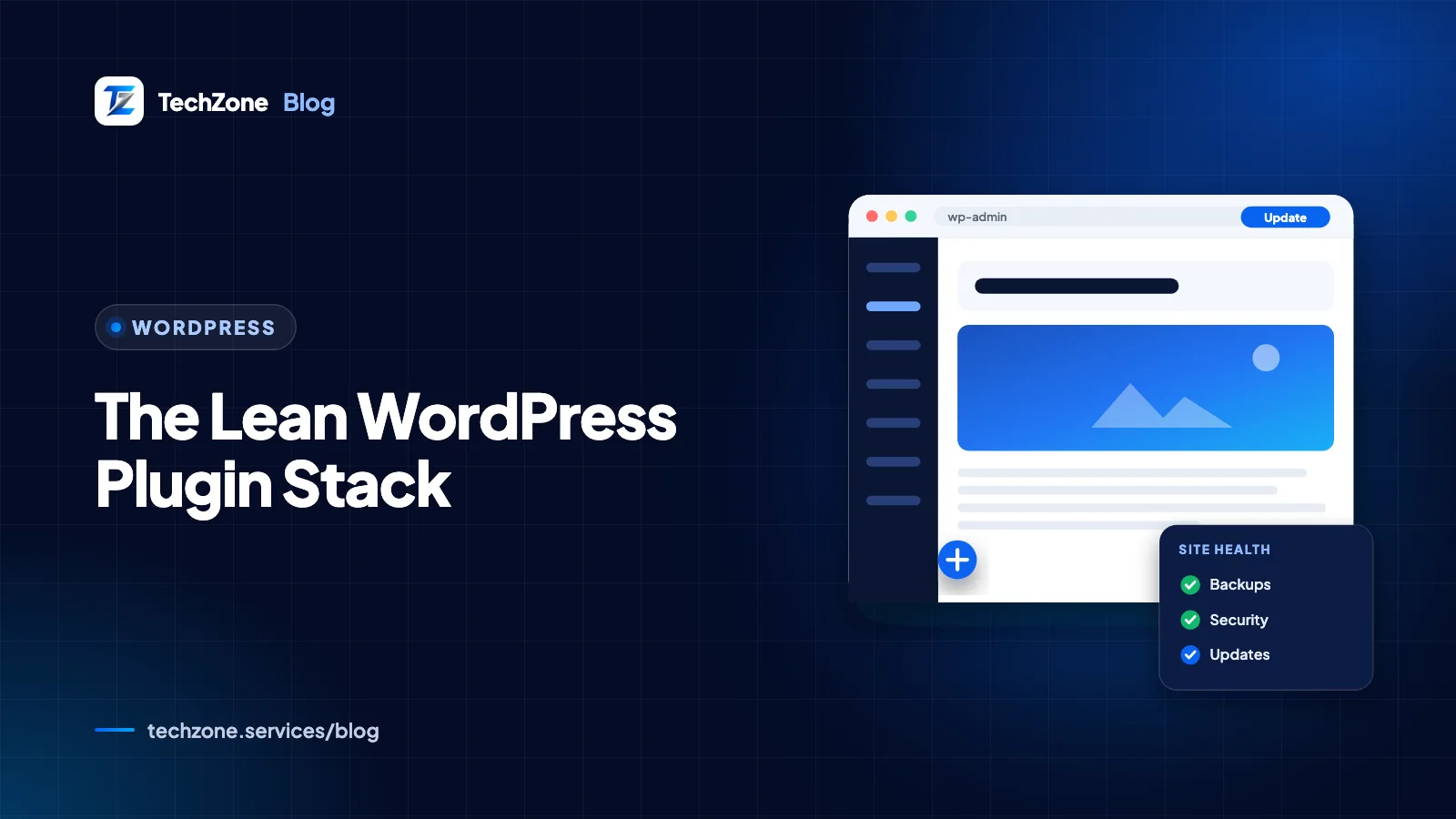
The essential WordPress plugins for a business website cover a handful of jobs: SEO, forms, spam protection, email delivery, caching, backups, security, and analytics with cookie consent. Add redirects and image optimization if your SEO plugin, host or WordPress itself doesn’t already handle them. One well-maintained plugin per job is enough.
This list is organized by job rather than by brand, and it flags where your host or another plugin already covers a job, so you don’t install two tools that fight each other. TechZone doesn’t make any of these plugins; they’re the options we see working reliably on business sites.
Every name below is in the WordPress.org plugin directory unless stated otherwise, and none of this guide depends on prices, which change often. Check each vendor’s site for current plans.
Key takeaways
- Install one well-maintained plugin per job; two SEO, caching or security plugins on the same site cause conflicts rather than extra protection.
- Rank Math includes redirects and a 404 monitor for free; Yoast keeps its redirect manager in Premium, so pair free Yoast with Redirection.
- Check your host first: many include caching, backups or a firewall, which removes a plugin from your list.
- Akismet keys are free only for personal blogs, so a business site needs a paid plan or a different spam tool.
- Vet every plugin on its WordPress.org page: last update, tested version, active installs, recent reviews and resolved support threads.
What are the essential WordPress plugins for a business website?
The must-have WordPress plugins are the ones that protect the site, capture leads and let search engines understand it. The table lists each job, free options to consider and when you can skip the job entirely.
| Job | What it does | Options to consider | Skip it if |
|---|---|---|---|
| SEO | Titles, meta descriptions, XML sitemaps, schema, canonical URLs | Yoast SEO or Rank Math (choose one) | Never skip; just never run two |
| Forms | Contact and quote forms that email you and store entries | Contact Form 7, WPForms Lite, Fluent Forms | Your booking or CRM tool provides the form |
| Spam protection | Blocks bot submissions on forms and comments | Akismet (paid for business sites), Antispam Bee, Simple Cloudflare Turnstile | Your form plugin already has CAPTCHA or Turnstile switched on |
| Email delivery | Sends WordPress email through a proper mail service | FluentSMTP, WP Mail SMTP | Your host routes WordPress mail through an authenticated service |
| Caching | Serves stored copies of pages so they load faster | LiteSpeed Cache (on LiteSpeed servers), WP Super Cache, W3 Total Cache | Your host provides server-level page caching |
| Image optimization | Compresses images and serves WebP or AVIF | Modern Image Formats, ShortPixel, Imagify, EWWW Image Optimizer | Your caching plugin or CDN already optimizes images |
| Backups | Scheduled copies of files and database, stored off the server | UpdraftPlus | Your host keeps daily off-site backups you can restore yourself |
| Security | Firewall, malware scanning and login protection | Wordfence, Sucuri Security, Two Factor | Your host or CDN runs a firewall and scanning (keep two-factor login) |
| Analytics | Connects Google Analytics and Search Console | Site Kit by Google | Tags are managed in Google Tag Manager |
| Cookie consent | Shows a banner and blocks tracking until visitors agree | Complianz, CookieYes | You run no tracking or advertising cookies |
| Redirects | Sends old URLs to new ones with 301 redirects | Redirection, or Rank Math’s built-in manager | Your SEO plugin already handles redirects |
The minimal stack for a service site and a WooCommerce store
A lead-generation site for a clinic, law firm or contractor needs only the table’s core: one SEO plugin, one form plugin with spam protection, an SMTP plugin, backups, security, consent and analytics, plus caching and images if the host doesn’t cover them. That’s usually fewer than ten plugins. If your site runs far more, have a WordPress developer check what each one does before you remove anything.
A WooCommerce store adds WooCommerce itself, one payment gateway plugin per provider you actually use and a shipping or courier integration. Stores also need backups frequent enough to capture new orders, and a caching setup that excludes the cart, checkout and account pages.
Rank Math vs Yoast: which SEO plugin should you use?
Both are well maintained and either will serve a business site. Rank Math gives you more in the free version, including redirects; Yoast offers a simpler interface and moves its advanced tools into Premium. The only wrong answer is running both.
| Feature | Yoast SEO (free) | Rank Math (free) |
|---|---|---|
| Titles, meta, sitemaps, canonicals | Yes | Yes |
| Schema | Automatic schema for pages and posts; more types in Premium | 16+ schema types to apply to posts and pages |
| Redirect manager | Premium only | Included, with a 404 monitor |
| Search Console data in WordPress | Through the Site Kit integration | Built-in Search Console and Analytics integration |
| WooCommerce SEO | Separate WooCommerce extension | Automatic product schema and meta in the free plugin |
| Setup style | Fewer settings, sensible defaults | Setup wizard and modules you switch on as needed |
| Switching | Can be imported into Rank Math | One-click import from Yoast, AIOSEO and Redirection |
- Choose Rank Math if you want redirects, a 404 monitor and product schema without paying for extras.
- Choose Yoast if your editors already know it or you prefer fewer settings, and add the Redirection plugin for free redirects.
- Either way, check the output: view a page’s source or test it in Google’s Rich Results Test, and read our guide to schema markup for small businesses to see which types matter.
Which plugins handle forms, spam and email?
Use one form plugin, protect it with one anti-spam method, and route its notifications through an SMTP plugin. That trio is what turns a contact page into leads you actually receive.
Forms
Contact Form 7 is lightweight and flexible but plain to configure. WPForms Lite and Fluent Forms offer drag-and-drop builders, and Fluent Forms also stores and exports entries in its free version; with other form plugins, check whether saving entries needs a paid plan. If you build with Elementor Pro, its Form widget may cover simple forms without another plugin.
Spam protection
Akismet filters comment and form spam, but its WordPress.org page states that keys are free for personal blogs, with paid subscriptions for businesses and commercial sites. Antispam Bee is a free alternative for comments, and Simple Cloudflare Turnstile adds Cloudflare’s CAPTCHA alternative to forms and login pages.
Email delivery
WordPress sends email through your server by default, and those messages often land in spam or vanish. An SMTP plugin such as FluentSMTP or WP Mail SMTP sends every WordPress email through a proper service, such as Google Workspace, Microsoft 365, Amazon SES or Brevo. Test it by submitting your own contact form after setup.
Do you need a caching or image optimization plugin?
Only if your host doesn’t already provide one. Many managed WordPress hosts run server-level caching and tell you which cache plugins to avoid, so check their documentation before installing anything.
- LiteSpeed Cache is free, but its page caching needs a LiteSpeed server, LiteSpeed-powered hosting or the QUIC.cloud CDN. Its general features, such as minification and image optimization, work on any server.
- WP Super Cache (by Automattic) and W3 Total Cache suit Apache or Nginx hosts with no built-in page cache.
- Images: WordPress 7.1 now compresses and resizes images in the browser and supports AVIF and HEIC natively. The Modern Image Formats plugin from the WordPress Performance Team generates WebP or AVIF versions of new uploads; ShortPixel, Imagify or EWWW Image Optimizer also compress your existing library.
Plugins are only part of site speed. Hosting, theme weight, fonts and third-party scripts usually matter more, as our guide to speeding up a WordPress site explains.
Which backup and security plugins do you need?
You need one backup system that stores copies away from your server and one security layer, plus two-factor login for every administrator. Host backups kept on the same server as the site aren’t enough on their own.
- UpdraftPlus (free) schedules backups and sends them to Dropbox, Google Drive, Amazon S3 and other remote storage, with restores from the dashboard. Automatic backups before updates are a Premium feature.
- Wordfence adds a firewall, malware scanner and login security. Its free version receives new firewall rules and malware signatures 30 days after Premium users do, which matters for fast-moving threats.
- Two Factor, maintained by WordPress.org contributors, adds two-factor authentication if your security plugin doesn’t. Each user sets it up under Users > Your Profile.
Security plugins are one layer among several. Our WordPress security checklist covers the rest, from user roles to file permissions.
Watch out
Test a restore before you need one. Restore a backup to a staging site once a quarter; a backup that has never been restored is an assumption, not a plan.
How should you handle analytics and cookie consent?
Connect Google tools with one method and control them with one consent plugin. Site Kit by Google links Search Console, Analytics, PageSpeed Insights and Tag Manager inside WordPress, but its documentation says site owners remain responsible for notice and consent requirements, including the GDPR.
Complianz and CookieYes both show a consent banner, block scripts until visitors agree, support Google Consent Mode and integrate with the WP Consent API, a plugin that lets consent-aware plugins share the visitor’s choice. If you serve visitors in the EU or UK, or run Google Ads, set this up before you add tracking.
Why are fewer plugins better, and which ones should you never double up?
Every plugin adds code to update, test and secure, and every overlap creates a chance of conflict. WordPress’s own hardening guide tells you to keep plugins updated, delete ones you don’t use and install only from the WordPress.org directory or well-known companies.
The count matters less than the weight and the overlap. One heavy plugin that loads scripts on every page can cost more than five small admin-only tools. The same guide warns that plugins which execute PHP code stored in the database magnify the damage of a successful attack, so treat code-snippet plugins with care.
| Don’t combine | Why | Keep |
|---|---|---|
| Two SEO plugins | Duplicate titles, schema and sitemaps | One of Yoast or Rank Math |
| A cache plugin plus host caching | Stale pages and hard-to-trace bugs | Your host’s cache, unless it recommends a plugin |
| Two security plugins with firewalls | Blocked logins, slow requests, false alarms | One security plugin, or the host’s firewall plus two-factor login |
| Image optimization in two tools | Images compressed twice or conversions clashing | One image tool, whether cache plugin or dedicated |
| Redirects in two places | Redirect loops and chains | One redirect manager |
| Several ways of adding Google tags | Double-counted visits and conversions | Site Kit or Tag Manager, not both plus theme code |
How do you vet a WordPress plugin before installing it?
Read the plugin’s WordPress.org page before you click Install. The Meta box and Support section show most of what you need in under a minute.
| Signal | Where to find it | Red flag |
|---|---|---|
| Last updated | Meta box on the plugin page | No update in many months |
| Tested up to | Meta box | The warning that it hasn’t been tested with the latest 3 major WordPress releases |
| Active installations | Meta box | Very few installs for a critical job such as security or backups |
| Reviews | Ratings panel and recent reviews | Recent one-star reviews describing broken sites or aggressive upsells |
| Support | Issues resolved in last two months | Most threads unanswered |
| Requirements | WordPress version and PHP version | Needs versions your host doesn’t run |
| Front-end weight | PageSpeed Insights before and after, on staging | New scripts loading on every page for a feature used on one page |
Install new plugins on a staging copy first, and add each one to your update routine. Our WordPress maintenance checklist covers the weekly updates, monthly reviews and yearly plugin audit that keep a lean stack lean.
How TechZone can help
TechZone builds and looks after WordPress and WooCommerce sites for businesses in Pakistan, the UK, the UAE, the USA, Canada and Australia. Our web development services include plugin audits: we list what each plugin does, remove duplicates and abandoned ones, check what your host already covers and set up SEO, forms, email delivery, backups and security properly. For WordPress projects, our WordPress development services cover design, build, speed and handover. We start with a free consultation, then agree scope and cost in a written proposal. Book a free 30-minute call to review your plugin list.
Frequently asked questions
How many plugins are too many for a WordPress site?
There is no fixed number of WordPress plugins that is too many. A site with 25 well-coded plugins can be faster and safer than one with 8 heavy or abandoned plugins. The better test is whether each plugin does a job nothing else on the site does, is actively maintained, and doesn’t load scripts on pages that don’t need them.
Are free WordPress plugins safe to use?
Free WordPress plugins from the WordPress.org directory can be safe when they are actively maintained, widely used and well reviewed. Safety depends on maintenance, not price. Avoid pirated or nulled copies of premium plugins, which can contain malware, and remove any plugin whose developer stops releasing updates, whether it was free or paid.
Can I use Yoast SEO and Rank Math together?
Running Yoast SEO and Rank Math together is a bad idea, because both output titles, meta descriptions, schema and sitemaps, which creates duplicates and conflicting signals. Choose one SEO plugin. If you switch from Yoast to Rank Math, use Rank Math’s import tool to bring across your settings and page-level data, check key pages, then deactivate and remove Yoast.
Do I need a security plugin if my host has a firewall?
If your host or CDN already runs a web application firewall and malware scanning, a second firewall plugin often adds conflicts rather than protection. Keep two-factor authentication for administrators, strong passwords, updates and off-site backups in any case. Ask your host exactly what its firewall and scanning cover before deciding whether a security plugin is still needed.
Should I buy premium versions of WordPress plugins?
Buy a premium WordPress plugin when it replaces work you would otherwise pay a developer for, or adds a feature the business actually uses, such as scheduled pre-update backups or advanced form integrations. Buy licenses in the business’s own account, track renewal dates, and remember that an expired license usually means no more updates for that plugin.