
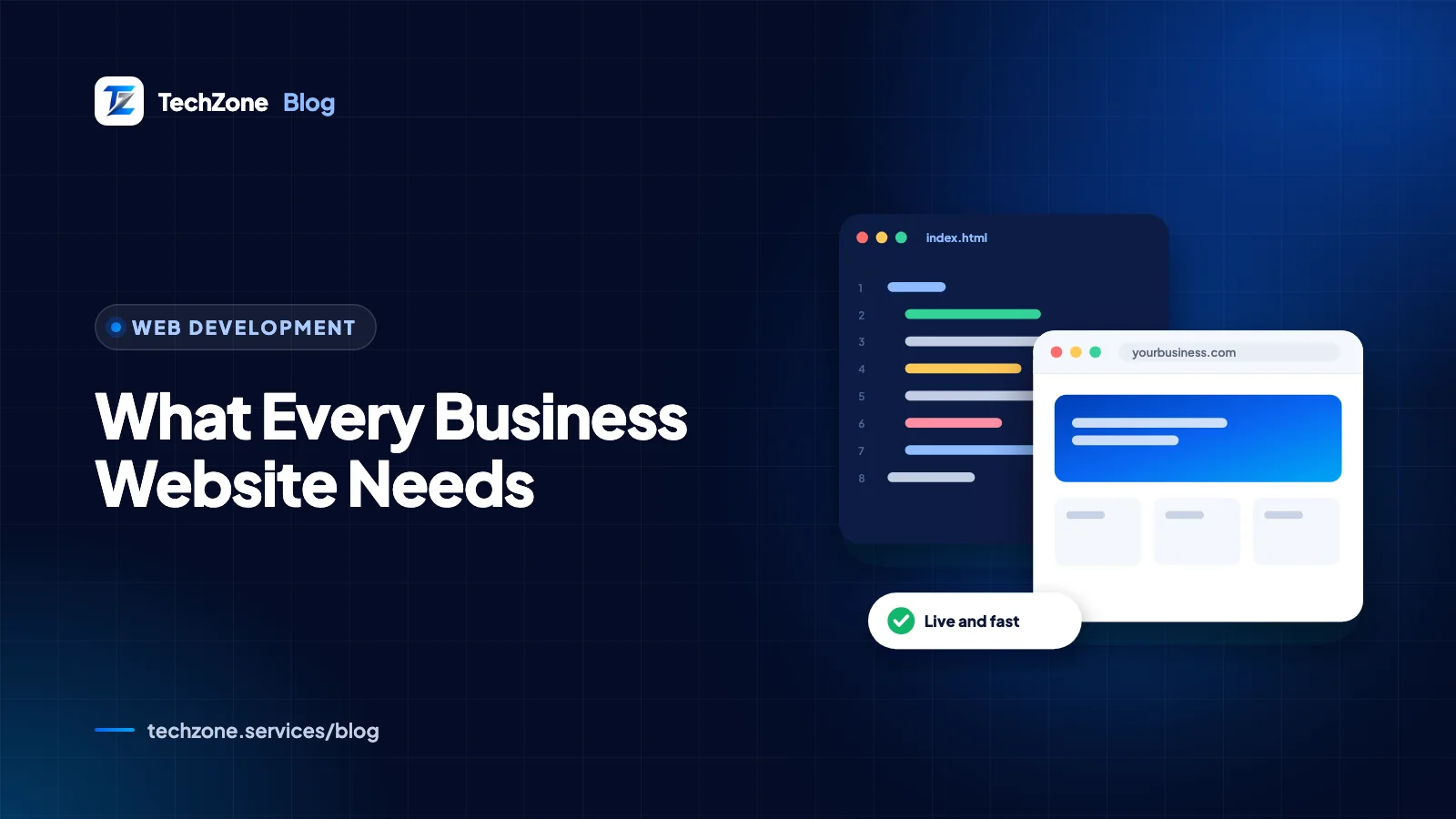
Small business website essentials fall into two groups. The pages are a home page, one page per core service, About, Contact, reviews or case studies, an FAQ and a privacy policy. The features are a clear call to action, one-tap calling and WhatsApp, forms that work, fast mobile pages, HTTPS, lead tracking and basic accessibility.
This checklist explains each item: why it matters, what to include and the mistake that most often costs leads. Use it to plan a new site or to check the one you have before you spend more on ads or SEO.
If you’re starting from scratch, read it alongside our guide to the website development process, which shows where each item fits between the brief and launch.
Key takeaways
- Every small business website needs a home page, service pages, About, Contact, reviews, an FAQ and a privacy policy.
- Put a call button, a WhatsApp link and a short form within one tap on every mobile page.
- HTTPS, fast mobile pages and accounts registered in your own name are non-negotiable technical basics.
- Google Analytics requires a privacy policy, and UK visitors must be able to refuse non-essential cookies as easily as accept them.
- Mark form, call and WhatsApp clicks as GA4 key events so you can see which pages produce leads.
What should a small business website have?
It should have a small set of pages that answer what customers ask before they buy, and features that make contacting you easy, safe and measurable. Everything else, such as a blog, online booking or live chat, can wait until the basics are live and tracked.
The small business website essentials at a glance
| Item | Type | When | Why it matters |
|---|---|---|---|
| Home page with a clear headline and one main call to action | Page | Launch | Visitors decide quickly whether they’re in the right place |
| One page per core service | Page | Launch | Each service can match its own searches, questions and ads |
| About page | Page | Launch | Shows the real people and experience behind the business |
| Contact page with full details | Page | Launch | Removes the last obstacle before an inquiry |
| Reviews, testimonials or case studies | Page or section | Launch | Proof from other customers |
| FAQ | Page or section | Launch | Answers objections before they cost you a call |
| Privacy policy, plus a cookie notice where required | Page | Launch | Required by Google Analytics terms, and often by privacy law |
| Click-to-call and WhatsApp links | Feature | Launch | Phone visitors contact you in one tap |
| Tested forms and a thank-you page | Feature | Launch | Inquiries arrive and can be counted |
| Responsive, fast mobile pages | Feature | Launch | Google indexes the mobile version of your pages |
| HTTPS on every page | Feature | Launch | Protects form data and avoids browser warnings |
| GA4 key events and Search Console | Feature | Launch | Shows which pages and channels produce leads |
| Accessibility basics | Feature | Launch | More people can read and use the site |
| Domain, hosting and backups in your name | Feature | Launch | You keep control if you change developer |
| LocalBusiness structured data and matching business details | Feature | First 90 days | Helps Google connect your site with your business |
Which pages does every business website need?
The U.S. Small Business Administration’s list of five essential pages is a sound base: home, about, products or services, contact and testimonials, with an FAQ, appointment scheduling and a blog as later additions. For 2026, add a privacy policy and give each core service its own page.
| Page | What it must include | Common mistake |
|---|---|---|
| Home | A headline that says what you do, for whom and where; one primary button; proof near the top | A slogan that could belong to any company, or a slider rotating three messages |
| Service pages | What’s included, who it’s for, how it works, what affects the price, FAQs and a call to action | One “Services” page with a paragraph per service |
| About | Real names, photos, experience, credentials and where you’re based | A company history with no faces |
| Contact | Phone, WhatsApp, email, address or service area, hours, a map for storefronts and a short form | A form only, with no phone number or address |
| Reviews and case studies | Reviews with names and context; project write-ups with real photos | Anonymous quotes such as “Great service! J.” |
| FAQ | Questions customers actually ask about price, timing, areas and payment | Questions nobody asks, written for keywords |
| Privacy and legal pages | What data you collect, why, which tools you use and how to request deletion; stores add shipping, returns and terms | A copied template that names another company or tools you don’t use |
Why each service needs its own page
A dedicated page lets the title, headings and copy match what people search, such as “kitchen renovation in Lahore”, and gives your ads a relevant landing page. It also carries its own proof and FAQs. Don’t create near-identical pages that only swap a town or service name: write each one for the people who need that service.
How do visitors contact you in one tap?
Put a contact route on every page: a header button, a click-to-call link and, if your customers use it, a WhatsApp link. On a phone, one tap should open the dialer or a chat with your number already filled in.
- One main call to action per page. Pick the action you want (“Get a quote”, “Book a visit”) and repeat it after key sections instead of showing five competing buttons.
- Click-to-call. Use a
tel:link with the full international number, so it also works for visitors calling from abroad. - WhatsApp. WhatsApp’s click to chat format is
https://wa.me/followed by your full number in international format, without zeros, brackets or dashes. Add?text=to pre-fill a message. - Short forms that deliver. Ask only what you need to reply, send notifications through a proper mail service (SMTP) so they don’t land in spam, and use spam protection that doesn’t block real people.
- A thank-you page. Send form users to a page that confirms receipt and says when you’ll reply. It reassures the customer and is the easiest action to track.
<!-- Example links for a placeholder Pakistani mobile number, 0300 0000000 -->
<a href="tel:+923000000000">Call +92 300 0000000</a>
<a href="https://wa.me/923000000000?text=Hi%2C%20I%20would%20like%20a%20quote">Chat on WhatsApp</a>
Pakistan note
Local numbers start with 0 (0300, 0321 and so on), but links need the international form: drop the leading 0 and add 92. Test both links from a phone that doesn’t have your number saved, and make sure the WhatsApp number is on an account someone checks during business hours.
What technical essentials keep the site fast, secure and yours?
Four things: HTTPS on every page, fast pages on a phone, a responsive layout and accounts you control. None of them is visible when it works, and each one costs you leads when it fails.
HTTPS on every page
HTTPS encrypts what visitors type into your forms. Google has announced that Chrome 154, scheduled for October 2026, will ask for the user’s permission before the first visit to any public site without HTTPS. Most hosts include a free certificate; check that every old http:// address redirects to its https:// version.
Fast, responsive mobile pages
Google uses the mobile version of your content for indexing and ranking, and recommends responsive design. It also says Core Web Vitals are used by its ranking systems. Aim for the “good” thresholds at the 75th percentile of page loads:
| Metric | What it measures | Good |
|---|---|---|
| Largest Contentful Paint (LCP) | How quickly the main content loads | 2.5 seconds or less |
| Interaction to Next Paint (INP) | How quickly the page responds to taps and clicks | 200 milliseconds or less |
| Cumulative Layout Shift (CLS) | How much the layout jumps while loading | 0.1 or less |
Check your field data in PageSpeed Insights or the Core Web Vitals report in Search Console. Oversized images, heavy sliders and stacks of third-party scripts are common causes of slow small business sites.
Accounts in your name
Register the domain in your own registrar account, and keep hosting, Google Analytics, Search Console and your Business Profile under a business email you control. Whoever builds the site, a freelancer or a web development agency, should get access, not ownership, and hand every login back at launch. Set up automatic off-site backups and agree who applies software updates, because an unmaintained site becomes a security risk.
What helps Google understand your business?
Four things help: clear page titles, a verified Search Console property, consistent business details and structured data. Together they help Google match your pages to searches and connect your website with your Google Business Profile.
- Search Console: verify your domain, submit your XML sitemap and check the Pages report after launch for pages Google can’t index.
- Titles and headings: give every page a unique title that names the service and place, such as “Emergency Plumber in Leeds | Brand Name”.
- Business details: use the same name, address and phone wording on your site, your Business Profile and directories.
- Structured data: LocalBusiness markup states your name, address, phone and hours in a machine-readable form. Our schema markup guide for small businesses shows which types to add and how to test them.
Which legal and accessibility basics apply to a small business website?
You need a privacy policy as soon as you collect personal data or run analytics; cookie consent depends on where your visitors are; accessibility basics apply everywhere. This isn’t legal advice, so check the rules in each country you sell to.
Privacy policy
If you use Google Analytics, its terms require you to post a privacy policy that gives notice of your use of cookies and discloses your use of Google Analytics and how it collects and processes data. List the tools you actually run, what each form collects, how long you keep inquiries and how people can ask for their data to be deleted.
Cookie notice where required
Under the UK’s PECR rules, you can’t set non-exempt cookies before the visitor consents, consent needs a clear positive action, and refusing must be as easy as accepting. The ICO now lists exceptions, including some cookies used only for statistics about how your site is used, if you give clear information and a free, simple way to object. Advertising cookies still need consent.
If you have visitors in the UK or the EU, use a consent banner that actually blocks tags until people choose, not one that only displays a message.
Accessibility basics
- Text contrast of at least 4.5:1 against its background, or 3:1 for large text (WCAG 2.2, level AA).
- Buttons and other tap targets at least 24 by 24 CSS pixels, or spaced well apart, as WCAG 2.2 Target Size (Minimum) requires.
- Alt text on meaningful images, a visible label on every form field and headings in a logical order.
- Every menu, button and form usable with a keyboard, with a focus outline that sticky headers and chat widgets don’t cover.
How do you know if the website is working?
Measure leads, not visits. In GA4, mark your lead actions as key events: go to Admin, open Events under Data display and click the star next to the event. For a service business, that usually means thank-you page views, phone link clicks and WhatsApp link clicks.
Then run a ten-minute check every month: submit each form, tap each call and WhatsApp button on a phone, load the site on mobile data and look at Search Console for new errors. When the tracking shows where visitors drop off, our guide to increasing your website conversion rate covers what to test next.
What can wait until after launch?
A blog, online booking, live chat, multiple languages and a client portal can all wait until the core pages are live and measured. Add each one when you have a clear reason and someone to maintain it.
| Feature | Add it when |
|---|---|
| Blog | You can publish useful answers to customer questions on a steady schedule |
| Online booking | Appointments are your main conversion and your calendar is kept current |
| Live chat | Someone can answer during business hours; an unanswered widget does more harm than none |
| Multiple languages | You have real customers in that language and properly translated pages |
| Client portal or accounts | Customers need to log in for orders, files or bookings, and you have budget to maintain it |
Whatever you add, avoid the traps that quietly lose inquiries, such as vague headlines, hidden contact details and intrusive pop-ups. Our list of website design mistakes that cost small businesses leads covers them with a fix for each.
How TechZone can help
TechZone designs and builds websites for small businesses in Pakistan, the UK, the UAE, the USA, Canada and Australia. Our web development team can build a new site around this checklist or review your current one and give you a prioritized list of fixes, from service pages and WhatsApp links to HTTPS, tracking and accounts in your name. The WordPress development page explains how we plan and build these sites. Scope, timeline and cost are agreed in a written proposal before any work begins. Book a free 30-minute consultation to go through your site together.
Frequently asked questions
How many pages should a small business website have?
A small business website needs as many pages as it takes to cover each core service properly, plus the home, About, Contact, reviews, FAQ and privacy pages. A business with four services therefore starts with around ten pages. Adding thin pages for the sake of size doesn’t help; one strong page per service is better than several weak ones.
Do I need a website if I already have a Facebook page and a Google Business Profile?
A website is still worth having alongside a Facebook page and a Google Business Profile. You control the website, while social platforms control reach and layout. A Business Profile links to a website, ads need a landing page, and service pages answer detailed questions that a profile or social post can’t hold.
How much does a small business website cost?
The cost of a small business website depends on the number of pages, custom design versus a template, features such as booking or payments, who writes the content, and ongoing hosting and maintenance. Ask several developers to quote against the same written brief, and compare what each proposal includes rather than the headline price.
Should a small business website show prices?
Showing prices on a small business website filters out poor-fit inquiries and builds trust. If every job is different, show a starting price, typical ranges or the factors that affect the price, such as size, materials or turnaround time. Customers who understand the likely cost before calling are easier to convert.
How often should a small business website be updated?
A small business website needs software and plugin updates as soon as they’re released and tested, a working check of forms and contact links every month, and a content review every few months. Update prices, services, team photos and reviews whenever they change, because outdated details lose trust faster than an old design.
Sources and further reading
- 5 Essential Pages For Your Small Business Website – U.S. Small Business Administration
- Understanding Google Page Experience – Google Search Central
- Web Vitals – web.dev
- HTTPS by default – Google
- What's New in WCAG 2.2 – W3C Web Accessibility Initiative
- Google Analytics Terms of Service – Google Marketing Platform