
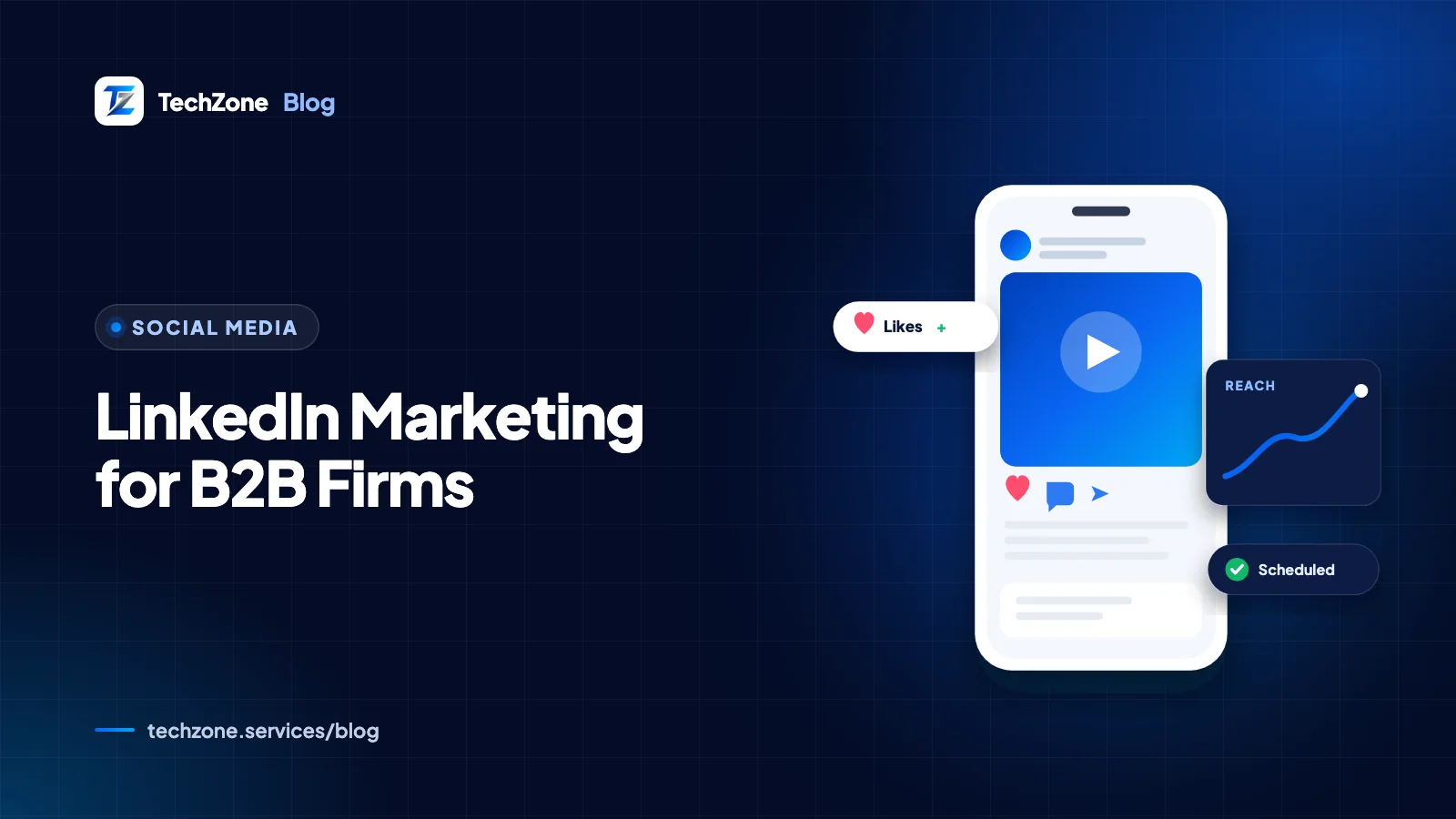
LinkedIn marketing for B2B works when three pieces run together: a complete company Page that proves you are a real firm, founders and staff who share useful expertise from their own profiles, and a small, tightly targeted ad budget aimed at the accounts you want to win. Judge it by conversations and pipeline, not likes.
This guide is for B2B service firms such as agencies, consultancies, software houses and IT firms, including teams in Pakistan selling to the UK, the US and the UAE. It covers Page setup, who should post, a weekly routine, ads, lead capture and measurement, updated for 2026 changes such as the retired My Company tab.
Key takeaways
- Complete every field on your company Page; LinkedIn says Pages with a logo, description and website URL can get 30% more weekly views.
- Posts from founders and subject experts usually travel further than Page posts, so build your content plan around people.
- Start LinkedIn Ads with one tightly targeted ad set: the minimum daily budget is $10 and every audience needs at least 300 members.
- Lead Gen Forms arrive pre-filled from LinkedIn profiles; sync them to your CRM and reply within one working day.
- Measure LinkedIn by conversations, meetings and pipeline from target accounts, not by followers or likes.
Why is LinkedIn worth it for B2B marketing?
LinkedIn is built around employer, job title and seniority, so it’s the easiest social network for finding business buyers, and the one where they expect business content. LinkedIn reports more than 1.3 billion members, including over 290 million in North America and over 430 million across Europe, the Middle East and Africa.
That precision suits firms whose buyers have clear job titles, whose deals are big enough to justify a sales conversation, and who sell across borders to people they haven’t met. One new client can be worth years of fees, so a handful of the right conversations pays for the effort. If you sell low-cost products to consumers, our guide to choosing social platforms for a small business points you elsewhere.
How do you optimize a LinkedIn company Page?
Fill in every field, use LinkedIn’s image sizes, and make the Page say in five seconds what you do, for whom, and what to do next. LinkedIn says Pages with information such as a logo, description and website URL are more discoverable and potentially receive 30% more weekly views.
| Field | What good looks like | Common mistake |
|---|---|---|
| Logo | 400 x 400 pixels (268 x 268 minimum), PNG or JPEG under 3 MB, readable on light and dark backgrounds | A wide logo squashed into a square |
| Cover image | 1512 x 256 pixels, one line about your offer or proof, away from the edges | Text in the lower-right corner, which can be cropped |
| Tagline | One line naming who you help and the outcome, for example “Shopify stores and paid ads for UK skincare brands” | A slogan with no service or audience |
| Overview (About) | Open with what you do, for whom and where; then services, proof and how to start | A company history that buries the services |
| Website, industry, size, locations | Accurate, with every real office listed | Blank or outdated company size |
| Custom button | Edit page, Buttons tab, Custom button toggle; choose Contact us, Request services or Visit website | Sending clicks to the homepage, not a contact page |
| Languages | Name, tagline and description in each language your buyers read (more than 20 supported) | One language for every market |
Watch out
Without a paid Premium Company Page, LinkedIn shows your custom button only after a visitor clicks More. Put your contact or booking link in the Overview, posts and founder profiles too.
Why do founder and employee profiles often outperform the company Page?
People follow people. A Page post reaches mainly the Page’s followers, while a founder’s post reaches their connections and followers, and comments from colleagues or clients can carry it further. Service buyers are also buying the people who do the work, so hearing from them builds trust faster than brand copy.
Set up the profiles that will carry your content
- Headline: say who you help and how, not only your job title. “Helping UK law firms win more inquiries from Google” tells a buyer more than “CEO at Company”.
- About and Featured: open with the problem you solve, end with how to contact you, and pin a case study and your best post.
- Follow or Connect: since LinkedIn removed creator mode in 2024, any member can make Follow the main profile button. Choose it if you post often.
Get employees involved without scripts
LinkedIn retired the My Company tab and its employee advocacy features, so there is no built-in feed of recommended posts any more. Page admins can still notify employees about important Page posts, and reshare employees’ posts and mentions from the Feed tab of the Page dashboard.
The rest is process: ask two or three subject experts to post weekly in their own words, and give them raw material such as project photos and client questions, not copy to paste. Identical posts from five colleagues look coordinated.
What should a B2B company post on LinkedIn?
Post what a buyer wants to know before hiring you: your point of view, your process, proof from clients like them, and the people who do the work. Substance matters more than format, but these formats suit B2B best.
| Format | Best for | Practical notes |
|---|---|---|
| Text post, with or without one image | Opinions, lessons, short client stories | Only the opening lines show before “see more”, so lead with the point |
| Document post | Checklists, frameworks, before-and-after breakdowns | Upload a PDF, PPT, PPTX, DOC or DOCX of up to 100 MB and 300 pages; one idea per page |
| Short video | Founder explainers, project walkthroughs | Add captions so it works without sound |
| Newsletter | A monthly deeper piece that builds subscribers | Any member can start one; Pages need more than 150 followers and a record of original posts |
| LinkedIn Live or event | Q&A sessions and panels | Promote it a week ahead from founder profiles |
| Case study | Proof for buyers close to a decision | Problem, approach and result in client-approved words; see how to write a marketing case study |
A weekly LinkedIn routine for a small team
About three hours a week, shared between two or three people, keeps you visible. Pages and personal profiles can both schedule posts, up to three months ahead for Pages, so batch the writing.
| Day | Who | Task | Time |
|---|---|---|---|
| Monday | Founder | Publish a point-of-view or lesson post and reply to every comment that day | 45 min |
| Tuesday | Page admin | Post a client story or document post on the Page; notify employees if it matters | 30 min |
| Wednesday | Subject expert | Share a process tip or project breakdown from their own profile | 30 min |
| Thursday | Founder or sales lead | Comment on ten posts from target accounts; send five personalized connection requests | 30 min |
| Friday | Page admin | Review Page and ad analytics; log new conversations in the CRM | 30 min |
How do LinkedIn Ads work for B2B?
In Campaign Manager you pick an objective, target people by location, company and job, then set a budget and bid. LinkedIn’s minimum daily budget is $10 for any ad format, and every audience must include at least 300 members with a location set, so small tests are possible.
Campaign Manager now mirrors Meta and Google: a campaign holds ad sets, and each ad set carries its own targeting, budget and ads.
| Funnel stage | Objective | Use it when |
|---|---|---|
| Awareness | Brand awareness | You want target accounts to recognize your name before sales outreach |
| Consideration | Website visits | You want visits to a service page, guide or case study |
| Consideration | Engagement | You want comments, follows, or to run Thought Leader Ads |
| Consideration | Video views | You have a strong founder or explainer video |
| Conversions | Lead generation | You want contact details without sending people to your website |
| Conversions | Website conversions | Your site converts and the Insight Tag or Conversions API tracks form fills |
LinkedIn ads for B2B: targeting basics
- Location (required): the countries or cities where your buyers work, not where you are based.
- Company: company names, industry and company size.
- Job experience: job title, job function, seniority and skills.
- Matched Audiences: upload a company list (at least 300 rows; LinkedIn recommends 1,000 or more companies), upload a contact list, or retarget website visitors and people who engaged with your ads.
Don’t stack every filter: start with location, company size and two or three job functions, and exclude your employees and current clients. To hand this over, our paid social and digital marketing team builds and manages LinkedIn campaigns.
Thought Leader Ads: promote posts that already work
Thought Leader Ads put budget behind a person’s post instead of a Page post. You can promote public text, single-image, video, article and newsletter posts from employees, creators and other members once the author approves. They run under Brand awareness or Engagement (plus Video views for video); documents, polls and multi-image posts aren’t eligible.
For a small firm this is often the best first ad: take a founder post that already drew the right comments and show it to your whole target list.
Example
A Lahore software house wants UK operations directors at logistics firms with 50 to 500 staff. It uploads 1,000 target companies and runs two UK ad sets at $25 a day each for four weeks: a Thought Leader Ad on the founder’s best post and a document ad gated with a Lead Gen Form, about $1,400 in total. It keeps whichever started conversations with the right job titles, not whichever had the cheapest clicks.
How do you capture and follow up LinkedIn leads?
Use Lead Gen Forms for low-friction offers, sync them to your CRM, and reply within one working day, while the lead still remembers you.
- Lead Gen Forms: with the Lead generation objective, people who click your ad see a form pre-filled with their LinkedIn profile data. Add one qualifying question at most.
- Gated document ads: a document ad can require the form before the full document opens. You choose how many pages to preview, so a single-page document can’t be gated.
- Getting leads out: download them from Content & Assets, then Lead generation forms, or sync a CRM such as HubSpot or Salesforce. LinkedIn says collected member profile data can only be stored for one year, so keep your CRM as the record.
- Website conversions: install the Insight Tag, and add the Conversions API to send offline results, such as signed contracts, back to LinkedIn.
- Organic leads: lead gen forms on LinkedIn Pages have been discontinued, so organic leads arrive through messages, your custom button and links to your site.
LinkedIn is one channel among several. Our comparison of lead generation channels for service businesses shows where it fits alongside search, referrals and email.
How do you measure LinkedIn marketing results by pipeline, not likes?
Track whether the right people see you, talk to you and buy from you. Likes and followers are easy to grow and say little about revenue.
| Stage | Metric | Where to find it |
|---|---|---|
| Reach the right accounts | Impressions and engagement from target companies | Campaign Manager’s Companies view, which replaced the Company Engagement Report |
| Interest | Page visitors by job function and industry; founder post impressions | Page Analytics (Visitors, Followers, Content); profile post analytics |
| Conversations | Inbound messages, accepted requests from target titles, form leads | LinkedIn inbox, Campaign Manager, your CRM |
| Pipeline | Meetings booked, proposals sent and their value | CRM with a required lead source field |
| Revenue | Deals won, value and cost per won deal | CRM plus ad spend and staff time |
Tag every link you post with UTM parameters so Google Analytics 4 shows which posts, profiles and ads sent each visit, and ask every new lead how they heard of you. For the formula and a worked example, see how to measure social media ROI.
How can a Pakistan-based firm win UK, US and UAE clients on LinkedIn?
Market to the buyer’s country, not your own: target ads at the countries you sell into, post during their working hours, and show proof from clients in those markets.
- Time zones: schedule posts for your buyers’ morning. A UK morning is early afternoon in Pakistan, the UAE is one hour behind, and US East Coast mornings fall in Pakistan’s evening.
- Ad account currency: LinkedIn’s list of ad account currencies includes US dollars, pounds and UAE dirhams but not Pakistani rupees, and the currency can’t be changed later, so choose carefully.
- Targeted Page posts: LinkedIn lets you target organic Page posts by location, language and industry, so a UK case study can go to UK followers.
- Proof buyers can check: name the client’s country and sector in case studies, show real faces, and link team profiles to the Page.
- Easy meetings: use a booking link that shows slots in the visitor’s time zone.
How TechZone can help
TechZone runs LinkedIn programs for B2B firms in the UK, the USA, Canada, Australia, the UAE and Pakistan: company Page and founder profile optimization, a posting routine your team can sustain, Insight Tag, Lead Gen Form and CRM setup, and small ad tests aimed at your target accounts. Our social media management service covers planning, posting, replies and paid campaigns. Our digital marketing services page lists what’s included, and you can book a free 30-minute call to go through your Page and targeting with us. Scope, timeline and cost are agreed in writing before anything starts.
Frequently asked questions
How often should a B2B company post on LinkedIn?
A B2B company should post on LinkedIn as often as it can keep up with useful content, which for most small firms means two or three Page posts a week plus one or two posts each from the founder and a subject expert. Consistency over months matters more than volume in any single week, and every post should still say something a buyer would find worth reading.
Is LinkedIn Sales Navigator worth paying for?
LinkedIn Sales Navigator is worth paying for when someone on your team prospects on LinkedIn every week. It adds advanced search filters by function, seniority and company, saved lead and account lists, alerts when prospects change jobs, and InMail credits. If nobody will use it for outreach several times a week, the free LinkedIn search and a spreadsheet of target accounts are enough to start.
How much does LinkedIn advertising cost for a small B2B firm?
LinkedIn advertising costs are set by an auction, so the price per click or lead depends on your audience, objective, bid strategy and how many advertisers want the same people. LinkedIn’s minimum daily budget is $10, and it suggests $25 a day for new advertisers paying in US dollars. Plan a test of at least four weeks so you collect enough data to compare ads.
Are LinkedIn automation tools and engagement pods allowed?
LinkedIn automation tools and engagement pods are not allowed. LinkedIn’s help page on prohibited software says it doesn’t permit bots, browser extensions or plug-ins that scrape or automate activity, or tools that try to manipulate its content algorithms, and these break the User Agreement. Accounts using them risk restriction, so schedule posts with LinkedIn’s own tools or approved partners instead.
How long does LinkedIn marketing take to generate leads?
LinkedIn marketing usually takes a few months of steady posting before organic content brings regular inbound conversations, because trust builds through repeated exposure. LinkedIn Ads can produce form leads within days of launch, but B2B deals still follow your normal sales cycle, so judge results by pipeline over a quarter rather than by a single week.
Sources and further reading
- About LinkedIn – LinkedIn Pressroom
- Edit your LinkedIn Page or Showcase Page – LinkedIn Help
- Marketing objectives available for your ad campaigns – LinkedIn Marketing Solutions Help
- Thought Leader Ads – LinkedIn Marketing Solutions Help
- Making the Most of Your Budget – LinkedIn Ad Tips
- Available currencies for your ads account in Campaign Manager – LinkedIn Marketing Solutions Help