
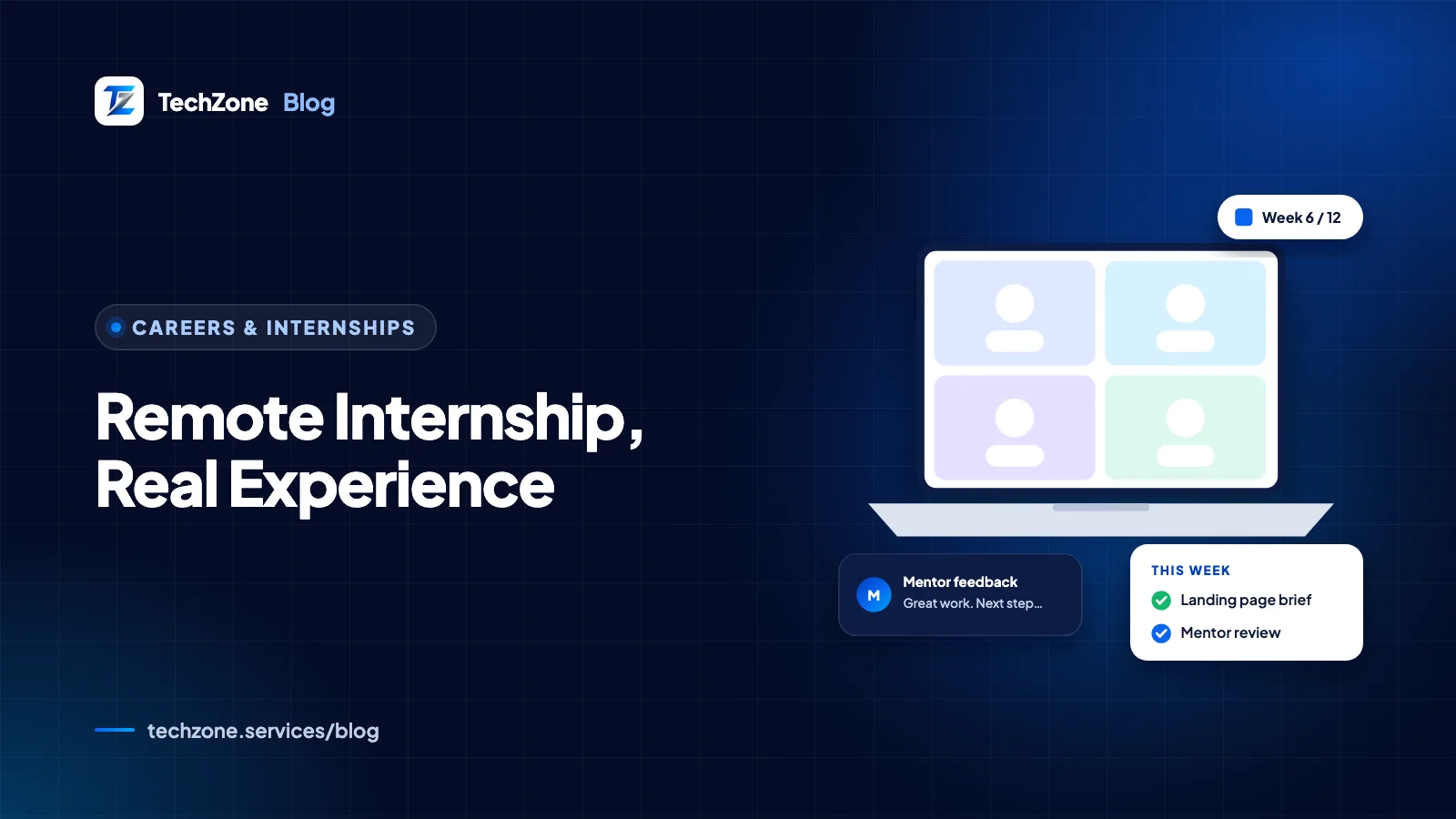
A virtual internship builds real work experience when it gives you real briefs, deadlines, regular written feedback from a named mentor and a final project you can show. Done well, it proves the skills remote employers look for: clear writing, async collaboration, time management and hands-on use of tools like Git, Figma, Jira and Slack.
The catch is that quality varies. Some programs run like a real team; others hand out a certificate with little work behind it.
This guide explains what a good virtual internship involves, which skills it builds, how to spot a low-value program, and how to present your virtual internship experience on your CV and LinkedIn.
Key takeaways
- A good virtual internship includes real briefs, deadlines, written feedback from a named mentor, a defined duration and a final project.
- Remote internships build skills employers value: written communication, async collaboration, time management and practical use of tools like Git, Figma and Jira.
- Be cautious of programs that hide who supervises you, cannot describe the work, pressure you to decide fast or promise guaranteed jobs.
- Save briefs, feedback and results as you go, so your CV describes outcomes you delivered instead of duties you were given.
- List a virtual internship under Experience on your CV and LinkedIn, and include a certificate ID employers can verify.
What does a good virtual internship involve?
A good virtual internship works like a remote job at a smaller scale: real briefs, real deadlines, regular feedback from a named mentor and a final project you can show. Location is not the test. NACE, the US National Association of Colleges and Employers, defines an internship as experiential learning in a professional setting “across in-person, remote, or hybrid modalities.”
NACE’s criteria also call for a defined beginning and end, clear responsibilities, learning objectives, and supervision by someone with relevant expertise who gives feedback. In practice, a strong program includes:
- Real briefs. Tasks modeled on actual client or business work, such as building a landing page, cleaning a dataset or drafting a content plan, with a clear description of what “done” means.
- Deadlines and a weekly rhythm. Due dates you are expected to hit, and a predictable cycle of assignment, submission and review.
- Feedback you can act on. Written comments from a mentor who explains what to change and why, not just a pass or fail.
- A final project. A larger piece of work that pulls together what you learned and becomes the centerpiece of your portfolio.
- Proof of completion. A certificate that states the program and dates, ideally one an employer can verify online.
Which skills does a virtual internship build that employers value?
Remote work makes you practice habits that are hard to teach in a classroom: writing clearly, working without constant supervision, managing your own time and using shared tools properly. These map closely to NACE’s eight career readiness competencies, which include communication, professionalism, teamwork and technology.
Written communication
Most remote work happens in writing: status updates, questions, pull request descriptions and handover notes. Learning to write a short message that someone can act on without a follow-up call is one of the most transferable skills you can build.
Async collaboration
Asynchronous work means your mentor or teammates may reply hours later, sometimes from another time zone. You learn to give full context up front, check the shared board before asking, and keep work moving while you wait.
Time management and ownership
Nobody sees you at a desk, so your output is the only evidence of your effort. Weekly deadlines teach you to break a brief into steps, estimate honestly and flag problems early instead of the night before.
Tools that real teams use
Hands-on time with common workplace tools is one of the most concrete things a virtual internship adds to your CV. The exact set depends on your track:
| Tool | What you use it for | What it shows an employer |
|---|---|---|
| Git and GitHub | Version control, branches and pull requests for code | You can work in a shared codebase without breaking it |
| Figma | Designing interfaces and responding to comments on design files | You can take design feedback and iterate |
| Trello or Jira | Tracking tasks on a board and updating their status | You can plan work and keep others informed |
| Google Workspace | Shared Docs, Sheets and Slides with comments and version history | You can collaborate on documents in real time |
| Slack | Channels, threads and quick status updates | You communicate clearly, in the right place |
How can you tell a real virtual internship from a low-value one?
A real internship gives you real tasks, a named person who reviews your work, a clear scope and duration, and proof of completion that someone else can check. If a program cannot describe those things before you join, treat it with caution.
Use this checklist before you apply or accept an offer:
- Real tasks: Can they describe the kind of work you will do, with examples? Vague promises of “exposure” are a warning sign.
- Named mentor and feedback: Will a specific person review your submissions, and how often? Automated quizzes alone are not mentorship.
- Clear scope and duration: Is there a set number of weeks, a start date and a defined track or role?
- Verifiable certificate: Does the certificate carry a unique ID that employers can check on the issuer’s website? A PDF anyone could edit proves little.
- No pressure tactics: Are you rushed to decide, promised a guaranteed job, or asked to pay to secure a job offer? The US Federal Trade Commission warns job seekers not to pay for the promise of a job.
- A real organization: Does the company have a working website, published contact details and a history you can check?
Also look at the balance between learning and labor. NACE’s criteria say an internship should not simply advance the employer’s operations or replace work a regular employee would do. A program that asks for large volumes of work with no feedback is using you, not training you.
How do you get the most out of a virtual internship?
Treat it like a job with a portfolio attached: set goals early, communicate more than feels necessary, act on feedback and document everything. What you get out of a virtual internship depends heavily on how you work during it.
Set two or three goals in week one
Pick outcomes you can point to later, such as shipping a responsive website, learning Git branching or running a small usability test. Share them with your mentor so the feedback you get supports them.
Send short, regular updates
A three-line update covering what you finished, what is next and what is blocking you keeps your mentor informed without a meeting. It also builds the written habit employers want.
Ask questions that are easy to answer
Say what you were trying to do, what you tried and what happened, and include a link or screenshot. A mentor can answer that in one reply instead of three.
Act on feedback where people can see it
When you resubmit, note what you changed in response to each comment. It shows you listen, and it gives you ready-made examples for interviews.
Keep a work log
Save each brief, your submission, the feedback and the final result in one folder. That log becomes your CV bullets, your portfolio and your interview stories. Before publishing anything, check whether the work can be shared publicly.
How should you present a virtual internship on your CV and LinkedIn?
List it under Experience like any other role, label it as a virtual or remote internship, and describe what you delivered rather than what you were exposed to. If you have a certificate ID or verification link, include it so an employer can confirm it quickly.
On your CV
The UK National Careers Service recommends listing experience with the most recent first and describing each role in two to three lines using the STAR method (situation, task, action, result). For a virtual internship, that could look like this:
- Web Development Intern (Virtual), organization name, month and year to month and year
- Built a responsive five-page WordPress site from a client-style brief, revising the layout after two rounds of written mentor feedback.
- Submitted weekly tasks through Git branches and pull requests, and delivered a final project on schedule.
For more ways to phrase this, see our resume tips for students with internship experience.
On LinkedIn
LinkedIn’s Experience section accepts internship positions alongside jobs and contract roles, and you can attach skills to each position so they also appear in your Skills section. Add the internship there, link your final project in the description, and add your certificate under Licenses & certifications.
Make it verifiable
A certificate an employer can check removes doubt. TechZone certificates, for example, carry a Certificate ID in the format TZ-2026-WEB-7K3Q9P, and anyone can enter it on the certificate verification page to see its status, program and dates. Our guide on how to verify an internship certificate walks through the process.
Is a virtual internship as valuable as an in-person one?
It can be, if the work and feedback are real. Employers look at what you did and what you can show, and NACE’s internship definition applies equally to in-person, remote and hybrid formats.
There are trade-offs, though. You miss the informal learning that comes from overhearing how colleagues solve problems, and nobody notices you are stuck unless you say so. Virtual internships reward people who ask for help early and write clearly.
The upside is access. A remote program lets you work with a team in another city or country without relocating, and it gives you direct practice in the remote collaboration that distributed teams depend on.
How TechZone can help
TechZone runs a fully virtual, mentor-led internship program lasting 8 to 12 weeks depending on the track. Interns complete weekly tasks modeled on real client projects, get written mentor feedback on every submission and finish with a final project, then receive a certificate with a unique Certificate ID.
There are ten tracks, from Web Development and App Development (Flutter) to Data Analysis and Business Development. Students, recent graduates and career changers can apply without prior work experience, though basics of the chosen track are expected. To apply, fill in the short form and upload your CV on the application page; TechZone replies by email.
Frequently asked questions
Do you need to be a student to do a virtual internship?
Many virtual internships are open to more than current students. Recent graduates and career changers often use a virtual internship to gain structured, supervised experience in a new field. Check each program’s eligibility rules before applying. The TechZone virtual internship, for example, accepts students, recent graduates and career changers, and expects basic knowledge of the chosen track rather than prior work experience.
How much time does a virtual internship take each week?
The weekly time commitment for a virtual internship depends on the program, the track and the size of each task. Before accepting a place, ask for an estimate of weekly hours and the deadline pattern, then block fixed time in your calendar. A virtual internship with weekly deadlines is easier to fit around studies or a job when you plan those hours in advance.
What equipment do you need for a virtual internship?
A virtual internship needs a reliable computer, a stable internet connection, a working microphone for calls and a quiet place to focus. Software depends on the track: developers usually need a code editor and Git, while designers need access to a design tool such as Figma. Ask the program which tools and accounts it expects before the start date.
What should you do if you fall behind during a virtual internship?
If you fall behind during a virtual internship, tell your mentor as early as possible, explain the cause briefly and propose a revised plan, such as finishing the core requirements first. Mentors can usually help when they hear about a problem early. Staying silent and missing a deadline without warning does far more damage to your reference than asking for help.
Where should a career changer put a virtual internship on a CV?
A career changer can place a virtual internship in a “Relevant experience” section above older, unrelated jobs, so recruiters see the new field first. Earlier roles can follow under “Other experience” with a focus on transferable skills. Label the entry clearly as a virtual internship, give accurate dates, and describe the projects delivered and tools used.
Sources and further reading
- Internship Meaning and Definition: A NACE Guide — National Association of Colleges and Employers
- What is career readiness? — National Association of Colleges and Employers
- Job Scams — Federal Trade Commission Consumer Advice
- Manage your profile Experience section — LinkedIn Help
- How to write a CV — National Careers Service