
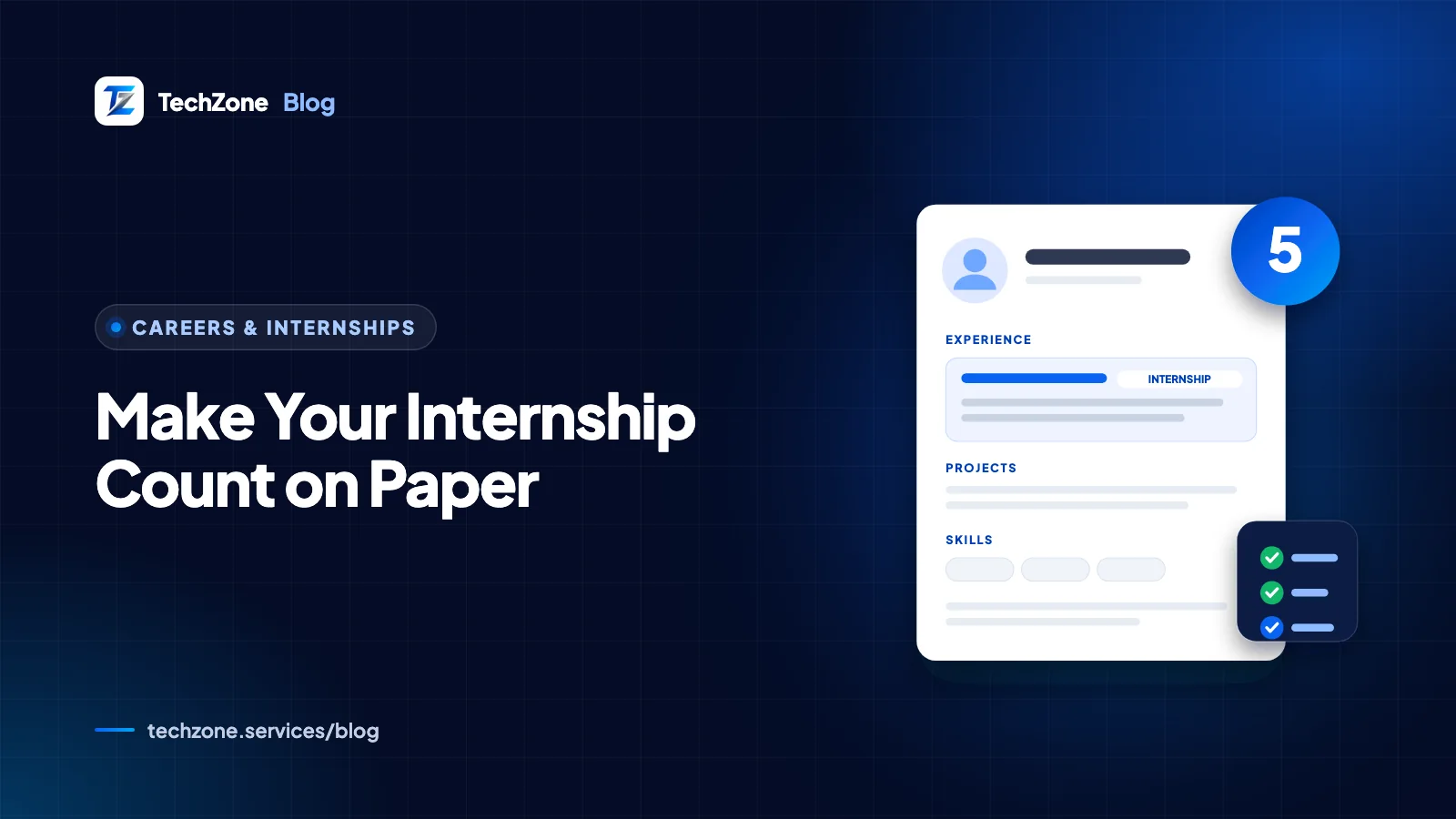
The five resume tips for students with internship experience: list the internship under Experience with a clear title, dates and “Remote” if it was virtual; write bullets that start with an action verb and name the tools and outcome; tailor keywords to each posting; link your projects and a verifiable certificate; and keep everything on one clean page.
An internship is often the strongest thing on a student resume, and also the most often wasted. “Intern, assisted with various tasks” tells a recruiter nothing. The same internship, written well, shows that you can take a brief, use real tools and deliver work that someone reviewed.
The advice below follows guidance from university career centers, including MIT, Harvard and UT Austin, applied to one specific job: turning an internship into resume lines that hold up in an interview.
Key takeaways
- List every internship, including virtual ones, under Experience with a job title, organization, location or “Remote,” and dates.
- Write each bullet as action verb + what you did + tools used + outcome, and never invent metrics you cannot back up.
- Tailor each resume to the job posting’s keywords, and keep the formatting plain so applicant tracking systems can read it.
- Add links to live projects, a portfolio and a verifiable internship certificate so reviewers can check your work.
- Keep a student resume to one page, with skills grouped by category instead of one long unsorted list.
1. Put your internship in the Experience section, clearly labeled
An internship is work experience, so it belongs under Experience (or Relevant Experience), not buried under Certifications or Activities. Give it the same four elements as any job: title, organization, location and dates.
- Title: use a specific, honest title such as Web Development Intern or Digital Marketing Intern. Don’t inflate it to “Developer” or “Marketing Executive.”
- Organization: the company’s name as it appears on its website and on your certificate.
- Location: the city, or Remote for a virtual internship. It is accurate, and it tells the reader up front how the work was done.
- Dates: month and year for the start and end, for example Jun 2026 – Aug 2026. Use one date format across the whole resume.
List entries in reverse chronological order, most recent first. Harvard’s career center recommends this order within each section, and UT Austin’s career services notes that both recruiters and applicant tracking systems work better with chronological resumes than functional ones.
2. Write achievement bullets, not duty lists
Each bullet should say what you did, with what, and what came of it. A reliable pattern is action verb + task + tools + outcome.
Start with a strong verb such as built, designed, analyzed or wrote; MIT’s career office publishes a list of resume action verbs grouped by skill. Drop first-person pronouns and use the past tense for finished roles. Name the actual tools, like WordPress, Figma, Google Analytics 4, Python or Excel, because those are the words recruiters and screening software look for.
On numbers, MIT’s advice is to quantify if you can. The key word is can. Use a number only if you counted or measured it: pages built, tasks delivered, a Lighthouse score you actually recorded. An invented traffic percentage falls apart the moment an interviewer asks how you measured it. A concrete outcome without a number, such as “approved by mentor after one revision,” beats a fake statistic every time.
| Before (duty) | After (achievement) | What changed |
|---|---|---|
| Worked on the company website. | Built three responsive landing pages in WordPress and Elementor from client-style briefs; all passed mobile and cross-browser review. | Specific verb, named tools, real scope and a checkable outcome |
| Helped with social media. | Planned and wrote a four-week Instagram content calendar for a mock retail brand, designing post graphics in Canva. | Shows planning, writing and tool skills, and is honest that the brand was a mock brief |
| Did SEO tasks. | Ran a technical SEO audit of a practice site with Screaming Frog and PageSpeed Insights, then wrote a prioritized fix list reviewed by a mentor. | Names the tools and the deliverable |
| Responsible for data analysis. | Cleaned a sample sales dataset in Python (pandas) and presented monthly trends in a Looker Studio dashboard. | Replaces “responsible for” with what you produced |
| Assisted the design team. | Redesigned a checkout flow in Figma using usability heuristics, then revised it after written mentor feedback. | Shows process and how you respond to feedback |
Tip
Read each bullet and ask: could I talk about this for two minutes in an interview? If not, it is either too vague or not really yours.
3. Tailor every resume to the job posting
Adjust your bullet wording, skills and order for each application, using the language of the job posting. A generic resume makes the reader do the matching; a tailored one does it for them.
MIT’s career office points out that employers may scan resumes for keywords. UT Austin’s career services describes applicant tracking systems (ATS) as software many employers use to rank and sort resumes before a recruiter sees them, and recommends listing the posting’s keywords, noting which ones repeat, and making a new resume version for each job. A quick routine:
- Copy the posting into a document and highlight the skills, tools and duties it mentions more than once.
- Mark the ones you genuinely used during your internship or projects. Ignore the rest; never add a skill you can’t demonstrate.
- Use the posting’s exact terms in your bullets and skills section. If it says “Google Analytics 4,” don’t only write “GA.” Where it reads naturally, include both forms, such as “search engine optimization (SEO).”
- Move the most relevant bullet to the top of each entry, and cut bullets that don’t serve this job.
Keep the formatting plain so the software can read it. UT Austin’s career services warns that an ATS can’t reliably read tables, columns, graphics, LaTeX files or resumes built on design sites like Canva. Use a single column and standard headings: Education, Experience, Projects, Skills.
4. Add a projects line with links reviewers can check
Give reviewers something to click. A short Projects section, or a links line under your internship, lets a recruiter see the work instead of taking your word for it.
- Live work: a deployed site, an app build, or a case study page.
- Portfolio or repository: GitHub for code, Behance or Dribbble for design, a personal site or shared folder for marketing and writing samples.
- Certificate link: the direct verification link for your internship certificate, not a screenshot. For a TechZone certificate, it follows the format
techzone.services/certificate-verification/?cert_id=TZ-2026-WEB-7K3Q9Pand opens the result on the TechZone certificate verification page.
MIT’s career office encourages students to include class, competition and personal projects, as long as you make their relevance to the role clear. Before you submit, click every link; a broken portfolio link is worse than none. Our guide on how to verify an internship certificate explains what employers check when they follow that certificate link.
5. Keep it to one page, with skills grouped by category
Most students should fit everything on one page. MIT’s career office advises sticking to one page unless you have extensive experience or an advanced degree, with a font no smaller than 10pt and margins of at least half an inch.
To make room, cut what the target job won’t care about: school-level details once you are well into university, hobbies unrelated to the role, and filler such as “hardworking team player.” Then group your skills so a reviewer can scan them quickly:
- Programming: HTML, CSS, JavaScript, PHP, Python, Dart (Flutter)
- Tools and platforms: WordPress, Elementor, Git, Figma, Shopify
- Marketing and analytics: Google Analytics 4, Google Search Console, Meta Ads Manager
- Spoken languages: English (professional), Urdu (native)
List only skills you could use on a task tomorrow. If a skill appears in your skills section, at least one bullet or project should show you using it.
What resume mistakes do students with internships make?
The most common mistake is describing an internship by its duties instead of its results. The others are smaller, but each one gives a reviewer a reason to move on.
- Vague bullets such as “assisted with various tasks” or “gained exposure to marketing”
- Invented or unverifiable metrics that collapse under a single interview question
- Calling a practice brief a “client project” when no client was involved
- Listing the internship only under Certifications, where it reads like a course rather than experience
- Dates that don’t match your certificate or LinkedIn profile, or date formats that change from entry to entry
- Typos and missing contact details, which Harvard’s career center lists among the top resume mistakes, plus broken links
- Multi-column templates, icons and photos that applicant tracking systems struggle to read
How do you describe a virtual internship on a resume?
Describe a virtual internship exactly like an in-person one, with “Remote” as the location and bullets about the work. There is no need to hide it or apologize for it; remote work shows you can meet deadlines and communicate in writing.
Two things make a virtual internship entry stronger. First, be precise about what the work was: if tasks were modeled on client projects, write “client-style brief” rather than implying a paying client. Second, show the skills remote work demands. The career readiness competencies defined by NACE, including communication, professionalism, teamwork and technology, make a useful checklist, and a single bullet about working from written briefs and feedback can cover several of them.
Example: a fictional intern’s resume entry
Example for illustration only. The intern, tasks and details below are made up; write your entry from your own work.
- Web Development Intern, TechZone (Remote) | Jun 2026 – Aug 2026
- Built four responsive WordPress pages with Elementor from weekly client-style briefs, revising each after written mentor feedback
- Compressed images and set up caching on a practice site, recording before-and-after Lighthouse scores in the project report
- Delivered a final project: a five-page business website with a contact form, documented in a GitHub repository
- Certificate ID TZ-2026-WEB-7K3Q9P, verifiable at techzone.services/certificate-verification/
For more on what these internships involve and how to talk about them in interviews, read how virtual internships build real work experience.
How TechZone can help
If your resume needs an Experience entry built on reviewable work, TechZone’s virtual internship program gives you weekly tasks modeled on real client projects, written mentor feedback on every submission, a final project and a certificate with a unique ID employers can check. It runs 8 to 12 weeks depending on the track, across ten tracks from web development to business development. No prior work experience is needed, just the basics of your chosen track. When you’re ready, apply with a short form and your CV, and we’ll reply by email.
Frequently asked questions
Should I put an unpaid internship on my resume?
Yes. An unpaid internship belongs on a resume exactly like a paid one, because employers are judging the work you did and the skills you used, not what you were paid. List the unpaid internship under Experience with your title, the organization, the location and the dates. There is no need to write “unpaid” anywhere on the resume.
Can I list an internship I haven’t finished yet?
Yes. List an unfinished internship with its start date and “Present” as the end date, and describe the work you have completed so far. Do not list a completion certificate until it has actually been issued. Once the internship ends, update the resume entry with the end date, the final project and the certificate verification link.
Should I send my resume as a PDF or a Word file?
Send your resume in whatever format the job posting or application form asks for. A PDF keeps the layout intact across devices, while some employers specifically request Word (.docx) files. If the posting doesn’t say, a simply formatted PDF is a common choice. TechZone’s internship application, for example, accepts a CV as a PDF or Word file up to 5 MB.
Do students need a summary or objective at the top of a resume?
A summary or objective is optional on a student resume. A one- or two-line summary can help when you are switching fields or want to name your target role and strongest skills, but it should be tailored to each job. If space is tight, drop the summary before cutting internship bullets or projects that show real work.
How many bullet points should each internship have on a resume?
Most internship entries on a student resume work well with three to five bullet points. Give more bullets to the experience most relevant to the job you are applying for and fewer to older or less related roles. Each bullet point should describe a different task or outcome rather than repeat the same point in new words.
Sources and further reading
- Resumes — MIT Career Advising & Professional Development
- Resume action verbs — MIT Career Advising & Professional Development
- Harvard College Guide to Creating a Strong Resume — Harvard FAS Mignone Center for Career Success
- Applicant Tracking Systems — UT Austin College of Natural Sciences Career Services
- What is Career Readiness? — National Association of Colleges and Employers (NACE)